Church of St. Joseph (Prešov): A Franciscan Monastery Church in Slovakia


Site at a Glance
- Rating
- 4.7
- Popularity
- Low
- Country
- Slovakia
- Primary era
- Early Modern
- External website
- Open
- Eras represented
- Medieval, Early Modern, Modern
- Civilizations
- Habsburg, Hungarian
- Site type
- Religious
- Remains
- Church
On this page19 sections
History
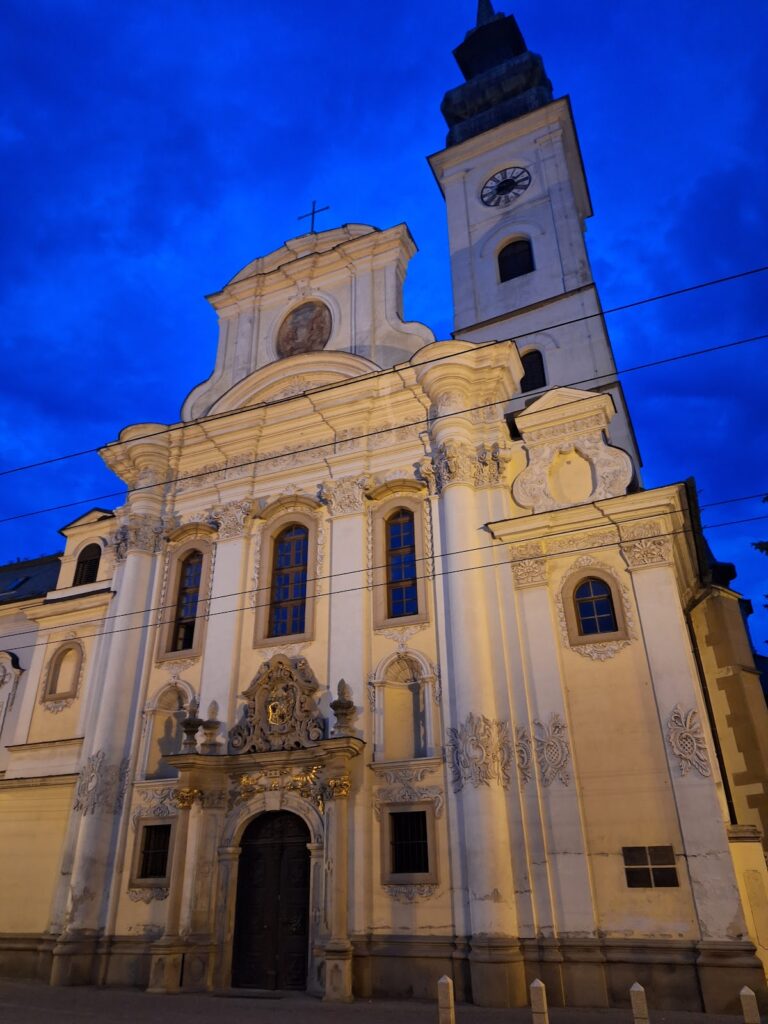
The Church of St. Joseph (Prešov) is a Roman Catholic Franciscan monastery church in Slovakia, rebuilt in the Early Baroque period between 1708 and 1718 and still administered by the Order of Friars Minor. It belongs to the Parish of St. Nicholas in the Košice Archdiocese and is currently the only Franciscan church with two towers in Slovakia.
Gothic origins and the Carmelites
A Roman Catholic Gothic Church of the Holy Trinity stood on the site in the eleventh century. In 1380, Carmelite friars built a new church and a small monastery while retaining the Holy Trinity dedication. The continued use of that dedication suggests that the town, rather than the Carmelites alone, may have initiated the construction.
The Carmelites left Prešov in 1529. The church and monastery then passed to the town administration and served economic and defensive purposes during the Reformation, a period of religious change that brought Protestant communities and Catholic institutions into conflict across central Europe.
Franciscan possession and seventeenth-century rebuilding
Emperor Leopold I ordered the church and monastery to be assigned to Franciscans from nearby Nižná Šebastová in 1661. The Protestant town council prevented the friars from taking possession until 1671, when royal troops under General Spankau occupied Prešov and enabled their entry.
Financial assistance from Baron František Klobušický of Prešov and Baroness Šóšová of Solivar allowed the Franciscans to begin rebuilding the Gothic church in 1671. The work altered the presbytery and nave and inserted side chapels between the piers. The Franciscan presence in the wider area had begun earlier. The Friars Minor settled at Solivar before 1482, left during the second half of the sixteenth century, and established themselves at Nižná Šebeš in 1634. During the seventeenth century, they served Catholic worshippers in private houses while seeking to recover the former Carmelite monastery in Prešov.
In August 1682, forces involved in the Tököly Uprising, an armed revolt against Habsburg rule, occupied Prešov and destroyed part of the furnishings of both the parish Church of St. Nicholas and the Church of St. Joseph. The Franciscans were permitted to remain and conduct Catholic services, but under restrictions. After the uprising was suppressed in 1685, the church returned to the administration of the Order of Friars Minor.
Early Baroque transformation
During the uprising of Francis II Rákóczi, his forces occupied Prešov in 1704. A confessional mixed commission established in 1705 divided the city’s churches among different denominations and left the Franciscan church in Franciscan hands.
A comprehensive rebuilding of the church and monastery followed from 1708 to 1718 under the direction of the Košice builder Ján Tornyossi, again supported financially by the Klobušický family. The church was rededicated to Saint Joseph. Its two-towered west facade was remodelled under the influence of Il Gesù, the principal Jesuit church in Rome and an important model for Baroque church architecture.
Further rebuilding took place from 1732 to 1735. The church was solemnly consecrated in 1735, on the fourteenth Sunday after Pentecost, by the Archbishop of Kalocsa, Count Klobušický. The monastery survived the general suppression of monasteries ordered by Emperor Joseph II in 1787. The friars were required to wear black rather than their customary brown habits, giving rise to the nickname “Black Franciscans.” Earlier, in 1679, as many as eight friars had died during a plague epidemic.
Fire, war, and restoration
A fire on 21 December 1870 destroyed the entire interior, including the richly decorated main altar. Reconstruction replaced the altar with an illusionistic oil wall painting made by the Franciscan Konrád Švestka of Kroměříž. The painting, completed in 1872, recreated the appearance of the lost altar and preserved the memory of the fire and subsequent rebuilding.
A second fire on 3 December 1888 destroyed both slender church towers. Their lower portions survived and have retained essentially the same form to the present. Soviet bombardment of Prešov in 1944 later damaged the roof and stained-glass windows. Repairs were completed in 1947, when Mikuláš Jordán added facade sgraffiti, a wall-decoration technique made by cutting through contrasting plaster layers, depicting the Holy Trinity and the Holy Family.
The Franciscan monastery was dissolved in 1950 during Action K, the state suppression of male religious orders in Czechoslovakia, and the friars were interned. The church remained the property of the Catholic Church. Religious life was restored in 1990, when the Franciscans returned to the monastery and church. A general repair took place from 1984 to 1991. The church is registered as a national cultural monument of Slovakia under number 2258/2, recorded on 17 April 1963. The Saint Roch sculptural group before the church is separately registered under number 2258/3, designated on 4 March 1977.
From 1930, the Franciscans also maintained a seat in the building of the Commissariat of the Holy Land on Dilongova Street. A relic collection begun in 2001 by the Franciscan Thomas Becket Pila had reached 471 relics of saints and blessed persons. It includes relics associated with John Paul II, Teresa of Calcutta, Padre Pio, and the Fatima children. The remaining relics are kept in the Chapel of the Holy Relics behind the altar and displayed during the novena and octave of the Feast of All Saints.
Remains
The church stands in the southern part of Slovenská Street, the oldest street in Prešov, beside Franciscan Square. It is a single-nave Early Baroque building that incorporates elements of the earlier Gothic structure. The monastery is attached to the north side. Svätoplukova Street runs along the west, an Evangelical parsonage stands to the south, the Garden of Art lies to the southeast, and the Franciscan Steps and Kmeť’s tree-lined promenade extend to the east.
Plan and exterior
Presbytery and nave
The church is approximately 40 metres long and 18 metres wide, with an internal nave height of 13 metres. The rebuilding of 1708 to 1718 retained the perimeter walls of the former polygonal Gothic presbytery. Two bays of Early Baroque lunette vaulting covered the surviving walls, while an internal partition changed the polygonal interior into a rectangle. The lower part now contains the sacristy. The upper part, formerly the friars’ choir, houses the Chapel of the Holy Relics.
The nave contains side chapels placed between the piers. These chapels were added shortly after the Franciscans took possession in 1671 and remain an important part of the church’s internal arrangement. A continuous fresco-decorated corridor runs north of and parallel to the nave, connecting the confessionals, sacristy, monastery, and church. It also contains the Chapel of Our Lady of Lourdes for Marian adoration. The former passage from the corridor into the church was located where a window now stands.
West facade
The west facade combines Baroque stucco ornament with a carefully ordered central entrance. Projecting pilasters frame the portal, which is topped by a broken triangular pediment containing a coat of arms within Baroque ornament. Above it, a tall triple semicircular window is separated from three smaller upper windows by a substantial cornice. A cross stands on the right side of the facade.
The 1947 sgraffiti by Mikuláš Jordán depict the Holy Trinity and the Holy Family. Between the towers is a Franciscan emblem, while the towers carry double-armed cardinal crosses. The facade also bears four sandstone sculptures made by the Košice burgher Šimon Griming. They represent Saint Roch with a small dog and a plague wound, Saint Florian extinguishing a fire, Saint Francis, and Saint Anthony.
Towers and bells
The two towers rise to approximately 30 metres. The north tower serves as the bell tower and contains four bells cast in 1925 by the Buchner firm of Košice. Their diameters are 122, 83, 70, and 50 centimetres. The largest carries an invocation to Jesus, Mary, and Joseph; the second invokes Saint Francis; the third invokes Saint Anthony of Padua; and the smallest, a death bell, bears a cross. The fires of 1888 destroyed the slender upper portions of both towers, while their lower sections survived in their established form.
Saint Roch sculptural group
A several-metre-high sandstone group of Saint Roch stands before the church. Franciscan friars commissioned it in 1730. The statue of Saint Roch was placed in front of the church in 1733, the group was completed in 1795, and it was renovated in 1843. The original sculptures are kept in a repository in the tower of the Church of Saint Nicholas, while copies stand before the church. Ladislav Rezek of Hořice made the copies in 1987.
Interior and chapels
Main altar space
The main altar space is dominated by the illusionistic oil wall painting made by Konrád Švestka in 1872. It reconstructs the appearance of the destroyed 1732 main altar by František Strecius, which contained 42 sculptures centred on the twelve-year-old Jesus, the Virgin Mary, and Saint Joseph. The painting also records the destruction by fire on 21 December 1870 and lists the years of later reconstruction.
A large image of the Holy Family occupies the composition. Saint Peter and Saint Paul appear beside it, while stained-glass windows above them depict the Annunciation. Those windows were added in 1956. The upper altar includes the four Evangelists, a semicircular image of the Nativity, angels, and a trefoil cross. The main altar mensa carries a tabernacle, the vessel or cabinet where consecrated Eucharistic bread is reserved, decorated with the alpha and omega, traditional Christian symbols of Christ as the beginning and the end, and flanked by angels. A throne made by Alojz Nevický was added above it in 1939 for exposition of the Blessed Sacrament. It now contains a cross and an eternal light.
Southern chapels
The southern chapel nearest the main altar contains a Baroque altar dedicated to Saint Anthony of Padua. It was built in 1719 beside the Klobušický family coat of arms, and the statue of the saint dates from the early twentieth century. The altar also includes two prophets, a dove representing the Holy Spirit, angels, clouds, and a coffin-shaped Baroque mensa. Baron František Klobušický and Terézia Klobušická are buried in the chapel. A small coffin bearing the coat of arms of Archbishop and Count František Klobušický is set into the south wall above a marble plaque. The altar was moved there from the Chapel of Saint Francis of Assisi in 1947.
The middle southern chapel contains a Baroque Holy Cross altar from the second half of the eighteenth century. It depicts the crucified Christ with Mary and the Apostle John. Above them is the Eye of God surrounded by putti. The coffin-shaped mensa carries symbols of the Passion, including a cross, crown of thorns, scourge straps, and a column with a rope. During the Christmas season, the church’s nativity scene is placed in this chapel.
The third southern chapel contains a Baroque altar of Our Lady of the Seven Sorrows from the second half of the eighteenth century. Behind glass, the Virgin Mary holds the dead Christ, with two nuns beside her, one carrying a Bible and the other a cross. God the Father holding a globe, angels, and winged angel heads occupy the upper section. A relic of John Paul II is permanently displayed there.
The smallest side chapel lies in the south tower. It contains an image of the Virgin Mary and was originally the Chapel of the Holy Cross. In 1947 it became the Chapel of Our Lady of Perpetual Help, retaining its original Baroque mensa.
Northern chapels
The first northern chapel is dedicated to Saint Francis of Assisi. Its Neo-Baroque altar was made in the 1930s by the Prešov woodcarver Alojz Nevický. It shows Christ embracing Francis from the cross, with Saint Elizabeth of Hungary and Saint Louis IX of France at the sides. The composition also includes the Franciscan coat of arms, God the Father with a globe, angels holding Veronica’s veil, and an image of the praying Franciscan Peter of Alcantara above the passage to the monastery corridor.
The middle northern chapel is dedicated to the Sacred Heart of Jesus. Its Baroque altar contains a statue of Christ from the first half of the twentieth century, a canopy held by two angels, and an emblem of a stork carrying a piece of gold. Local tradition connects the emblem with Baron František Klobušický, who is said to have become a patron of the church after a stork dropped a piece of gold during his hunt.
The third northern chapel is dedicated to Saint Thérèse of Lisieux. Its Secessionist-Neo-Romanesque altar, made by Alojz Nevický, depicts the kneeling Carmelite nun receiving roses from the child Jesus, held by the Virgin Mary. Angels, a carved cross with the Passion, the Franciscan emblem, and a statue of the Infant Jesus of Prague complete the arrangement. Three former canon tables remained on the altar until the 1970 liturgical reform. Above the passage to the monastery corridor is an image of the praying Franciscan Peter of Alcantara.
Furnishings and connected spaces
Organ, pulpit, and nave furnishings
The choir contains an organ with a Classical-style case. Otto Rieger of Budapest built it as a two-manual instrument. In 1995, the Organa firm of Kutná Hora rebuilt it as a three-manual organ, adding seven stops and altering the original disposition. It now has 2,228 pipes.
A Baroque pulpit from the first half of the eighteenth century stands on the north side. Its canopy bears Christ, two angels, and the four Western Church Fathers, Gregory, Jerome, Augustine, and Ambrose. It also includes the dove of the Holy Spirit. On the parapet are the four Evangelists with their symbols, a teaching Christ, three angels, two coats of arms, and the Franciscan hand-and-cross emblem.
Baroque pews installed in the mid-eighteenth century remain in use. Their twisted pilasters carry plant motifs, curling ornament, and lion sculptures. Fourteen plaster Stations of the Cross reliefs from the beginning of the twentieth century are distributed along the north and south sides.
Corridor and former Porziuncola altar
The corridor north of the nave contains the confessionals, sacristy, monastery connection, and Chapel of Our Lady of Lourdes. A former Baroque Porziuncola altar once stood where the confessionals are now located. A Porziuncola altar is associated with the small Church of Saint Mary of the Angels at Assisi and with the Franciscan tradition of plenary indulgence. Its painting of Saint Francis receiving that gift from Christ for the Church of Saint Mary of the Angels is now displayed in the choir above the sacristy.
Nativity scenes and relics
A nativity scene has been installed on Franciscan Square each year since 2013. The indoor nativity scene, purchased in Padua in 2017, contains movable figures and is placed in the Holy Cross chapel during the Christmas season. Relics associated with the manger of Jesus and with Saint Francis are displayed beside it. The Chapel of the Holy Relics behind the altar houses the wider collection of relics associated with saints and blessed persons.
Nearby sites