Cathedral of Saint John the Baptist: Metropolitan Greek Catholic Cathedral in Prešov


Site at a Glance
- Rating
- 4.8
- Popularity
- Low
- Country
- Slovakia
- Primary era
- Early Modern
- External website
- Open
- Eras represented
- Medieval, Early Modern, Modern
- Civilizations
- Austrian Empire, Habsburg, Hungarian
- Site type
- Religious
- Remains
- Cathedral
On this page13 sections
History
The Cathedral of Saint John the Baptist is a Greek Catholic cathedral in Prešov, Slovakia, whose present form was created chiefly through a Baroque rebuilding between 1753 and 1759. A Greek Catholic church remains in communion with the Catholic Church while following an Eastern Christian liturgy and ecclesiastical tradition. Today the building serves as the cathedral of the Prešov Greek Catholic Archdiocese and the metropolitan seat of the Slovak Greek Catholic Church of the Byzantine-Ruthenian rite, the Eastern rite followed by that church.
From Carmelite chapel to Minorite church
The church stands in the southern part of Prešov’s old town on Hlavná Street. Its predecessor was a Gothic hospital chapel belonging to the Carmelites, a religious order, on the edge of the medieval town. During the fourteenth century, the chapel was rebuilt as a single-nave church dedicated to the Virgin Mary.
In 1673 the church passed to the Minorites, the Order of Friars Minor founded by Saint Francis of Assisi. The friars enlarged their monastery by taking space from the poorhouse and orphanage, which then disappeared. Their presence prepared the way for a substantial transformation of the church in the eighteenth century.
The Baroque rebuilding
At the initiative of the Minorites, and with the support of Bishop Stefan Keczer of the Great Varadín chapter, the church was extensively reconstructed from 1753 to 1759. The work was directed by the local master builder Kasper Urlespacher. The Košice sculptor Jozef Hartmann produced sculptures of Saint Stephen and Saint Ladislaus, while the rebuilding gave the church its principal Baroque character.
The reforms of Emperor Joseph II, the Habsburg ruler who suppressed many contemplative religious communities in his territories, brought another change in 1787. The Minorite order was dissolved, and the church and monastery buildings passed to the city. After a severe fire damaged them, the buildings were used as military storage facilities.
Establishment of the Greek Catholic cathedral
Prešov became the seat of vicars of the Bishop of Mukachevo’s Uniate Church in 1790. On 3 November 1815, Emperor Francis I established a Greek Catholic eparchy in Prešov. An eparchy is the Eastern Catholic equivalent of a diocese. Pope Pius VII confirmed the new bishopric in the papal bull Relata semper on 21 September 1818. After the eparchy took over the church in 1821, the building became a cathedral.
Further changes adapted the building to its expanding ecclesiastical role. Two side chapels were added to the nave in 1835, and a third, called the parish chapel, was formed in the rebuilt entrance. Bishop Jozef Gaganec adapted the church to the Eastern rite between 1846 and 1848, and the tower was heightened in 1865.
Twentieth-century disruption and restoration
The church remained with the Slovak Greek Catholics until 1950, when the Czechoslovak authorities abolished the Greek Catholic Church, imprisoned most of its clergy, and attempted to compel the faithful to join the Orthodox Church. The building was taken over by the Orthodox Church during this period. It was returned to the Greek Catholics on 5 June 1968, during the political liberalization known as the Prague Spring.
A major restoration followed in 1977–1980. In 1990, the remains of Bishop Pavol Peter Gojdič, a Catholic blessed and hieromartyr, were placed in a sarcophagus in one of the cathedral’s chapels. A hieromartyr is a Christian cleric recognized as having suffered martyrdom for the faith. The crypt also holds the burials of important Slovak Greek Catholic figures, including the Prešov auxiliary bishop Vasiľ Hopko, who is likewise honored as a Catholic blessed.
Pope John Paul II prayed in the church during his 1995 pilgrimage to Slovakia. In 2008, Pope Benedict XVI established the Prešov Greek Catholic Metropolitan Province, and the cathedral became an archcathedral and metropolitan cathedral. It is protected as a Slovak national cultural monument, a status registered in 1963.
Remains
Layout and exterior
The building is a masonry, single-nave church aligned from east to west, with the presbytery at the western end. The nave was lengthened during the eighteenth-century rebuilding, and a new presbytery was added beyond it. The former presbytery was converted to accommodate a choir, while only its original net vault survives from the earlier church. The present nave has three bays, each covered by its own sail vault, a curved vault that rises from the edges of a bay like part of a sphere. The presbytery is narrower than the nave.
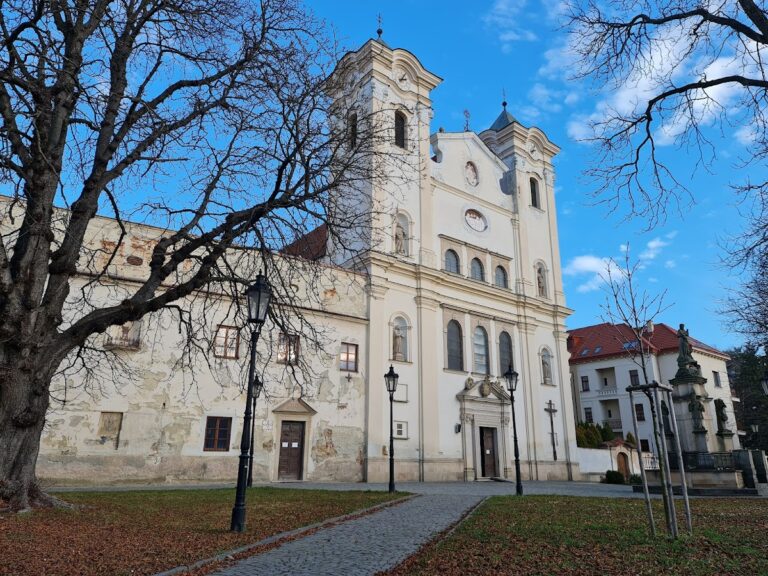
The five-axis facade has a flat central projection divided into three sections by flat pilasters and crowned by a blind gable. The gable contains a painted scene of the baptism of Jesus by John the Baptist. Below it, an ornamental round-arched portal projects from the wall with a pair of columns crowned by vases. A decorative heraldic cartouche surmounts the entrance. The portal and stone vases belong to the eighteenth-century Baroque rebuilding.
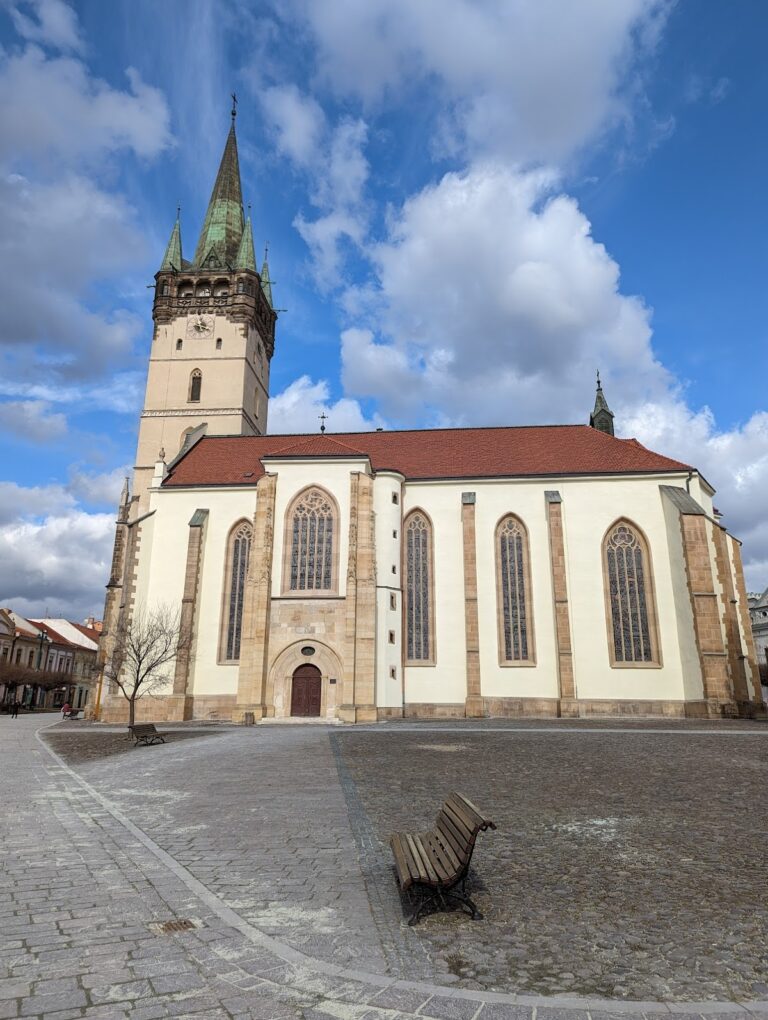
A square clock tower is attached to the north side of the main body. Its two-level roof structure ends in a spire, and the tower was heightened in 1865. These exterior elements, together with the elongated nave and western presbytery, express the successive rebuilding and adaptation of the medieval church.
Nave decoration
The ceiling of the nave carries Rococo frescoes with four scenes from the life of John the Baptist. An unknown painter from Košice created them in 1757. The preserved eighteenth-century pulpit and its painted decoration are by Mikuláš Jordán. Beside it is his painting of the meeting between the aged Simeon and the Son of God.
Sanctuary and iconostasis
The white-and-gold iconostasis dates from the first half of the nineteenth century. An iconostasis is the screen of icons that separates the sanctuary from the nave in an Eastern Christian church. Juraj Román carved its wooden elements, and Albert Fikos of Vienna produced the painted work. The icons were painted by the local artists Jozef Miklossy and Michal Mankovics, who were associated with the local bishopric.
The presbytery decoration and the unfinished paintings above the entrances to the side chapels date from 1881 and are by Ignacy Roškovič. Together with the iconostasis, these works reflect the building’s adaptation to Greek Catholic worship after it became the seat of the Prešov eparchy.
Side chapels and sacred objects
Chapel of the Holy Cross
The Chapel of the Holy Cross stands on the north side of the nave. Its altarpiece contains a painting of the Savior on the cross by Jozef Miklossy.
Chapel of Saints Peter and Paul
The Chapel of Saints Peter and Paul occupies the south side of the nave. Its placement forms part of the side-chapel arrangement created and developed during the nineteenth-century adaptation of the church.
Parish chapel
The parish chapel is beside the entrance. Its altar contains an eighteenth-century sculpture of the Black Madonna. The goldsmith Ján Szylassy made the enamel decorations on the crowns of the Virgin Mary and Jesus, and Mikuláš Jordán painted the image of Saint Teresa of Jesus as a Carmelite nun.
The cathedral contains a copy of the Shroud of Turin, installed in 2003 and donated by the Archdiocese of Turin through AMCOR, Friends of the Eastern Churches. Its relics include those associated with the blessed hieromartyrs Pavol Peter Gojdič and Vasiľ Hopko, as well as relics of Saint John the Baptist, Saint Stephen the Protomartyr, Saint Anastasia, Saint Philip Neri, Saint Anthony of Padua, and Saint Philomena.