Enniscorthy Castle: An Anglo-Norman Fortress in Ireland


Site at a Glance
- Rating
- 4.3
- Popularity
- Low
- Country
- Ireland
- Primary era
- Early Modern
- External website
- Open
- Eras represented
- Medieval, Early Modern, Modern
- Civilizations
- English, Norman
- Site type
- Military
- Remains
- Castle
On this page9 sections
History
Enniscorthy Castle is an Anglo-Norman castle in Enniscorthy, Ireland, whose origins lie in the late twelfth or early thirteenth century. A wooden predecessor stood on the site before a stone castle was begun in the late 1190s, and the Norman owners occupied it by 1203. The castle’s surviving form is predominantly the result of extensive rebuilding during the sixteenth century.
Anglo-Norman foundation
The first stone castle was built by the Anglo-Norman knight Philip de Prendergast and his wife, Maud. The Anglo-Normans were Norman and other continental European settlers who established lordships in Ireland after the invasion of the late twelfth century. Philip and Maud’s descendants held Enniscorthy Castle until the 1370s.
MacMurrough Kavanagh rule
During the 1370s, Art Mór Mac Murchadha Caomhánach, a leading member of the MacMurrough Kavanagh dynasty, attacked the castle while seeking to recover his ancestral lands. The MacMurrough Kavanaghs captured it from its last Norman owner, a knight of the Meyler family, and held the castle and surrounding lands until 1536.
In that year, the MacMurrough Kavanaghs surrendered the castle and its lands to Lord Leonard Grey. The castle may already have been in ruins by then. The Earl of Kildare burned it in 1569, and Queen Elizabeth I granted the estate to the poet Edmund Spenser in 1581. Spenser, an English poet and Crown grantee, never lived there.
Elizabethan rebuilding and later conflict
During the Elizabethan plantations, settlement schemes through which English political control expanded in Ireland, the castle passed to Henry Wallop. Wallop, an English official and landholder, extensively enlarged, rebuilt, and refurbished the property. Most of the present castle dates from this late-sixteenth-century phase.
Oliver Cromwell’s forces captured Enniscorthy Castle in 1649 during the campaign that brought much of Ireland under Parliamentarian control. Irish Confederates and Royalists later retook it, but the Cromwellians captured it again. During the 1798 Rebellion, the castle served as a prison, first for the United Irishmen and later for British forces after they recaptured Enniscorthy.
Residence, museum, and conservation
The Roche family occupied the castle as a private residence from 1903 until 1951. By the beginning of the twentieth century, the building had fallen into ruins, and P. J. Roche restored it while extending and reconstructing parts of the structure. It later became the home of the Wexford County Museum.
The castle closed in 2006 for extensive renovation and refurbishment and reopened in 2011. During the works, its collections passed into the care of local authorities, while some displays were transferred to other Irish museums, including the museum of the 1798 Rebellion. The Office of Public Works, the Irish state body responsible for managing and conserving many national heritage properties, now cares for the castle.
The museum presents the development of Enniscorthy and the castle from their earliest Anglo-Norman origins. Its displays give particular attention to the building’s history as a family home, the Roche family, Enniscorthy’s industrial and commercial heritage, the 1916 Easter Rising, Colm Tóibín’s Brooklyn, and the modernist designer Eileen Gray. Objects from earlier Wexford County Museum displays are also represented.
Remains
Castle structure
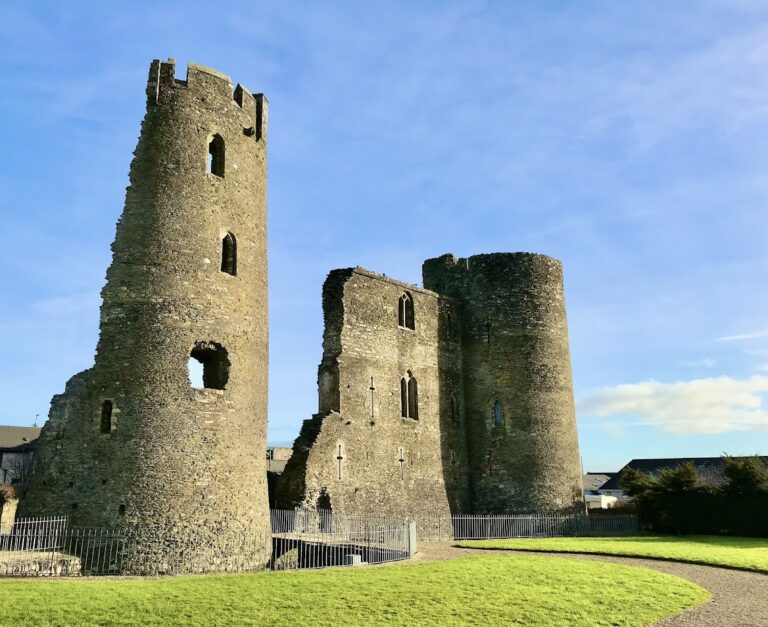
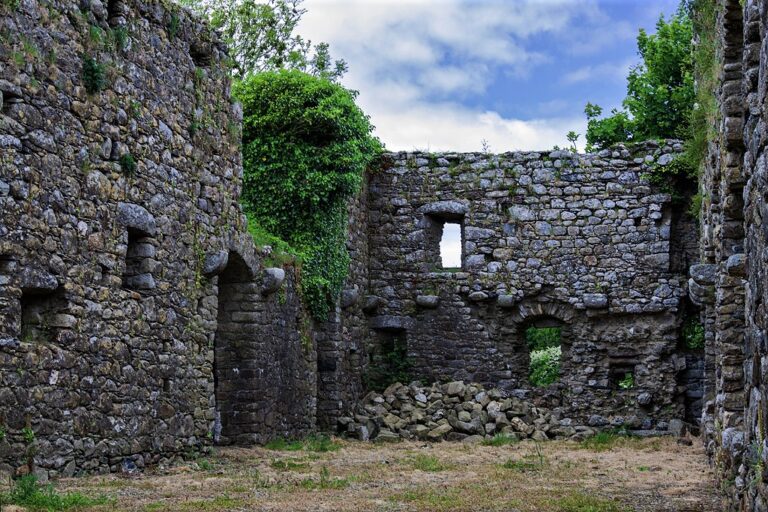
Enniscorthy Castle stands in the centre of Enniscorthy on the River Slaney. It is a lowland castle built in rubble stone, with a Norman-style plan formed around four corner towers and a rectangular, four-storey keep. The building’s original foundation belongs to the late twelfth or early thirteenth century, while most of the existing fabric dates from the sixteenth century and was updated during the late 1500s.
Keep and corner towers
The rectangular keep, also called a donjon, is the principal fortified residential building of the medieval castle. Its four storeys provided accommodation for the owners, garrison, and servants. The four corner towers reinforce the castle’s compact plan, which resembles those of other local castles, particularly Ferns Castle and Carlow Castle.
Later fabric and grounds
Parts of the building were extended and reconstructed during P. J. Roche’s restoration, after the castle had fallen into ruins by the early twentieth century. A memorial plaque in the grounds commemorates aviator Denys Corbett-Wilson and his first flight across the Irish Sea.