Rathmacknee Castle: A Late-Fifteenth-Century Tower House in Ireland


Site at a Glance
- Rating
- 5
- Popularity
- Very Low
- Country
- Ireland
- Primary era
- Medieval
- Eras represented
- Medieval
- Civilizations
- English
- Site type
- Military
- Remains
- Castle
On this page6 sections
History
Rathmacknee Castle is a late-fifteenth-century tower house in Ireland, associated with the Rossiter family. Tradition connects its construction with John Rosseter, who served as seneschal of the Liberty of Wexford, a high-ranking official responsible for governing that jurisdiction. The castle is also linked with his grandson Thomas Rossiter, who held the office in 1493.
The Rossiter family
After the Reformation, the Rossiters remained Catholic while continuing to support the English monarchy and retaining their lands. Their connection with Rathmacknee Castle therefore continued through a period of religious and political change.
War, confiscation, and later restoration
Colonel Thomas Rosseter fought against Oliver Cromwell’s forces at Wexford during the Irish Confederate Wars. Cromwell was the English parliamentarian military and political leader whose forces campaigned in Ireland during the mid-seventeenth-century wars. In 1654, Rosseter’s lands, including the castle, were confiscated.
The castle remained occupied until the 1760s. During the nineteenth century, its owner Hamilton Knox Grogan Morgan had the building restored. Rathmacknee Castle is now designated a National Monument of Ireland.
Remains
Enclosure and setting
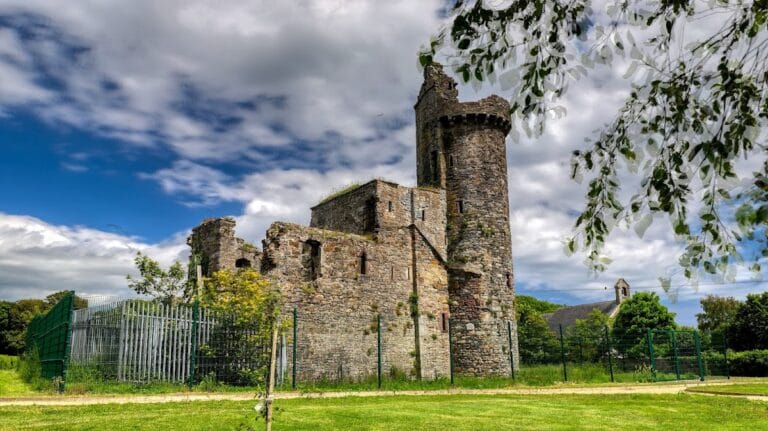
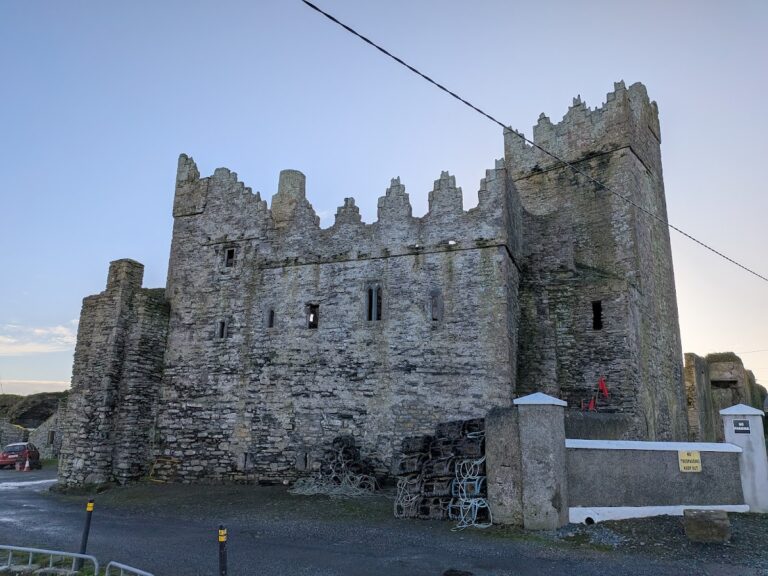
Rathmacknee Castle is a five-storey tower house built of rubble stone and now surviving as a ruin. It stands in the southeastern corner of a five-sided bawn, an enclosed defensive yard. A bartizan, or projecting defensive turret, extends from the bawn wall, while the parapet retains Irish crenellations. The castle is near a ford and a holy well dedicated to Saint Martin. A church and graveyard stood to its south, and protective earthworks lay to the north.
Entrances and upper rooms
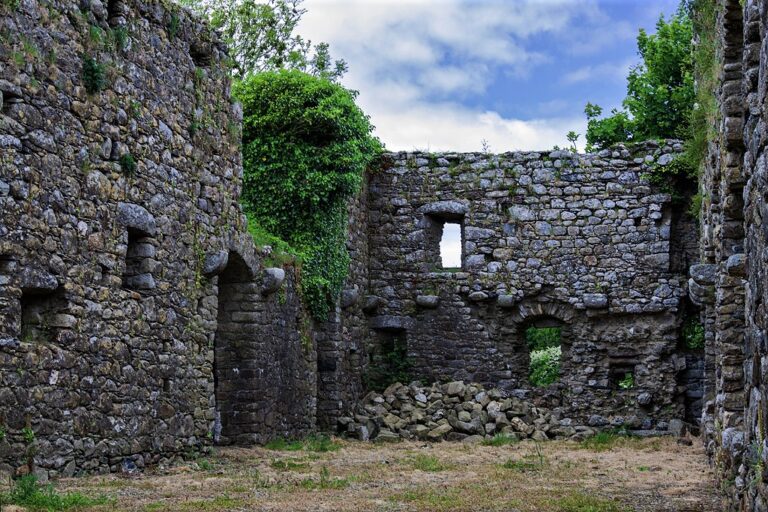
The entrance preserves evidence of a drawbar slot, a murder hole through which defenders could attack people below, and stairs. The upper rooms contain open fireplaces and vaulted ceilings. They also retain garderobes, medieval latrines built into or projecting from the thickness of a wall.
Nearby sites