Shōjō-ji Temple: Central Aizu Yakushi Hall in Japan
Site at a Glance
- Rating
- 4.1
- Popularity
- Low
- Country
- Japan
- Primary era
- Medieval
- Eras represented
- Medieval
- Civilizations
- Ashikaga shogunate
- Site type
- Religious
- Remains
- Monastery
On this page10 sections
History
Shōjō-ji Temple is a Buddhist temple in Japan’s Yugawa, Fukushima Prefecture, founded during the early ninth century. It belongs to the Shingon-shu Buzan-ha tradition, a major branch of esoteric Buddhism, and is also known as the Central Aizu Yakushi Hall. The temple bears the mountain name Rurikōzan and is dedicated to Yakushi Nyorai, the Medicine Buddha associated with healing and the relief of suffering.
Foundation in the early Heian period
The exact foundation date remains uncertain. Tradition places the temple’s establishment between 810 and 824, while another dating gives 807 as the year of its opening. Its foundation is traditionally attributed to Tokuitsu, a prominent Hossō monk active in eastern Japan and the Aizu region. Hossō is a Buddhist school concerned with consciousness and the nature of reality. Tokuitsu is also known for debating Saichō, the founder of Japanese Tendai Buddhism, over the relative standing of Tendai and the older Buddhist traditions of Nara.
At its foundation, Shōjō-ji was a large religious complex with a complete shichidō garan, the organized layout of a major Buddhist temple around seven principal buildings and related facilities. It contained numerous subsidiary buildings, twelve residences for monks, and more than 100 sub-temples. The temple became the central site of the Aizu Five Yakushi, a regional grouping of five Yakushi Nyorai images or cult centers, and was consequently known as the Central Aizu Yakushi.
Shōjō-ji’s position in the central Aizu Basin made it more accessible for public religious activity than Tokuitsu’s mountain-based center at Enichi-ji. Its location and collection of Buddhist images are understood as supporting religious instruction for local people while presenting Buddhist authority in the basin. The twelve early Heian Buddhist images associated with the temple’s foundation phase may reflect Tokuitsu’s efforts to spread Hossō Buddhism among the population of Aizu.
Later affiliations and rebuilding
The temple later became affiliated with Shingon Buddhism, apparently from the late Kamakura period. It remained a subsidiary temple of Ninnō-ji, a major Shingon-associated temple in Kyoto, until the early modern period.
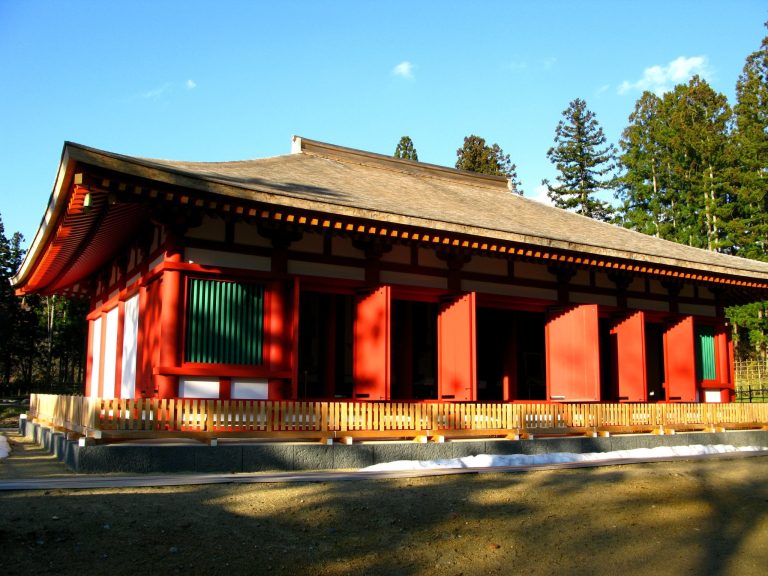
A fire struck Shōjō-ji in 1398. The lecture hall was rebuilt during the early Muromachi period, the era of the Ashikaga shogunate, which generally extended from the fourteenth to the sixteenth century. That reconstructed building is now known as the Yakushi Hall. The other surviving buildings belong to the early modern period or later.
Religious traditions and protection
A Buddhist memorial dance for Yakushi Nyorai is held each year on April 28. Another longstanding tradition tells of tanuki gathering at the temple during a ceremony performed by monks. The story was commemorated in an October festival, and the song “Shōjōji Tanuki no Bayashi,” composed by Shinpei Nakayama in 1925, retells the tanuki celebration.
The Yakushi Hall is designated an Important Cultural Property. The wooden seated Yakushi Nyorai and his two attendant figures are National Treasures, while several other early Heian Buddhist images from the temple are Important Cultural Properties. These designations reflect the importance of Shōjō-ji’s early sculpture and its place in the religious history of the Aizu region.
Remains
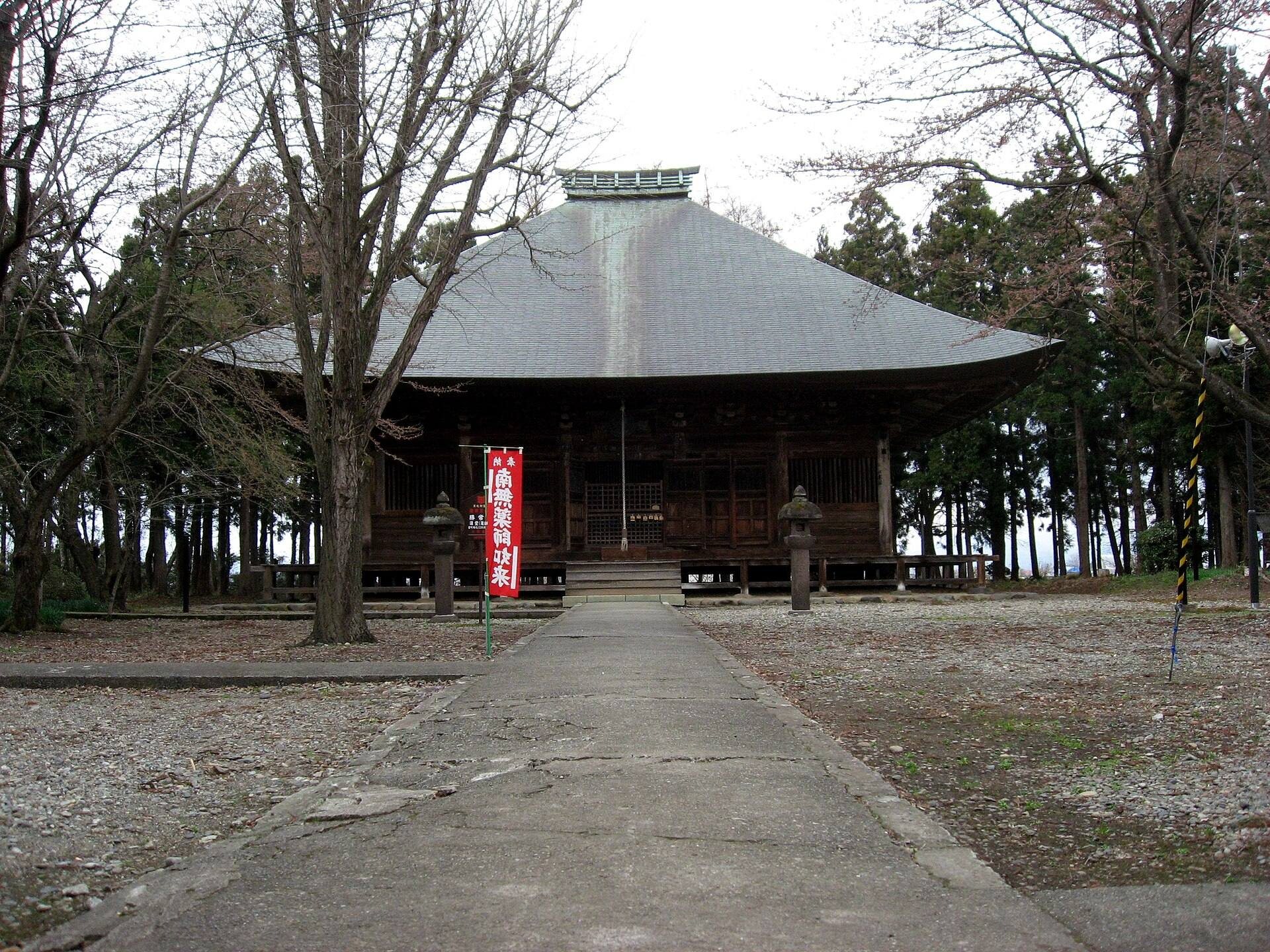
The present temple preserves part of the earlier complex. Its buildings include the Yakushi Hall, the head priest’s residence and reception hall, a kitchen, and the central gate, or chūmon. The arrangement is a reduced survival of the original complex, which included the organized seven-building temple layout, numerous attached structures, twelve monk residences, and more than 100 sub-temples.
Yakushi Hall
The Yakushi Hall is an early Muromachi-period building reconstructed on the site of the former lecture hall. Burn marks on its foundation stones preserve physical evidence of the fire that preceded its construction. The building originally had a thatched roof, which was replaced with copper sheathing in 1964. Its principal image remains inside the hall.
Early Buddhist images
Yakushi Nyorai and his attendants
The principal image is a seated wooden statue of Yakushi Nyorai, flanked by the bodhisattvas Nikkō and Gakkō. Nikkō and Gakkō are traditionally associated with sunlight and moonlight. The Yakushi statue dates from the early ninth century and was carved from a block of zelkova divided from front to back. It remains in the Yakushi Hall and received National Treasure designation in 1996. The two attendant figures have been moved to storage for safekeeping.
Heavenly Kings and other figures
Shōjō-ji retains more than 30 Buddhist statues. Twelve probably date from the temple’s foundation phase in the early Heian period, broadly the ninth century. The group includes four Heavenly Kings, protective Buddhist deities assigned to the four directions, as well as a standing Eleven-Headed Kannon, a standing Shō Kannon, two standing Jizō figures, and an unidentified standing bodhisattva possibly representing Kokūzō Bosatsu. Kannon is associated with compassion, while Jizō is a protective bodhisattva linked with travelers, children, and the dead.
The four Heavenly Kings are each carved from a single block of zelkova. A complete set of four early Heian Heavenly Kings made in this way is relatively uncommon. They formerly stood in the Yakushi Hall and are now kept in storage, although the figure of Kōmoku-ten is deposited with the Tokyo National Museum. The other principal early Heian images are also kept in the temple’s storage building.
The unusually large group of early Heian images preserved at Shōjō-ji outside the Kansai region indicates the temple’s status as a major religious institution in Aizu. Their number and style also help connect the surviving sculpture with the temple’s early foundation phase and with the religious activity associated with Tokuitsu.
Related Yakushi sculpture
The neighboring Uwauchi Yakushi Hall preserves a standing Yakushi Nyorai statue dating from the first half of the tenth century. The image is 182.6 centimeters high, approximately a century later than Shōjō-ji’s principal statue, yet its style is closely similar and may have been influenced by the earlier work. A standing Kichijōten, a Buddhist deity associated with prosperity and good fortune, in a private collection in Aizumisato has likewise been identified as probably related stylistically to the Shōjō-ji group.