Ćelije Monastery: A Serbian Orthodox Monastic and Cultural Center


Site at a Glance
- Rating
- 4.9
- Popularity
- Medium
- Country
- Serbia
- Primary era
- Early Modern
- External website
- Open
- Eras represented
- Early Modern, Modern
- Civilizations
- Ottoman, Serbian
- Site type
- Religious
- Remains
- Monastery
On this page11 sections
History
Ćelije Monastery is a Serbian Orthodox monastery in Serbia, near Valjevo in the territory of Lelić, dedicated to Saint Michael the Archangel. Its exact foundation date is unknown, but it was probably established during the rule of Despot Stefan Lazarević, from 1389 to 1427, a period of religious and social revival in western Serbia. The monastery belongs to the Eparchy of Valjevo, the territorial diocese under which it operates, and is currently a women’s monastery.
Medieval origins and Ottoman rule
Local tradition attributes the foundation of Ćelije to King Stefan Dragutin, who ruled from 1282 to 1316. Another tradition states that three brothers of the Nemanjić dynasty founded Ćelije, Jovanje, and Pustinja monasteries. During the period associated with Despot Stefan Lazarević, Valjevo was the seat of a metropolitan, and the monastery church at Ćelije served as the metropolitan cathedral.
Ottoman records mention the monastery in 1560, placing it near the village of Lelić. Throughout the eighteenth century, it functioned as a center of major religious and political activity in the Valjevo region. The monastery was demolished and burned several times during Ottoman rule, then repeatedly rebuilt on the same site.
Its clergy and monks were involved in the political struggles of the period. Danilo Vukašinović took part in a 1733 gathering of Serbian leaders in Belgrade, while Hadži-Ruvim later became the monastery’s abbot. After the defeat of the Serbian-Austrian alliance, Serbian populations moved north under Archbishop Arsenije IV Jovanović. In 1739, several thousand Serbian families were massacred near Ćelije. The nearby village later became known as Lelići or Leleci, names associated with the Serbian word lelek, meaning lamentation, mourning, or a cry of despair.
Uprisings and nineteenth-century changes
Because prominent monks from Ćelije participated in uprisings against Ottoman rule, Pasha Bušatlija burned the monastery and 13 other churches in the Valjevo region in early 1791. The monks had also taken part in the uprising led by Koča Kapetan. The Church of Saint Michael was rebuilt in 1793, when Hadži-Ruvim was abbot.
In 1804, the monastery clergy helped organize the First Serbian Uprising, the revolt led by Karađorđe Petrović against Ottoman rule. From 1804 to 1813, the monastery housed Karađorđe’s military hospital. Ottoman forces burned it again in 1810, and it was rebuilt in 1811 with assistance from wealthy Armenian Orthodox benefactors from Valjevo.
In 1837, Ćelije was converted into a parish church. Under the rule of Miloš Obrenović, its buildings also housed an elementary boarding school attended by the future Serbian Orthodox theologian and bishop Nikolaj Velimirović.
War, renewal, and modern religious life
Austrian forces demolished the monastery buildings during the First World War, after which they were rebuilt. By decision of the Holy Synod of the Serbian Orthodox Church, Ćelije was reactivated as a women’s monastery at the end of 1928. It functioned as a men’s monastery from 1935 to 1946 and returned to being a women’s monastery from 1945.
The buildings were destroyed again during the Second World War and rebuilt by nuns after the war. During this work, the nuns found large numbers of old bones in the ground, belonging to different periods. The monastery was completely restored in 2001.
The theologian and monk Justin Popović came to Ćelije in 1948 at the invitation of Abbess Sara and lived there until his death in 1979. A major Serbian theologian and philosopher, he wrote theological works and helped found the Serbian Philosophical Society. The Serbian Orthodox Church canonized him in 2010. Abbess Glikerija Janjić entered Ćelije in 1947 at the age of 13 and has served as its abbess since 1967. The monastery continues religious-book printing and icon painting and remains an active cultural and religious center.
The Church of Saint Michael was recognized as a cultural monument on 10 November 1950. The monastery was placed on Serbia’s list of cultural monuments of great importance in 1979, and the church was added to that list on 12 January 1983 under registration number SK 362.
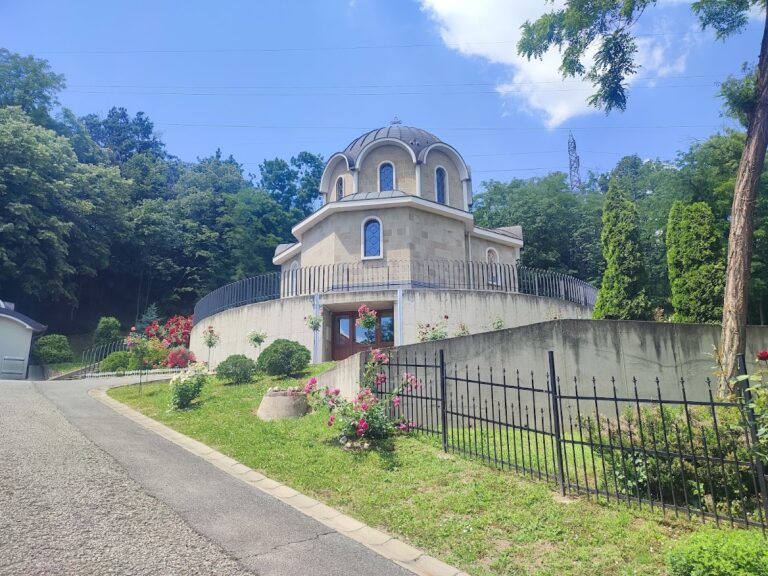
In accordance with Justin Popović’s will, his disciples used proceeds from publishing his writings to build a new church with three altars. Designed by Professor Predrag Ristić, it received its foundation consecration in 2007 and was completed in 2019. The church was consecrated on 22 September 2019 during celebrations of eight centuries of Serbian Orthodox autocephaly, the 125th anniversary of Popović’s birth, and the fortieth anniversary of his death.
On 14 June 2014, Justin Popović’s remains were exhumed and transferred to the new church in a ceremony led by Patriarch Irinej of Serbia. The event was attended by 20 bishops and approximately 15,000 pilgrims. The new church also received part of the relics of Saint Nectarios of Aegina.
Remains
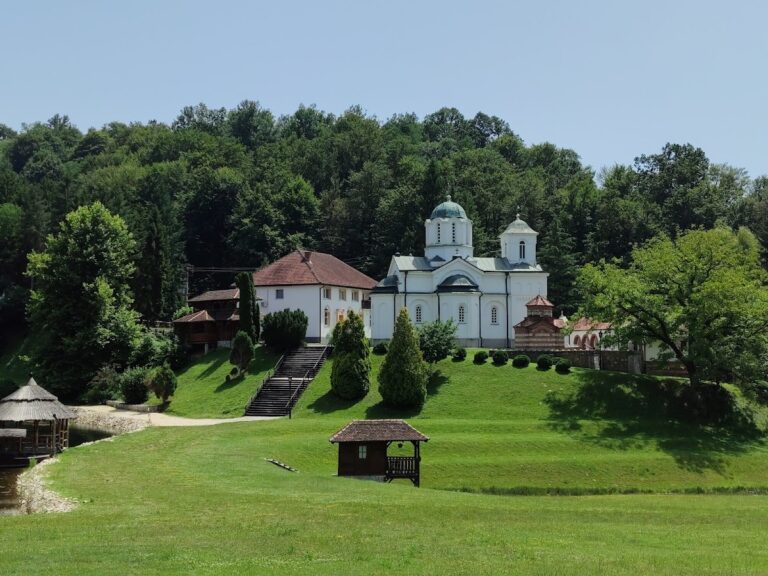
Ćelije Monastery stands in the gorge of the Gradac River, on its left bank in a hilly, wooded part of Lelić. Dense trees and rocky ground conceal the complex from distant view. The Gradac rises near Mount Povlen, passes underground after several kilometers, re-emerges near Bogatići above Ćelije, and then follows a winding gorge toward the monastery.
Older church and historic objects
Church of Saints Michael and Gabriel
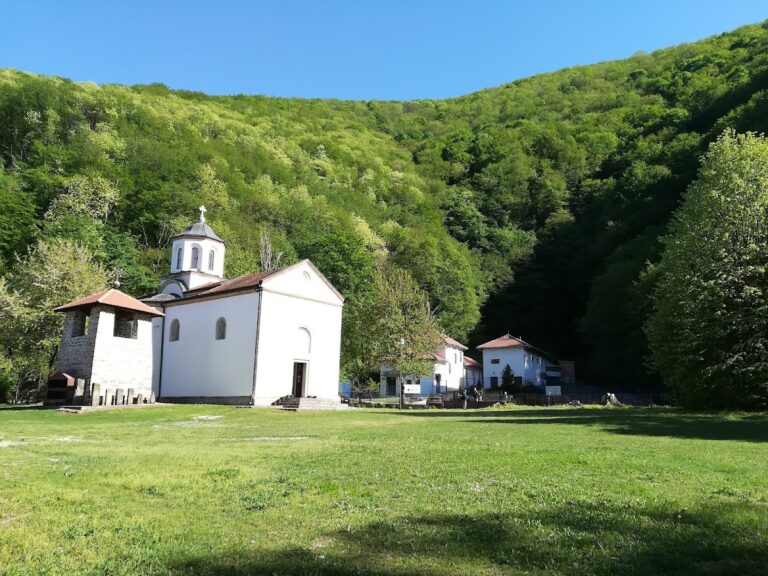
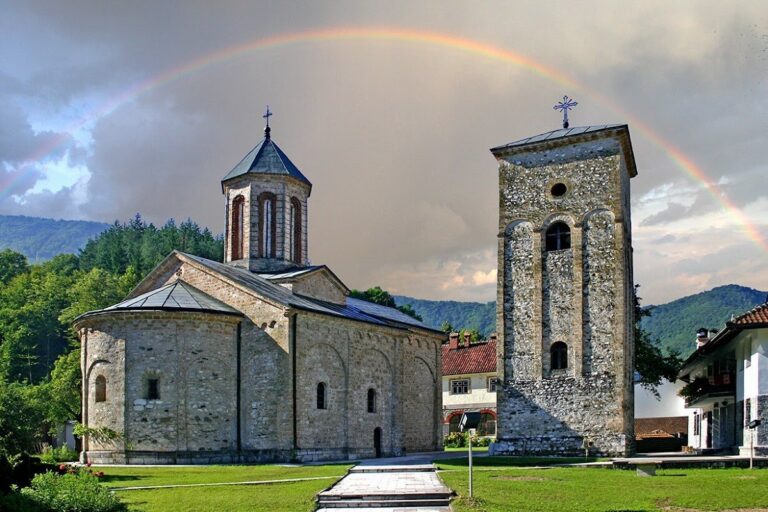
The older monastery church, dedicated to Saints Michael and Gabriel, is a single-nave Byzantine basilica with a dome above the naos, the central worship area. The interior rises 11 meters to the ceiling. Its nine-sided dome rests on thick walls and stepped arches rather than the pilasters commonly used for this purpose. The last recorded restoration of the dome took place in 1936.
The original iconostasis, the screen of icons separating the sanctuary from the main worship space, was painted by Petar Nikolajević Moler between 1798 and 1800. It was destroyed in 1810, and Jeremija Mihailović, Moler’s cousin, painted a replacement in 1816.
Icons, books, and graves
The monastery’s oldest icon is an image of the Holy Archangels, donated before 1798. Its oldest book is Boženstvenaja skrižalj, also known in the records as Skrižali. Bishop Danilo Petrović of Cetinje bought it in Russia in 1715 and later donated it to Ćelije.
Other valuable books include menaia for March and November, probably printed in Venice during the first decades of the eighteenth century; the Great Euchologion, printed in Russia during the second half of the eighteenth century and acquired around 1814; and a Church Slavonic Old Testament that once belonged to Matija Nenadović.
Justin Popović’s grave lies south of the altar and is marked, in accordance with his wishes, by a large stone cross and flowers on the grave mound. Beside the older church, on its left when facing the altar and immediately beyond the northern doors, is the grave of Ilija Birčanin. Birčanin was publicly beheaded at Valjevo on 4 January 1804 together with Aleksa Nenadović.
New church and continuing activities
Church with three altars
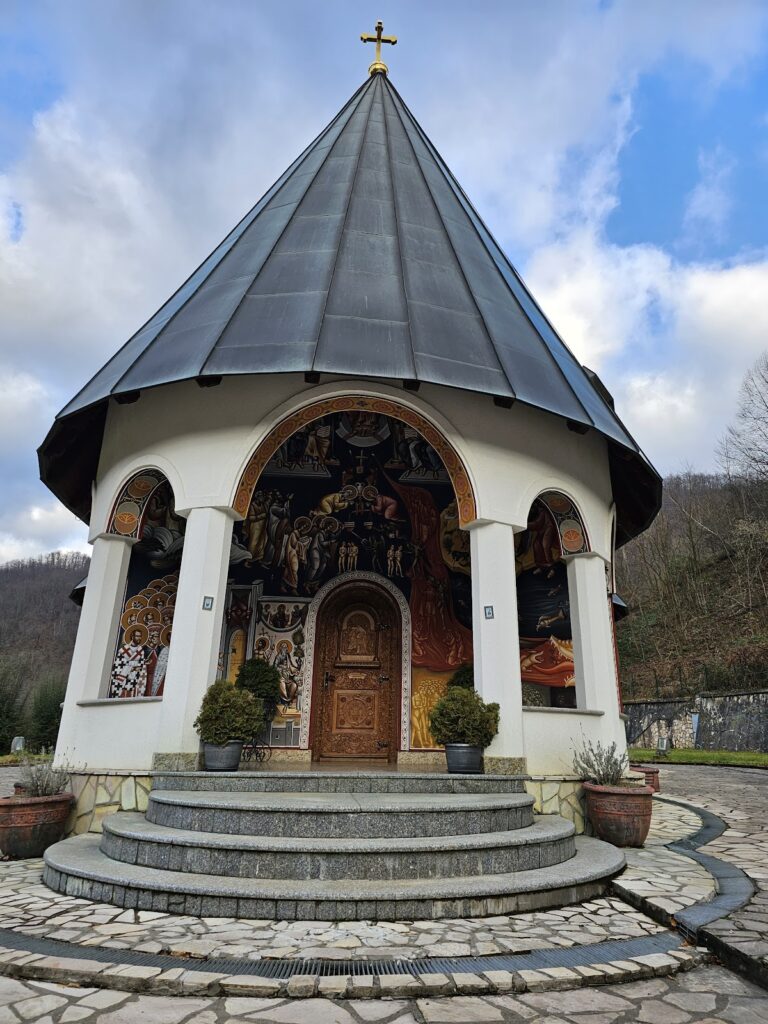
The new church has three altars dedicated to Saint Sava, Saint Justin Martyr, and Saint Mary of Egypt. It contains the relics of Saint Justin of Ćelije and part of the relics of Saint Nectarios of Aegina, sacred remains preserved for veneration.
Printing and icon painting
The monastery’s cultural work includes a printing house for religious books and a workshop for painting icons. These activities continue Ćelije’s role as a religious and cultural center alongside its churches, graves, books, and sacred objects.
Nearby sites