Rača Monastery: A Serbian Orthodox Monastic and Scribal Center in Serbia


Site at a Glance
- Rating
- 4.9
- Popularity
- Medium
- Country
- Serbia
- Primary era
- Medieval
- Eras represented
- Medieval, Modern
- Civilizations
- Ottoman
- Site type
- Religious
- Remains
- Monastery
On this page12 sections
History
Rača Monastery is a Serbian Orthodox monastery in Serbia, standing on the right bank of the Rača River at the foot of Mount Tara near Bajina Bašta. Its origins are traditionally attributed to the Serbian king Stefan Dragutin, who later became the monk Theoktist, and its foundation is commonly placed in 1275 or 1276. Other proposed dates extend into the late thirteenth century, while the attribution to Dragutin remains unconfirmed. The present church belongs to the Raška-Byzantine architectural tradition, a medieval Serbian form combining Byzantine church planning with regional features.
Medieval Foundation and Ottoman Period
The monastery was probably first destroyed after the Serbian Despotate came under Ottoman rule in 1459. It was later rebuilt and became an important Serbian Orthodox center under Ottoman rule, especially through its work of copying religious manuscripts. The community of scribes became known as the Rača scribal school, a term used for much of the Serbian literary activity of the seventeenth and early eighteenth centuries.
The earliest known Rača scribe was Theodor, a hieromonk, or monk who was also a priest, who identified himself in a manuscript of 1516. A 1623 inscription names the hieromonk Silvester as the copyist of a Rača synaxarion, a Christian liturgical collection arranged around saints’ days and feast days. The oldest entries in the monastery’s memorial book date from the first decades of the seventeenth century. Further information from the same period survives in the Rača chronicle preserved in Prague.
The Rača Scribal School and the Great Migration
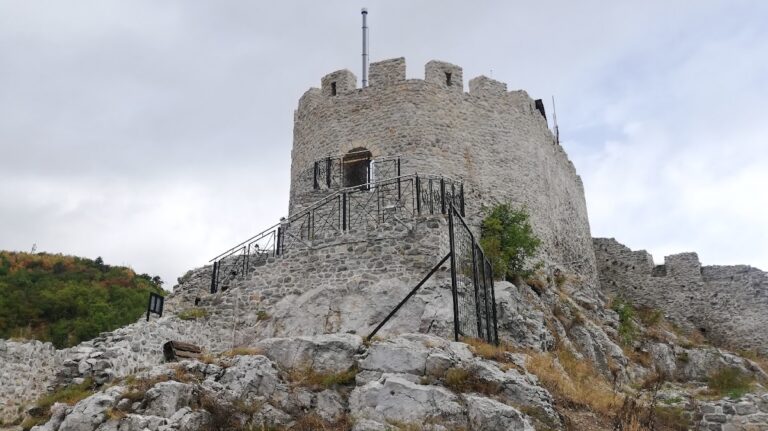
The seventeenth-century scriptorium, the place where trained religious scribes copied manuscripts, was described as having 300 monk-copyists, 400 people performing other work, and 200 guards. The associated school stood about a forty-minute walk along the Rača stream, near the Ladevac spring. The remains of the medieval scriptorium in that area are still under archaeological investigation.
Rača was destroyed again after the Great Migration of 1690, when many Serbs moved north during the Austro-Ottoman War of 1683–1699. The migration was led by Patriarch Arsenije Čarnojević. Some Rača monks reached Szentendre near Budapest, which later became an important Serbian cultural center in Hungary. Others settled in monasteries in Syrmia, including Beočin and Mala Remeta, where they continued copying religious books. Among the notable copyists associated with Rača were Jerotej Račanin, Kiprijan Račanin, and Gavril Stefanović Venclović.
Restoration under Hadži Melentije
Organized restoration began in 1795 through the efforts of Hadži Melentije Stefanović, an archimandrite, or senior monastic cleric, who later became a leader of the First Serbian Uprising against Ottoman rule. He secured an Ottoman imperial decree authorizing the work through the Ecumenical Patriarch. The church was rebuilt between 22 August 1795 and 22 July 1796, consecrated at Christmas that year, and completed internally by 1799. Monastic residences and service buildings were repaired or rebuilt during the same period.
A record from 1799 states that Belgrade Metropolitan Methodius and the Sokol district prince Stevan sold Rača to the Belgrade vizier for 15,000 groschen. Hadži Melentije later succeeded in redeeming the monastery. After the First Serbian Uprising failed in 1813, Ottoman forces burned Rača on 16 October and killed the monks Isaiah and Ignatius at the church’s Holy Table. Hadži Melentije organized a second restoration after returning to Serbia.
Nineteenth-Century Rebuilding
Builders Janja Mihailović, known as Mali, and Nikola Đorđević, known as Cincarin, took part in the second restoration. Following Hadži Melentije’s death in 1824, Archimandrite Mojsije Jovanović directed the construction of the church in 1826. The main restoration campaign, including the church, a residence with monastic cells, and other buildings, was completed by 1835, although the church painting was not yet finished. Prince Miloš Obrenović, Bishop Nikifor Maksimović of Užice, Archimandrite Melentije Kremanac-Radovanović, district official Jovan Mićić, and others provided substantial assistance.
Georgije Bakalović began making the iconostasis, the screen of icons separating the sanctuary from the main worship space, in the second half of August 1840. He also painted about twenty feast-day and other icons. Dimitrije Posniković painted the church in 1853 and 1854 with Milija Marković. Their work was applied to dry plaster in the all-secco technique, and followed models associated with Posniković’s teacher, Dimitrije Avramović, while also showing the influence of German and other Western painters.
War, Preservation, and Modern Monastic Life
The monastery treasury was once among the richest in the medieval monasteries of the region. Ottoman destruction and the 1690 migration dispersed gold vessels, liturgical objects, manuscripts, vestments, and other valuables. Many objects taken to Habsburg territories were never returned and were later looted or dispersed during the First and Second World Wars.
During the Second World War, Bulgarian forces plundered and burned the residence built in 1835 in 1943, causing extensive damage. The Miroslav Gospel, a twelfth-century Serbian manuscript, was then kept at Rača. Abbot Platon Milojević concealed it beneath stone slabs in the church altar, protecting it from the punitive expedition that burned the monastery buildings. The manuscript is now held by the National Museum of Serbia and was added to UNESCO’s Memory of the World Register in 2005. Tradition also holds that King Peter II of Yugoslavia spent a night at Rača while withdrawing from Belgrade in 1941.
After 1961, Hieromonk Hrizostom Pajić and the brotherhood undertook extensive rebuilding and repairs, including new residences and the replacement of the church’s worn wooden floor with marble. The treasury was revived during the second half of the twentieth century with help from heritage authorities, cultural specialists, archaeologists, and researchers of the Rača copyists’ literary work. Serbian Patriarch Pavle and Bishop Stefan of Žiča opened and blessed the restored treasury on 6 October 1996.
Pavle Stojčević, later Serbian patriarch, lived as a monk at Rača from 1948 to 1950 and again from 1951 to 1955. Through his efforts, part of the relics of King Dragutin, preserved remains or personal objects venerated in the Orthodox tradition, is kept at the monastery. Rača is protected as a Serbian monument of culture of great importance. Since 1995, the spiritual celebrations known as the Days of Rača beside the Drina have been held there during the first week of October.
Remains
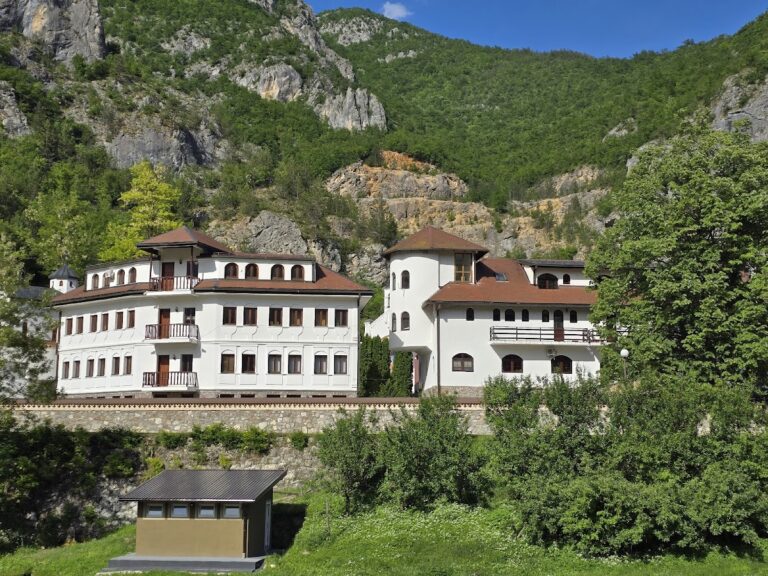
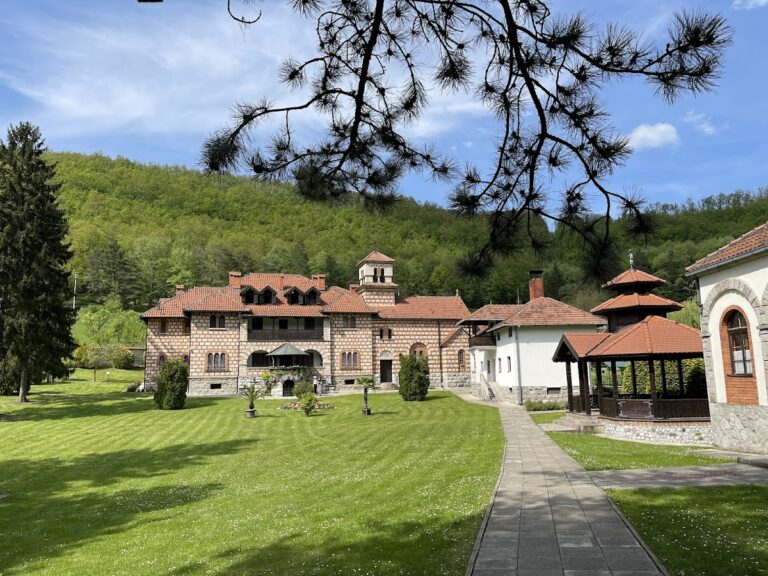
Rača’s surviving complex centers on the Holy Trinity church and includes a separate bell tower, monastic residences, service buildings, a treasury, and religious settlements near the Ladevac spring. The present buildings reflect the nineteenth-century rebuilding of a monastery with medieval origins, while reused material and surviving archaeological areas connect the current complex with earlier phases.
The Holy Trinity Church
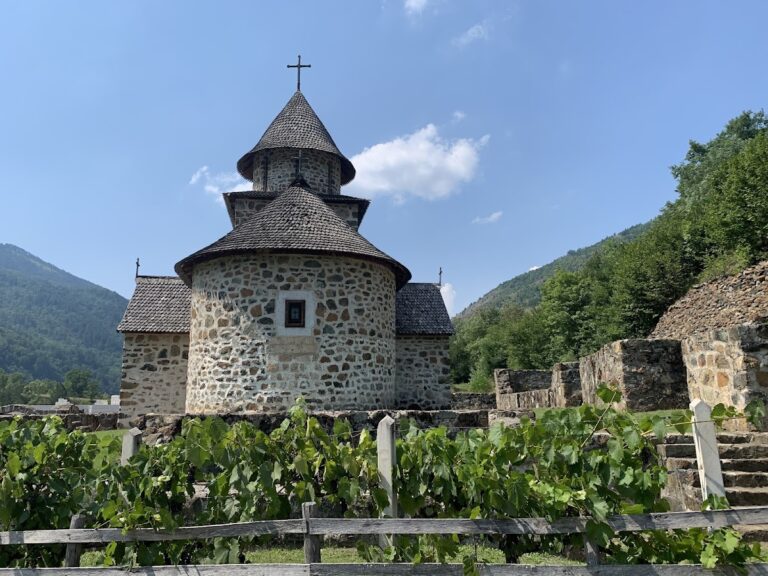
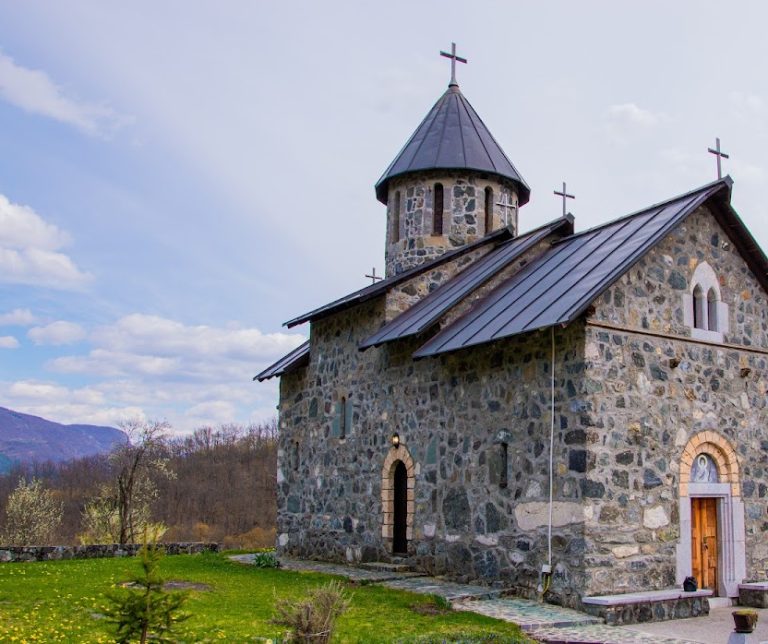
The present church was built on the foundations of its predecessor in 1826 and is dedicated to the Holy Trinity. The earlier church was dedicated to the Ascension of the Lord. The later building retains the predecessor’s general appearance and incorporates carved stone decoration and tufa blocks from the former church’s vaulting.
The church follows the Raška-Byzantine style. It measures 23 metres in length and 15.5 metres across the singers’ areas, rises 11 metres high, and has an altar measuring 8 by 6 metres. Its roof was covered with wooden shingles during the nineteenth-century rebuilding. The interior contains the iconostasis made by Georgije Bakalović from 1840 and his group of approximately twenty icons. Posniković and Milija Marković painted the interior in 1853 and 1854, while Posniković also painted Christ with angels above the entrance on the exterior.
The Bell Tower
A large bell tower stands several metres north of the church. Built in 1849, it is approximately as tall as the church and its dome. The tower has three storeys and is constructed from both dressed and rough stone. Each of its first and second storeys contains a window and blind arcades topped by a small rosette.
The ground floor has no windows and is entered from the south, facing the church. Above the doorway is an inscription on a decorated plaque. Bells were obtained for the restored monastery in 1833, although their later history is uncertain. Austrian forces removed two or three bells in 1918. Around 1952, Hieromonk Vasilije Domanović and Deacon Pavle Stojčević traced them to the tower of a Catholic church in the Banat village of Mali Karlovčić.
Residences and Monastic Grounds
A new monastic residence was built on the site of the residence burned in 1943. At the estate known as Monastic Dwellings, a two-storey residence with a chapel and ground floor was also constructed. Another residence was begun north of the church on the site of a deteriorated cooperage and an old residence. The church floor was repaired by replacing the worn wooden flooring with marble.
Ladevac Spring and the Medieval Scriptorium
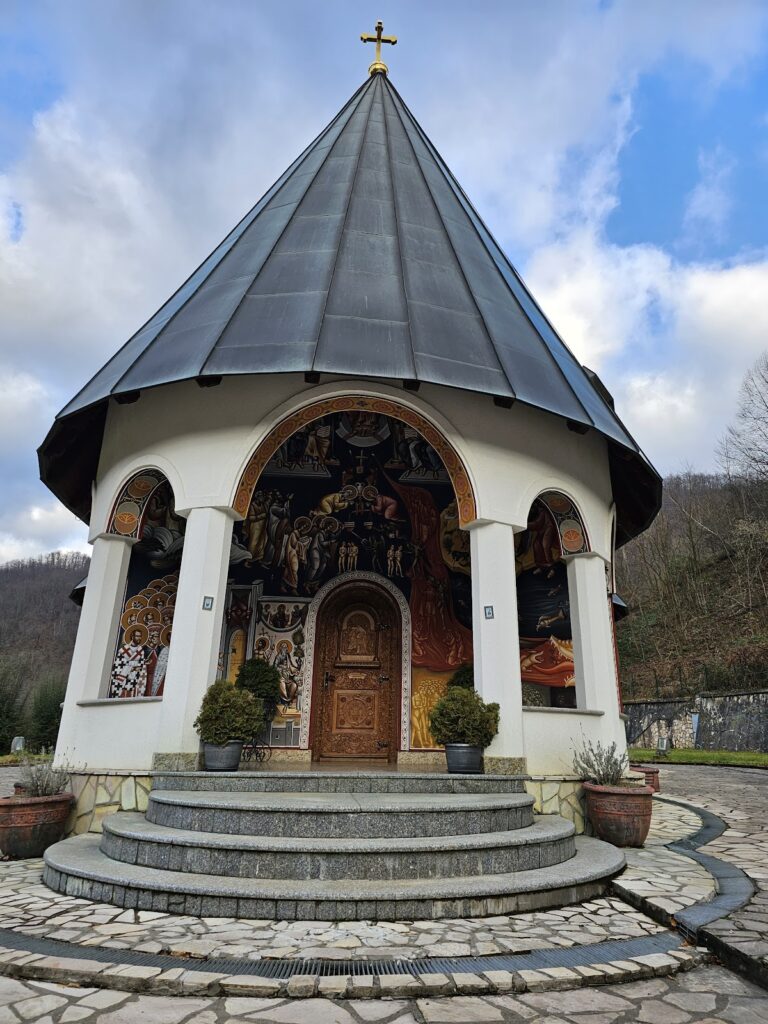
Near the Ladevac spring are hermitages and the Skete of Saint George. A skete is a small monastic settlement or hermitage connected with a larger monastery. The remains of the medieval scriptorium lie in this area beside the route along the Rača stream. They continue to be examined archaeologically and preserve the physical setting associated with the monastery’s manuscript-copying community.
The Treasury
The monastery treasury contains personal belongings of Hadži Melentije Stefanović, including a gold cross with a chain presented to him by the Russian emperor. It also preserves an insurgent flag from 1807 made by Stefan Gavrilović of Sremski Karlovci, Hadži Melentije’s insurgent treasury, and documents relating to monastery land, correspondence, administrative decisions, and court judgments.
Nearby sites