Kaona Monastery: A Serbian Orthodox Monastic Complex in Serbia


Site at a Glance
- Rating
- 4.9
- Popularity
- Medium
- Country
- Serbia
- Primary era
- Modern
- Eras represented
- Medieval, Modern
- Civilizations
- Byzantine
- Site type
- Religious
- Remains
- Monastery
On this page13 sections
History
Kaona Monastery is a Serbian Orthodox monastery in Serbia, located in the village of Kaona within the municipality of Vladimirci. Belonging to the Eparchy of Šabac, a territorial administrative unit of the Serbian Orthodox Church, it is protected as a cultural monument and immovable cultural property. Its present church, built in 1892 in the Byzantine or Serbo-Byzantine style, stands within a monastic site whose history reaches back to the medieval period.
Medieval origins and early records
The first church on the site is thought to date from the second half of the eleventh century. Monastic tradition places the foundation of Kaona Monastery in the fourteenth century, when Ikonija, traditionally described as the sister of the Serbian medieval heroic figure Miloš Obilić, established it as a religious endowment. This connection belongs to the monastery’s foundation tradition. The monastery appears in written documentation for the first time in 1548.
Restoration and nineteenth-century rebuilding
The church underwent a complete restoration in 1756 on the initiative of Abbot Gregorije. In 1766, the Serbian artist Teodor Stefanov Gologlavac painted the restored church. The building was later destroyed during the First Serbian Uprising, the Serbian revolt against Ottoman rule that began in 1804. It was rebuilt in stone in 1830, but collapsed in 1888. The present church was then erected on the foundations of its predecessor in 1892 and consecrated in 1911 by Sergije Georgijević, bishop of the Eparchy of Šabac.
War, loss, and twentieth-century renewal
During the First Serbian Uprising, monks took part in combat, while the monastery residence, or konak, a residential and service building for monks and guests, was turned into a hospital. Ammunition for the western theatre of operations was stored in the church, so worship moved to a room in the konak converted into a chapel dedicated to the Assumption of the Holy Mother of God.
The First World War brought further losses: the church archive was burned and two bells were taken. During the Second World War, the monastery served partly as a refuge. After the war, the church was in poor condition, and agrarian reform confiscated 120 hectares of monastery land. In 1945, all the monastery’s monks were killed by partisans. One of them was Nestor Ocić, who had been born in Dalj on March 14, 1918.
Major renovation began in 1962 after Teofilo Stanimirović became head of the monastery. He led a devotional movement in the Šabac–Valjevo diocese and remained abbot until 1995. Milutin Knežević followed him from 1995 to 2003 and played a major role in restoring and arranging the monastery. After becoming bishop of Australia and New Zealand in 2003, Knežević became bishop of Valjevo in 2006, following the division of the Šabac–Valjevo diocese into the dioceses of Šabac and Valjevo. Arsenije Cvetković headed the monastery from 2003 until his death in a traffic accident in October 2013. Filimon Zeković became head in 2013.
On August 29, 1992, the monastery marked the six-hundredth anniversary of its traditional foundation and the centenary of the present church. Serbian Patriarch Pavle served the hierarchical liturgy with two other bishops, clergy, and monks.
Remains
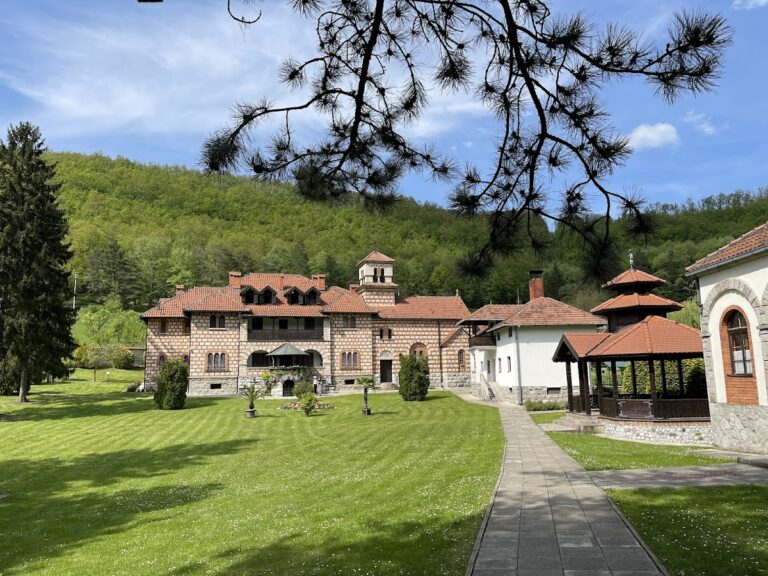
The monastery occupies a landscaped park covering several hectares. Its principal surviving building is the present church, accompanied by a separate bell tower and several later religious structures. Together, these buildings reflect the complex’s nineteenth- and twentieth-century development.
Church and bell tower
Church of the Holy Archangel Michael
The monastery church is dedicated to the Holy Archangel Michael and dates from 1892. Built in the Byzantine or Serbo-Byzantine style, it is made of brick on a stone foundation. The foundation incorporates monuments from the former monastic cemetery in the churchyard. Inside are an iconostasis, a screen of icons separating the sanctuary from the main worship space, and frescoes that include scenes in the dome and a depiction of Christ on the Mount of Olives.
Bell tower
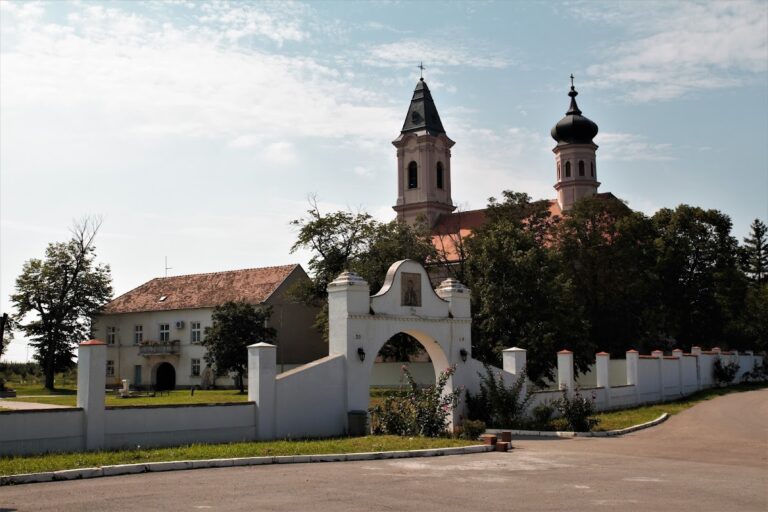
The bell tower stands approximately twenty metres from the church. Before it was built in 1911, the bells were thought to have been housed in the church cupola above the western entrance. Three bells of different sizes are used to call worshippers to prayer each morning and evening.
Later chapels and baptismal building
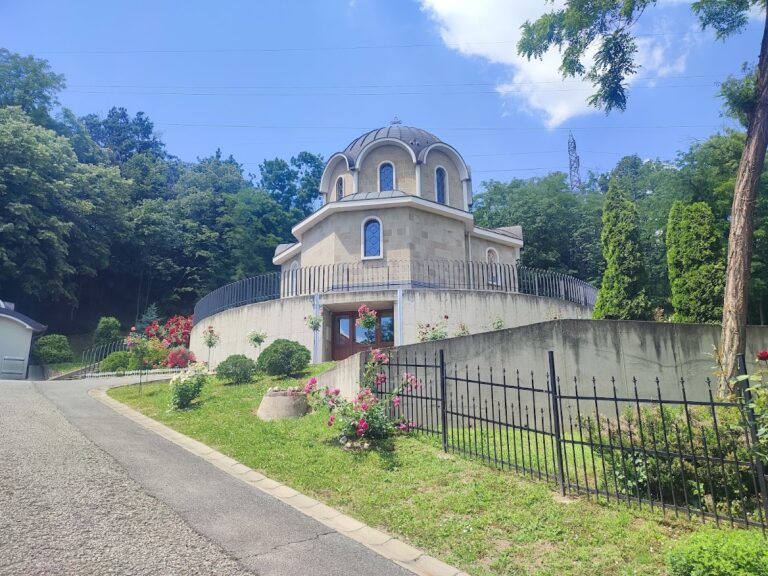
Saint Sava Baptistery
A baptistery dedicated to Saint Sava was built in 1984. Saint Sava was the first archbishop of the autocephalous Serbian Orthodox Church.
Saint Habakkuk Chapel
A chapel dedicated to Saint Habakkuk was erected in 1999. Habakkuk, an Old Testament prophet, is commemorated as a saint in Orthodox Christianity.
Cave chapel
A cave chapel was arranged in 2004, adding another worship space to the monastery complex.
Interior works and sacred objects
The monastery’s icons were made by Dragan Marunić and Nikola Lubardić, while Dorotej and Ljuban Marić of Lelić produced the woodcarving. A fragment of the relics of Venerable Mother Paraskeva, also known as Saint Petka, is preserved at the monastery as a sacred object. She is an Orthodox Christian saint whose relics are venerated in the Balkans.
Nearby sites