Einödhof, Apfelberg: A Rural Settlement and Castle Ruin in Austria


Site at a Glance
- Rating
- 4.7
- Popularity
- Very Low
- Country
- Austria
- Primary era
- Medieval
- Eras represented
- Medieval
- Civilizations
- Holy Roman Empire
- Site type
- Military
- Remains
- Castle
On this page11 sections
History
Einödhof, Apfelberg, is a dispersed rural settlement in Austria on the outskirts of Knittelfeld. Its history reaches back about 1,000 years, when it was associated with the estate of Einödhof Castle. The settlement lies in the Murtal district of Styria and was formerly part of the municipality of Apfelberg, which is now within Knittelfeld.
Medieval Estate and Admont Abbey
During the early twelfth century, the estate belonged to the Eppensteiners, a noble dynasty connected with the governance of Styria and nearby territories. In 1150, Chuniza de Phavendorf gave it to Admont Abbey, a Benedictine monastery that held land and exercised lordship over estates in Styria.
The estate was then generally known as Lobenich. The name Einöd emerged later, after a tithe from Chieneinode near Kraubath was transferred to Lobenich. The knightly retainers who administered the property for Admont adopted the name de Ainode. In 1287, Abbot Heinrich II transferred the estate to Duke Albrecht. The duke used it to compensate the lords of Lobming for their service during the conflict with the Archbishop of Salzburg. The fortified estate thereby formed part of the defensive system across the plain between the Mur River and the surrounding uplands.
Feudal Possession and Private Ownership
The Lobminger family held Einödhof for nearly 90 years, first as feudal tenants and later as pledge holders. A fief was land held from a superior lord in return for service. Admont redeemed the estate in 1375, although it continued as a fief of the territorial sovereign. In 1413, the abbey converted it into freehold property, meaning that it was held outright rather than as a feudal grant.
In 1420, Admont exchanged Einödhof with Hans Kainacher. His family retained the estate for almost two centuries. It was generally leased during this period, while members of the family later lived there themselves. In 1609, heavy debts led Christof von Kainach to sell the lordship to his neighbor Hans Jakob Zach. Zach’s son, Sigmund Friedrich, later sold his properties to Christof Adam von Teufenbach, whose son Ferdinand Heinrich soon transferred the estate to Hans Balthasar Graf Galler.
In 1746, Karl Ernst Graf Galler sold the residence to Thomas Reicher, although he kept the lordship. The Galler family had scarcely occupied the residence. The lordship went bankrupt in 1774 and subsequently passed to a countess of the Attems family, then to the Counts Wurmbrand and the Barons von Sessler.
Decline of the Castle and Agricultural Continuity
By the end of the nineteenth century, the castle had entered bourgeois and farming ownership. Its owners did not preserve it, and the ruin was dismantled in stages to prevent it from damaging neighboring buildings. The two-storey north wing remained inhabited until 1945, when severe structural damage made it uninhabitable.
Einödhof retained its agricultural character through the twentieth century. Three large farms operated there during that period. The farm known as vulgo Schlossbauer was dissolved and completely sold off at the end of the century. The settlement now contains two large agricultural enterprises and a smaller farm. The castle tower is protected as a monument.
Remains
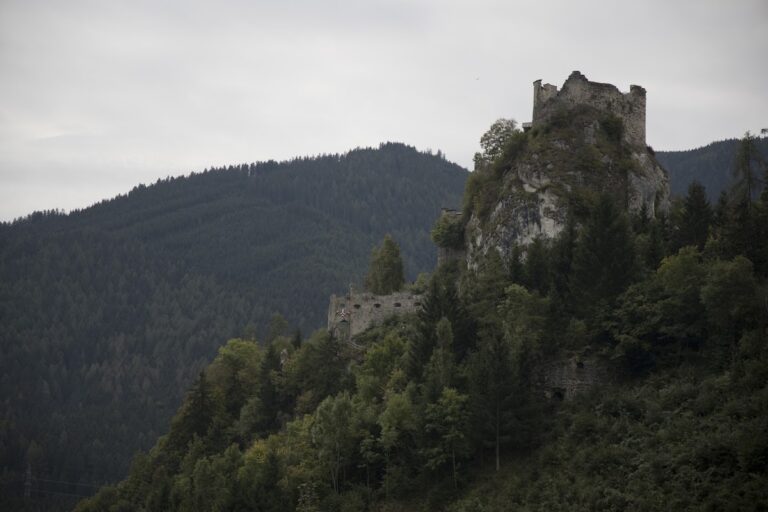
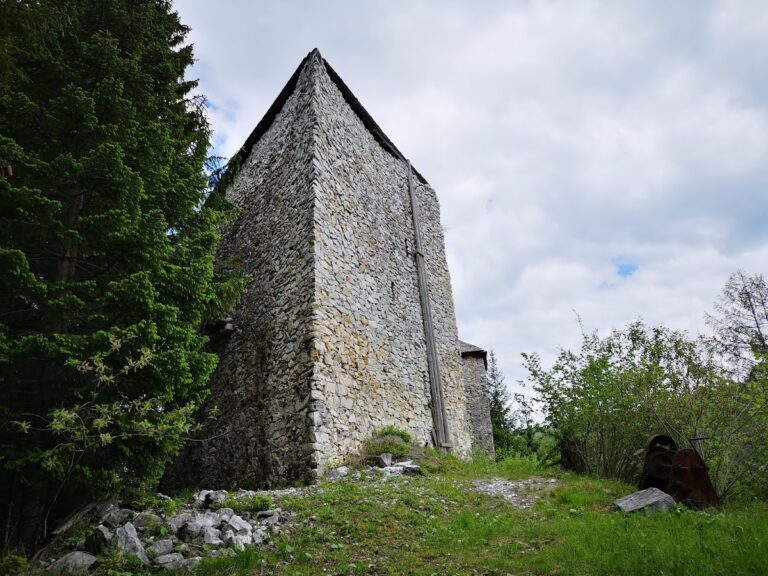
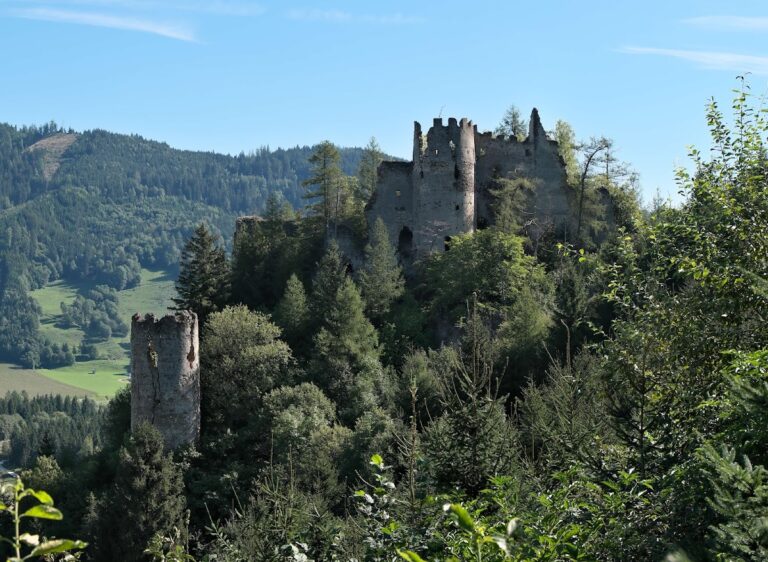
Einödhof survives as a dispersed settlement organized around agricultural properties and the ruin of its former castle. The castle stands at the western edge, in the area known as Alteinödhof, with the two large agricultural enterprises immediately nearby. The principal castle remnant is the main tower, accompanied by deteriorated sections of wall. The former north wing was a two-storey building and remains part of the ruin’s physical history through its surviving damaged fabric.
Castle Ruin
Main Tower
The main tower is the principal surviving element of Einödhof Castle. It stands with several deteriorated wall sections and is the part of the ruin protected as a monument. The castle was dismantled progressively over time so that adjacent buildings would not be endangered.
North Wing
The north wing was a two-storey structure that continued to be inhabited until 1945. Severe structural damage then forced its abandonment. Its deterioration belongs to the later phase in which the castle was progressively taken apart.
Agricultural Properties
Vulgo Einödhofer Farm
The property known as vulgo Einödhofer includes a historic barn of architectural interest, built many centuries ago. It also contains a modern chapel that shapes the appearance of the settlement, together with orchard meadows and a notable diversity of species.
Neueinödhof
Neueinödhof forms the smaller eastern part of the settlement and contains approximately eight detached houses. The buildings on its northern side date from the twentieth century, while those on the southern side were built during the twenty-first century.
Nearby sites