Castle of las Aguzaderas: A Medieval Fortress Defending a Spring in Spain


Site at a Glance
- Rating
- 4.6
- Popularity
- Low
- Country
- Spain
- Primary era
- Medieval
- External website
- Open
- Eras represented
- Medieval, Early Modern
- Civilizations
- Amazigh, Crown of Castile
- Site type
- Military
- Remains
- Castle
On this page8 sections
History
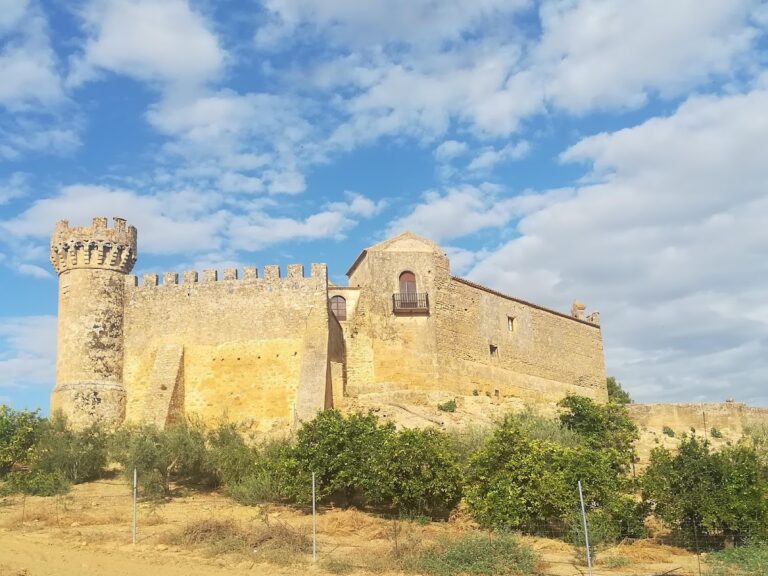
Castle of las Aguzaderas is a medieval fortress in Spain, near El Coronil in Seville province, built in the fourteenth century in the regional military style of its period. Its foundation has also been attributed, less certainly, to Berber groups. During the Reconquista, the long medieval expansion of Christian kingdoms into Muslim-ruled parts of the Iberian Peninsula, it protected the Aguzaderas or Abuzadera spring in the Banda Morisca, a frontier belt in Andalusia associated with that conflict.
A fortress for the frontier spring
The castle’s purpose was closely tied to the water source rather than to control of the surrounding territory. Six other towers formed part of the defensive system around the spring: Cote, Bollo, Lopera, Águila, Alocaz, and Llado. The fortress itself was modified during the fifteenth and sixteenth centuries as the frontier landscape and its settlements changed.
Roman and medieval settlements existed in the surrounding area. During the fifteenth century, the inhabitants of the local settlement moved to El Coronil after its donadío, a landholding or estate granted by a ruler or governing authority, was incorporated into that community. This relocation altered the relationship between the castle and the nearby population while preserving the fortress’s association with the spring.
Protection and restoration
On 12 February 1923, the castle was declared an architectural-artistic monument after work associated with Feliciano Candau and the Duke of Medinaceli. The declaration appeared in the Gaceta de Madrid on 17 February. A further protected-monument declaration was published in the Boletín Oficial del Estado on 29 June 1985.
The Ministry of Culture carried out a major restoration during the 1960s, producing much of the castle’s present state of conservation. Local traditions have added a legendary dimension to the site. One tale places a hidden treasure beneath the keep, to be found only by someone who can eat a pomegranate without wasting a seed while sitting there at midnight on Saint John’s Night. Another, presented on a panel at the entrance, tells of a warrior’s shadow patrolling the battlements at midnight while waiting forever for a lost love.
A separate tradition, recorded by the chronicler José Garrido and recounted by José de las Cuevas, names María Rodríguez as the only person buried in the parade ground. She was said to have lived at the castle during the “pestilential fevers” of 1800. The reason for her confinement there remains uncertain within the story, which identifies the supposed ghost as a woman.
Remains
Setting and defensive layout
The fortress stands in a depression or valley in the countryside at the foot of the Sierra Sur, about 3 kilometres from the urban centre of El Coronil. Its position reflects its practical purpose, since the Aguzaderas or Abuzadera spring lay within the surrounding frontier landscape and was the feature the castle was built to defend. The six named towers around the spring formed a wider defensive network, while the castle’s regional military design organized its own walls and internal spaces around the protected water source.
Castle structures
Keep and wall-walk
The surviving fortress includes a keep, or tower of homage, together with a battlemented wall-walk. The wall-walk, a fortified patrol passage along the top of a defensive wall, is the setting assigned to the apparition in the warrior legend. These elements express the castle’s defensive function and remain central to its present form after the modifications of the fifteenth and sixteenth centuries and the major restoration of the 1960s.
Entrance and parade ground
An entrance leads into the castle and the internal parade ground. The parade ground is associated with the tradition concerning María Rodríguez, whose supposed burial there gives the space a particular place in local memory. Together with the keep, wall-walk, and surrounding defensive system, it forms part of the surviving arrangement of the fortress built beside the spring.
Nearby sites