Église Sainte-Foy de Contamine-sur-Arve: A Gothic Church and Former Priory in France
Site at a Glance
- Popularity
- Very Low
- Country
- France
- Primary era
- Medieval
- Eras represented
- Medieval, Early Modern, Modern
- Civilizations
- Duchy of Savoy
- Site type
- Religious
- Remains
- Church
On this page10 sections
History
The Église Sainte-Foy de Contamine-sur-Arve, in France, is a Gothic church whose history began as a priory around 1083. The lords of Faucigny gave the church, then dedicated to Saints Peter and Paul, to Cluny Abbey, a leading Benedictine center connected to a network of monasteries. The donation was made through Guy de Faucigny, bishop of Geneva, and established a priory, a monastic house governed by a prior. In 1119, the lord of Faucigny confirmed the donation in Geneva in the presence of the first known prior.
Foundation and medieval rebuilding
The Benedictine monks placed the church under the dedications of Mary and Saint Faith of Agen, an early Christian martyr. Mary was also honored there under the title Our Lady, and the church later took Saint Faith as its sole dedication. It became a burial place for the Faucigny ruling family. Béatrice de Faucigny rebuilt the church in 1295, while further building work at the priory took place during the thirteenth and fourteenth centuries. Fires partly damaged the church and priory in the fifteenth century.
Conflict and the transfer to the Barnabites
In 1589, Bernese forces partly destroyed the church and priory during the French Wars of Religion, a series of conflicts between Catholics and Protestants in France. The attack came amid Duke Charles Emmanuel I of Savoy’s campaign to expand his influence. In 1588, with Spanish support, he seized the Marquisate of Saluzzo, previously held by France, and sought to take Geneva. In February 1589, King Henry III of France sent Nicolas du Harlay, lord of Sancy, to encourage the Bernese to aid Geneva and seize Faucigny.
Charles Emmanuel and Francis de Sales also promoted a proposed university at Thonon to counter Protestant influence from Geneva in the Chablais, a historical region in the western Alps near Lake Geneva. Their wider educational and charitable plan included a community of priests organized under the religious rule of Philip Neri, founder of the Oratory; a college managed by Capuchins; a school of arts and crafts; orphanages and refuges; and an academy teaching theology, medicine, and law. The Sainte-Maison of Thonon, a Catholic foundation for organized religious and charitable work, was assigned revenues from the priories of Saint-Jeoire, Nantua, and Contamine by Pope Clement VIII on 13 September 1599, payable after the deaths of their priors. When Bresse was ceded to France under the Treaty of Lyon, the Sainte-Maison lost the income from Nantua and faced financial difficulty. Francis de Sales then chose the Barnabites, a Catholic religious order, to manage the institution. Their agreement, signed on 12 April 1616, provided them with 1,000 ducatons, a type of coin, for support, mainly from Contamine’s revenues.
Despite these arrangements, the priory remained under Cluny’s authority. In 1607, Cluny’s grand prior Jean Papon described the monks continuing services in the surviving half of the old church, which was in very poor condition. In 1618, Cluny’s delegate Louis de La Tour inspected the priory on behalf of Abbot and Cardinal Louis de Lorraine. He prescribed church repairs and changes to monastic discipline. The Benedictines resisted Barnabite intervention, but, with the Duke of Savoy’s support, income attached to the monks’ offices began passing to the Barnabites in 1620. From 1622, the duke barred the Benedictines at Contamine from accepting novices.
A decree issued by Pope Urban VIII on 22 July 1624 suppressed the priory and arranged for the monks’ incomes to pass to the Barnabites as the monks died. The Savoy Senate confirmed it on 29 November 1624, and a papal brief addressed to Francis de Sales put it into effect on 20 March 1625. On 7 October, Francis de Sales had the decree read before the prior, Jen de Lucinge, and the Benedictine monks. Following their protest, he transferred the priory to the Barnabites, and the Benedictines left. Some joined Talloires Abbey, which sued the Barnabites to recover the priory.
Barnabite rule and later uses
The church’s restoration was completed in 1625. Under Barnabite authority, Contamine served both as a monastery and as a large farm supplying the order’s colleges at Annecy and Thonon. The Annecy college, formerly known as the Chappuisien College, had been managed by the Barnabites since 1614. They retained the priory until the French Revolution, when they were expelled in 1793 and the buildings were sold as national property. After passing through several owners, the buildings housed a cotton-cloth factory until 1837. The church returned to parish worship in 1803. Redemptorists, another Catholic religious order, were based at Contamine from 1847 to 1905.
The church was classified as a historic monument in 1909. In 1913, the General Council of Haute-Savoie asked the state to establish a practical agricultural school in the former Barnabite buildings. A ministerial decree established the school on 19 May 1917, and the buildings housed people disabled by the war until 1920. The church is Catholic and belongs to the Diocese of Annecy and the parish of La Trinité-au-Pays-des-Voirons.
Remains
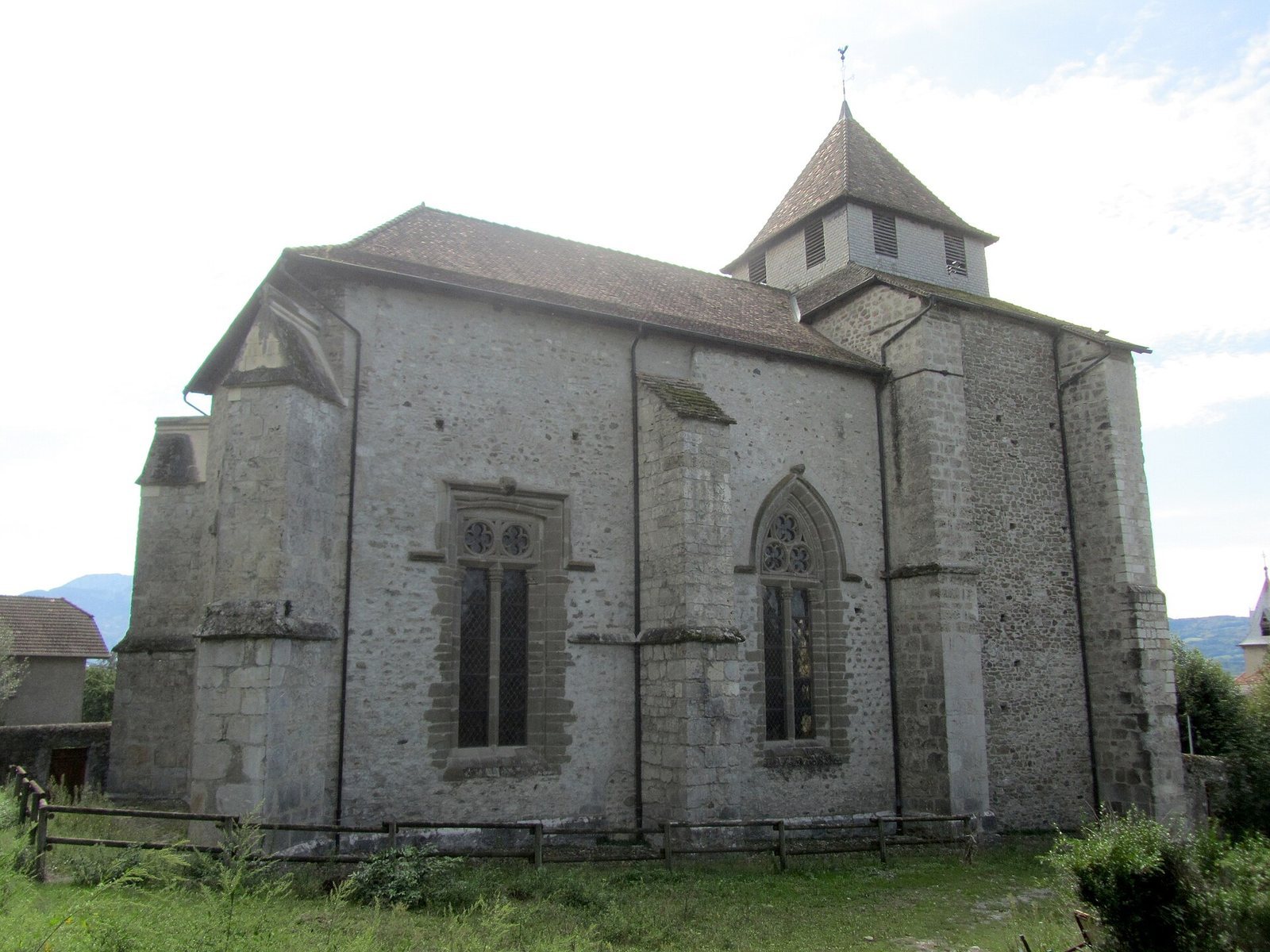
The surviving church is only part of the original Gothic building. Its single nave has three bays of unequal width, covered by rib vaults divided into four sections. The east end is flat rather than rounded, and the walls vary in thickness.
Church
Eastern end and supports
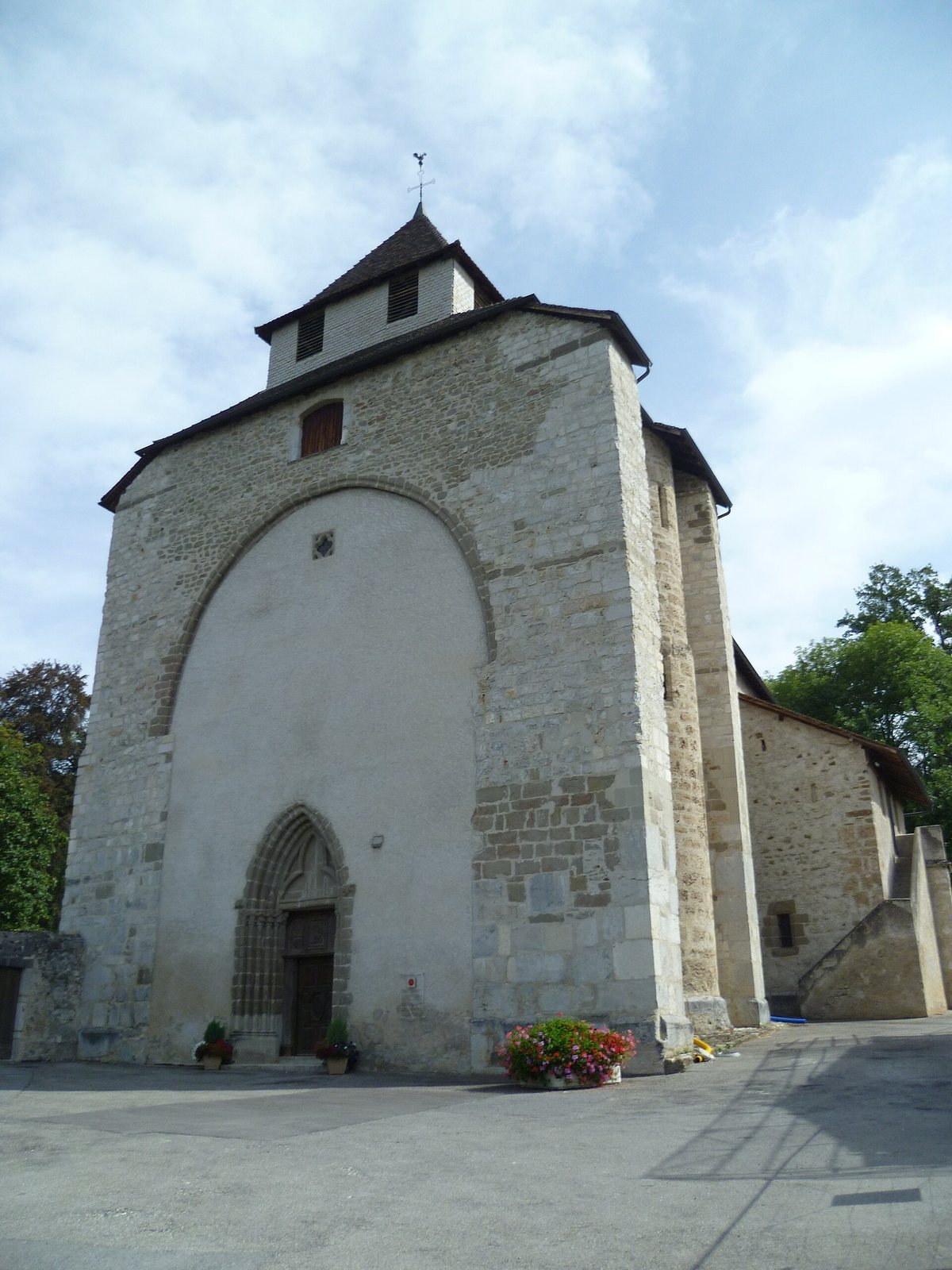
The easternmost surviving bay now forms the church’s east façade. It incorporates a former crosswise arch that once separated two bays, rough masonry infill, and a portal salvaged from the ruins and set at the center. A modern wooden bell tower stands above it. The bay’s thick walls have led to the suggestion that they once supported a stone tower, while very large buttresses reinforce this part of the building.
South stair turret and upper room
A half-turret beside the second buttress on the south wall contains a circular stair partly built into the wall. Its surviving upper section gives access to a room above the vaults of the two eastern bays. The room’s west window displays the arms of Celse Morin, a prior from Autun who probably built the room.
Cloister access
A blocked doorway in the church once connected the cloister with the choir, the part used by clergy for the liturgy.
Conventual buildings
The priory’s conventual buildings were first built in the thirteenth century and rebuilt during the seventeenth century. After later partial destruction, the surviving portions were incorporated into the agricultural school.