Château d’Étrembières: A Former Fortified Residence in France


Site at a Glance
- Rating
- 4.2
- Popularity
- Very Low
- Country
- France
- Primary era
- Medieval
- Eras represented
- Medieval, Early Modern
- Civilizations
- Unclassified
- Site type
- Military
- Remains
- Castle
On this page7 sections
History
Étrembières Castle is a former fortified residence in France, thought to date from the late thirteenth or early fourteenth century. It gave its name to the Étrembières family, whose knights are recorded from 1201 as vassals, or dependants holding land from a superior lord, of the counts of Geneva. The castle occupied a strategic position overlooking the bridge and ferry across the Arve near Gaillard.
Medieval Lords and Regional Power
By about 1320, the castle was held by the Compey family. Its political importance is illustrated by an agreement signed there in 1309 between Aymon de Quart, the prince-bishop of Geneva, and the citizens of Geneva. A prince-bishop was a churchman who also exercised secular authority over a territory. The castle later passed between the Compey family and Marin de Montchenu.
The Compeys lost the property after Philibert II de Compey killed Bernard de Menthon in 1479 and was condemned to death. The castle was confiscated again after another Philibert de Compey killed a canon from Fribourg in Geneva. These seizures formed part of the castle’s changing political and familial history in a region influenced by the counts of Geneva and the dukes of Savoy.
Savoyard Control and Destruction
On 9 November 1559, Duke Emmanuel-Philibert of Savoy granted the castle as a fief, meaning property entrusted by a superior lord in return for service, to François-Prosper de Genève-Lullin. In 1589, Clémence de Genève-Lullin received it as her dowry from her father, Prosper de Genève, when she married Bernard IV de Menthon.
That same year, the castle was burned during the war between Duke Charles-Emmanuel of Savoy, Geneva, and the king of France. Its governor was killed, and the building was later returned to a defensible condition because of its strategic position. Clémence, who had no children, bequeathed the property to Annecy Hospital on 8 March 1606, requiring the hospital to pay an annuity to the chapter of Notre-Dame-de-Liesse.
Industrial Experiment and Later Use
In 1857, Jean-Daniel Colladon tested a compressed-air drilling machine at the castle. After boring into Salève, the machine was used in excavating the Mont-Cenis Tunnel, a major Alpine railway tunnel linking France and Italy. The castle was restored during the twentieth century and now forms the centre of an agricultural estate.
Remains
Setting and Enclosure
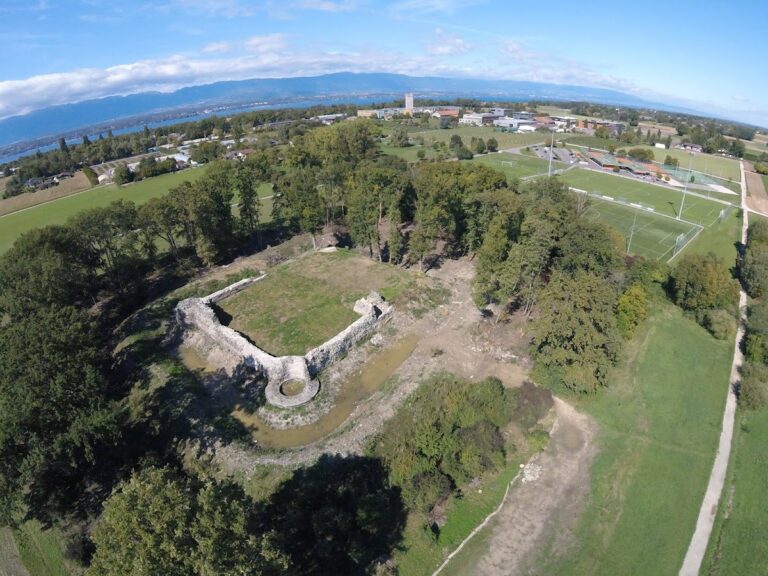
Also known as Château Haut, the castle stands at the northern end of Petit-Salève, the northern part of the Salève mountain. It occupies a mound rising 27 metres above Château des Terreaux. From this position, the castle overlooked the bridge and ferry used to cross the Arve near Gaillard, linking its physical setting to its defensive and strategic role.
The roughly rectangular enclosure measures 21 by 28 metres. Round towers once marked its corners, and three of them survive. The enclosure and its elevated position form the principal elements of the castle’s surviving fortified layout.
Residential Buildings
Residential buildings are arranged around an inner courtyard. They were remodeled during the fifteenth and sixteenth centuries, giving the complex a domestic arrangement within its fortified boundaries. The entire northwestern section was demolished in 1589, when the castle was burned during the war involving Savoy, Geneva, and the king of France. Twentieth-century restoration forms part of the present condition of the surviving complex.
Nearby sites