Easter Aquhorthies: A Prehistoric Recumbent Stone Circle in Scotland
Site at a Glance
- Popularity
- Medium
- Country
- United Kingdom
- Primary era
- Bronze Age
- Eras represented
- Stone Age, Bronze Age, Modern
- Civilizations
- British
- Site type
- Civic
- Remains
- Megalithic Monument
On this page8 sections
History
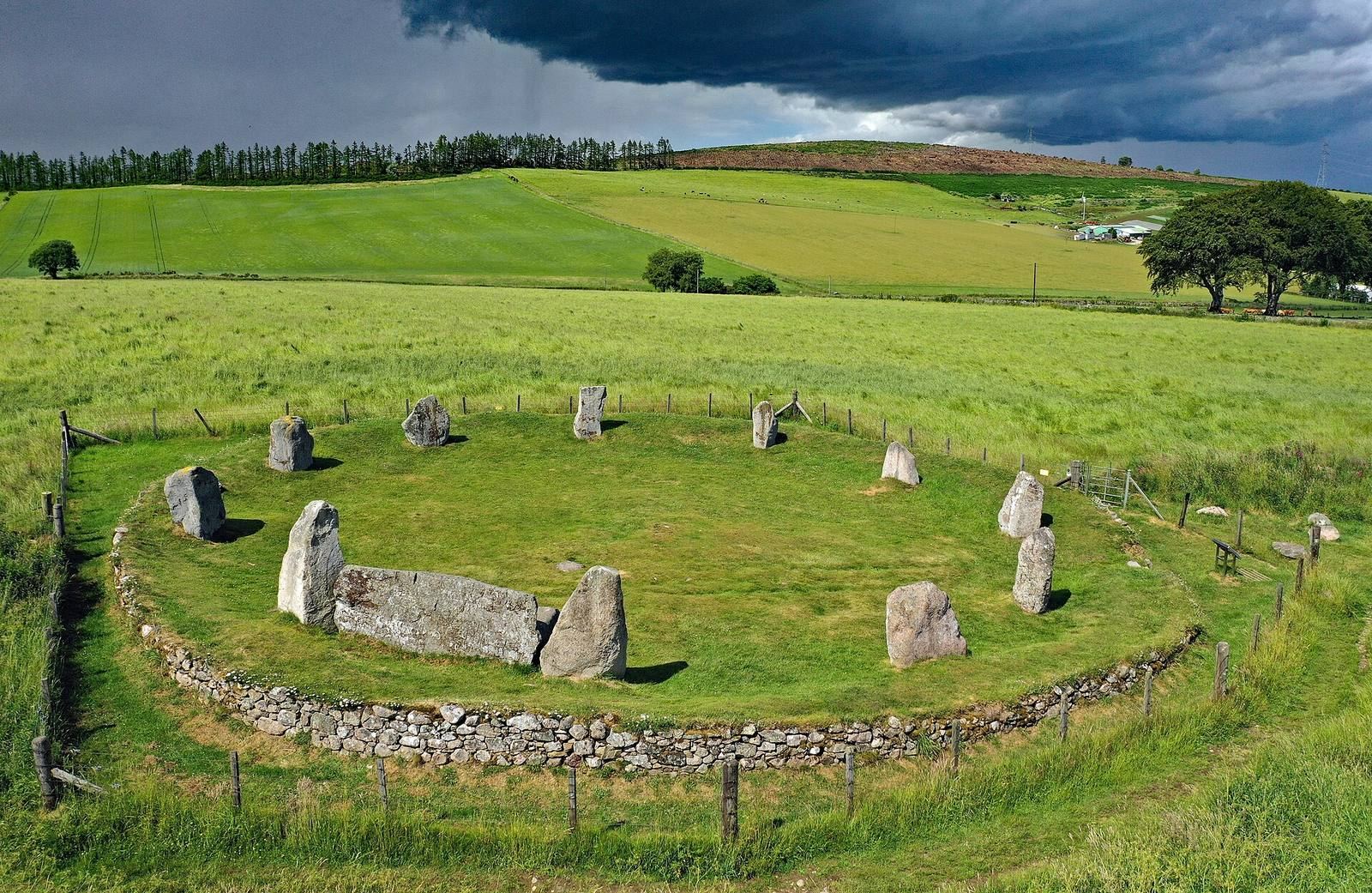
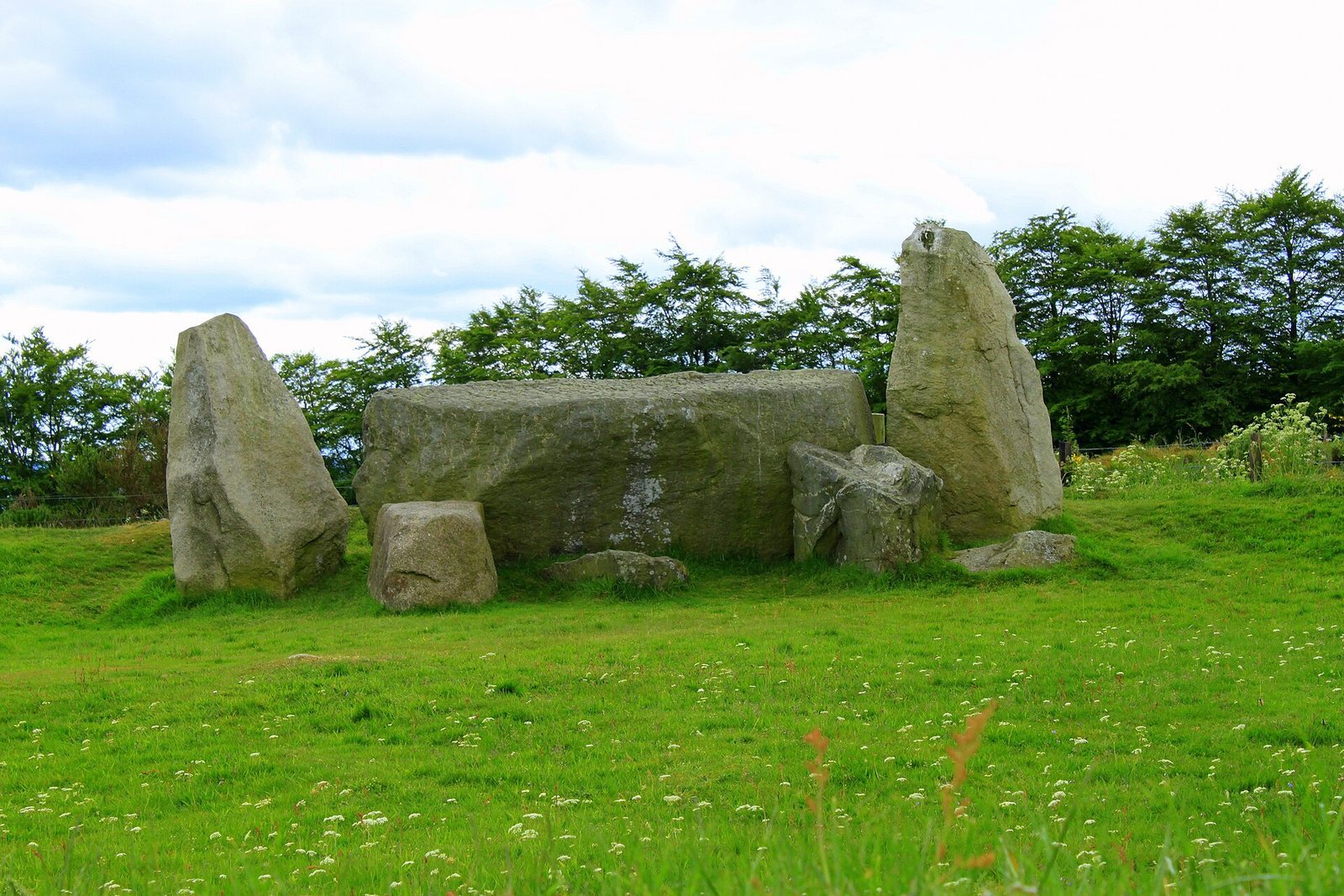
Easter Aquhorthies is a prehistoric recumbent stone circle near Inverurie in Aberdeenshire, Scotland, United Kingdom. This type of monument has a ring of standing stones, a large horizontal stone and two upright flankers. Its construction is broadly assigned to the Neolithic or Bronze Age. Proposed dates include 3000–2000 BC, while other estimates place it between 3,500 and 4,500 years old. Its precise age remains uncertain.
Origins and possible use
A burial may have been added at the centre during the Bronze Age, perhaps with a stone mound and a small stone-built burial chamber. The circle may also have had a religious purpose connected with the Moon. One theory links its arrangement to observing a lunar standstill, a recurring point in the Moon’s 18.6-year cycle when it reaches its farthest north or south in the sky. The name Aquhorthies may derive from a Scottish Gaelic expression meaning field of prayer, which could point to a long association with sacred use.
Landscaping and antiquarian interest
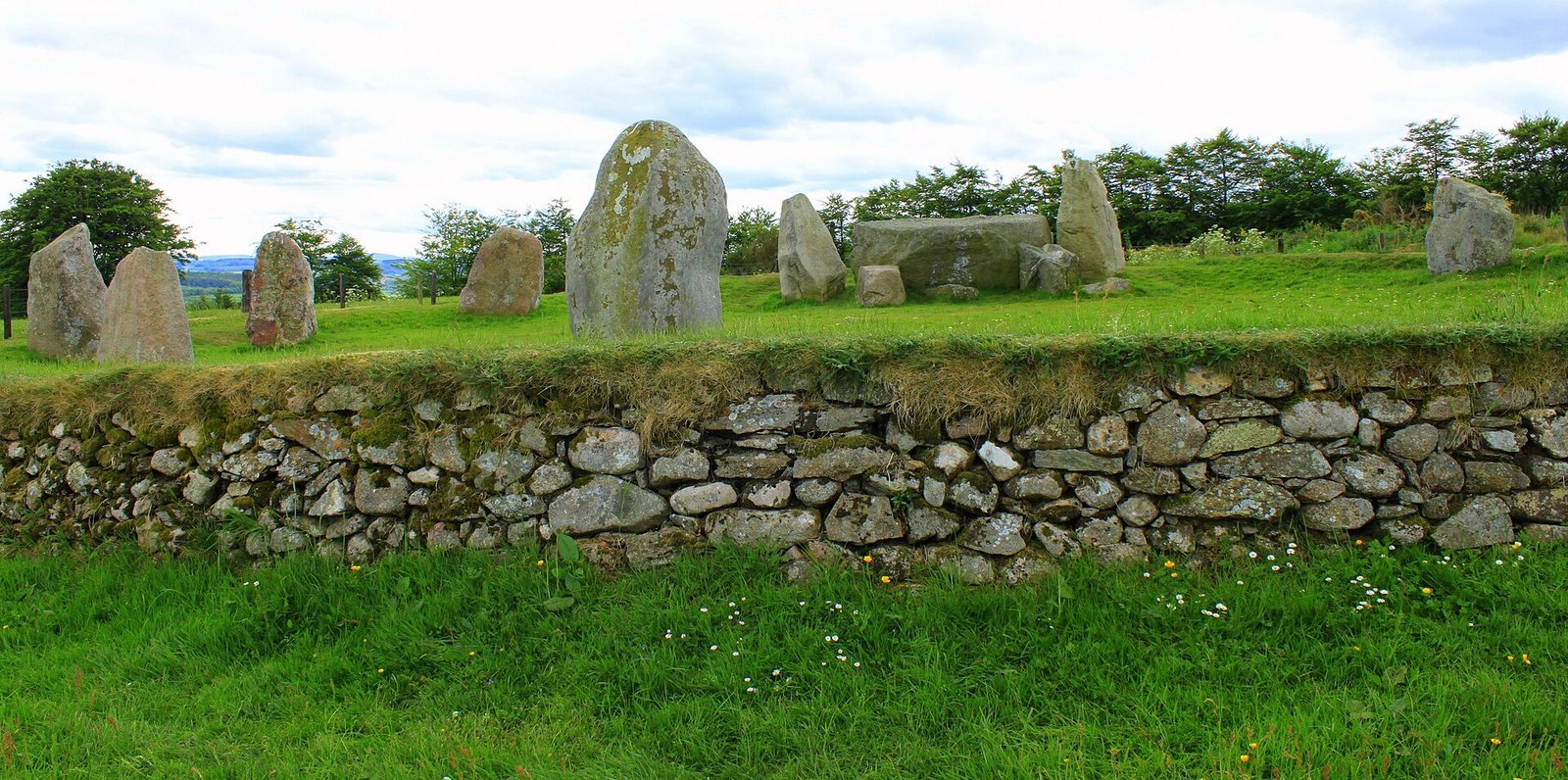
The circle’s surroundings were landscaped in the late nineteenth century. A stone enclosure called a roundel was built around it between 1847 and 1866–67. It is uncertain whether stones from a central cairn were reused in the enclosure. Paintings, drawings and descriptions brought the monument wider public attention during the 1870s and 1880s. Christian Maclagan produced a reconstruction resembling a broch, a type of prehistoric Scottish drystone tower. Augustus Pitt Rivers took an interest in the circle in 1884. Five years later, his assistants William Tomkin and Claude Gray measured, described and photographed it for a scale model, now held by The Salisbury Museum.
Surveys and conservation
A survey in 1900 described the circle as being in excellent condition. It became heavily overgrown in the early twentieth century, and in 1920 George Browne recorded whin bushes reaching head height. The monument was scheduled as an ancient monument in 1925 and placed in state guardianship in 1963. In 1985 its stones were cleaned to make casts for an Edinburgh exhibition, revealing previously unnoticed colour variations. Later investigation identified notable acoustic properties, though it remains unclear whether these existed before the central cairn was removed and the roundel built. A 1998 survey also found the circle well preserved. Historic Environment Scotland manages the site.
Remains
Setting and plan
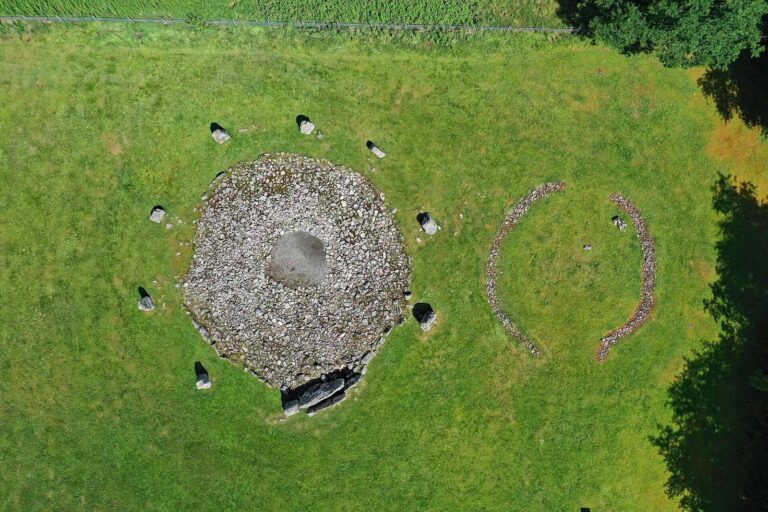
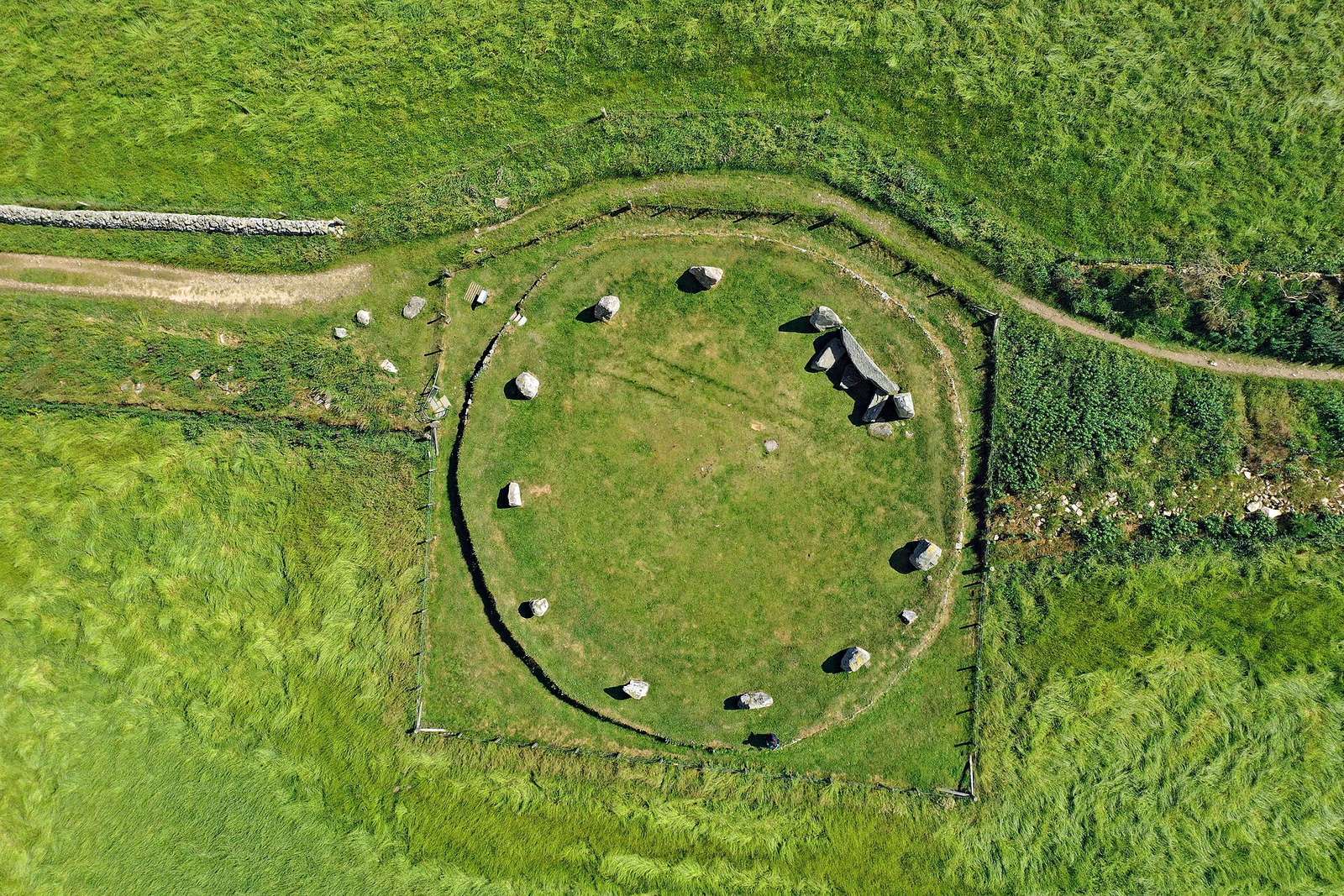
The circle stands on a gentle hillside about 4 km west of Inverurie, within a small fenced and walled enclosure. A stone roundel surrounds it. The arrangement comprises nine stones in the ring, two upright flankers and one recumbent stone, making twelve stones in total. The plan is slightly irregular, measuring about 19.5 m across, with dimensions of 18.4 m from west-northwest to east-southeast by 18.1 m on the other axis.
Stones and construction
Eight of the ring stones are pink porphyry, while the stone beside the eastern flanker is red jasper. Reddish stones occupy the south-southwest side of the circle, opposite grey stones. The flankers are grey granite; the recumbent stone is red granite flecked with crystals and crossed by quartz lines. Ring stones rise from about 1.1 m high on the north-northeast side to about 1.7 m near the flankers. The recumbent stone measures approximately 3.8 m long and 1.4 m high. Its upper surface has been smoothed and levelled, and its alignment corresponds with the southern moonset towards the nearby Hill of Fare. Two additional stones project into the circle at right angles to it.
Central features and preservation
Several stones show shaping: one is diamond-shaped, while another is roughly rectangular, with a block removed from an upper corner. A low mound about 25 cm high lies slightly off centre and may be the remains of a cairn. A possible small burial chamber has also been identified beneath a capstone. Easter Aquhorthies is among the best-preserved examples of its type, with its full complement of stones still standing in place and none re-erected.