Loanhead of Daviot Stone Circle: A Prehistoric Ceremonial Site
Site at a Glance
- Popularity
- Medium
- Country
- United Kingdom
- Primary era
- Bronze Age
- Eras represented
- Bronze Age
- Civilizations
- Unclassified
- Site type
- Religious
- Remains
- Sanctuary
On this page9 sections
History
Loanhead of Daviot stone circle is a prehistoric ceremonial site at Daviot in Aberdeenshire, Scotland, United Kingdom. It belongs to a type of stone circle centered on a large stone laid on its side, with an upright stone on either side. The circle’s construction date is uncertain, though the recumbent stone has been dated to the early Bronze Age, a prehistoric period marked by the widespread use of bronze. Ceremonial activity at the site is placed broadly between 3000 and 1500 BCE.
Prehistoric activity
The sequence in which the recumbent stone and central cairn were built remains unclear. The stone may have been set up before the cairn, or it may have belonged to the earliest features constructed at the site. A nearby cremation cemetery dates broadly to 2000-1000 BCE and may have begun as the circle fell out of use around 1500 BCE. Metalworking took place within the circle around 500 BCE.
Recording and restoration
Frederick Coles made the first detailed record of the circle in 1901, when the eastern flanker and four upright stones lay on the ground. He considered the two visible parts of the recumbent to have always been separate. In 1918, James Ritchie argued that it had once been a single block split in two and noted cupmarks, small hollows deliberately made in stone.
The circle became a scheduled monument in 1925, a status that gives an archaeological site legal protection in Scotland, and entered state guardianship in 1933. Excavations in 1934-1935, directed by archaeologist Howard Kilbride-Jones, substantially changed its appearance through restoration. In 1989, stones were taken from the center and the site was re-turfed.
Remains
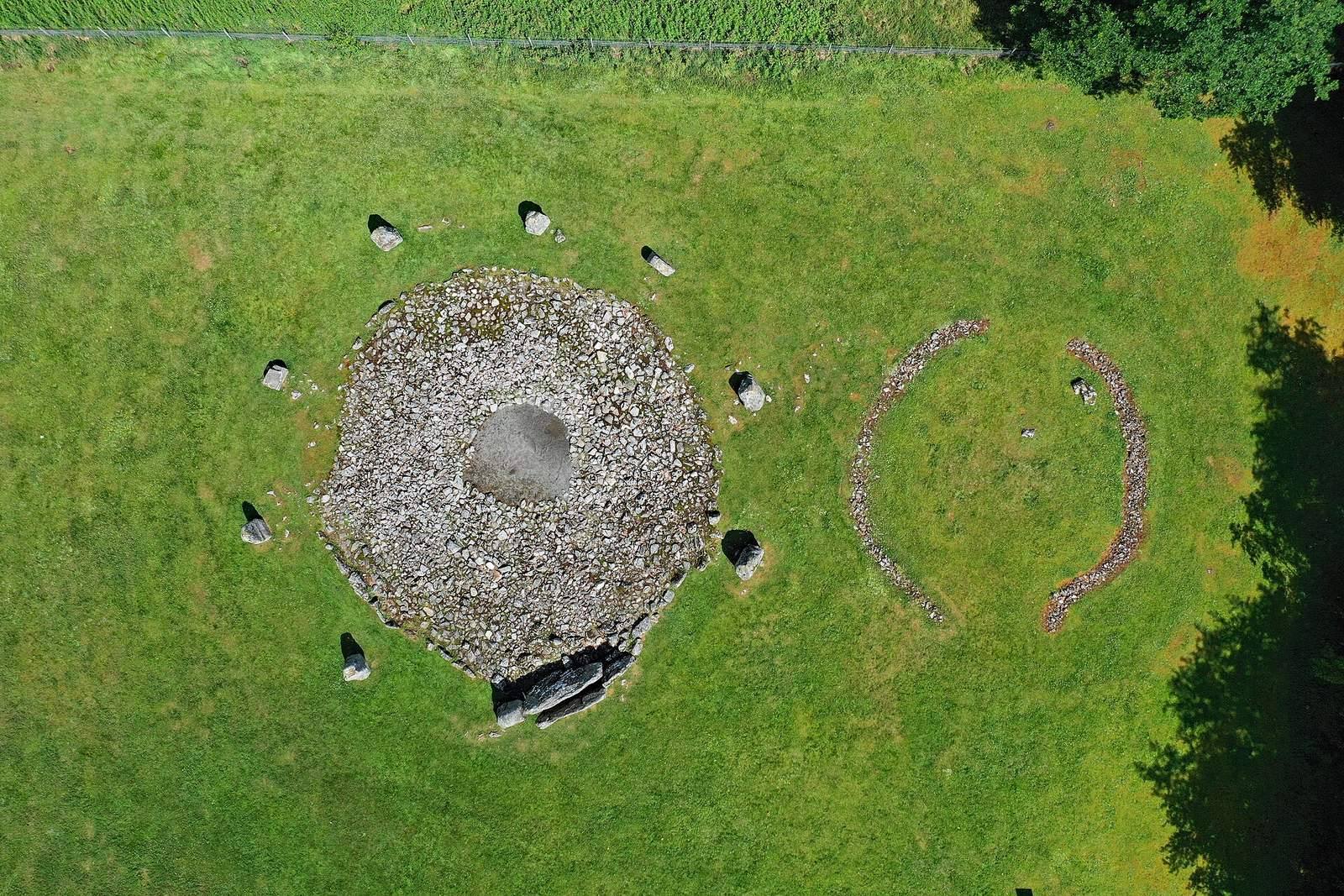
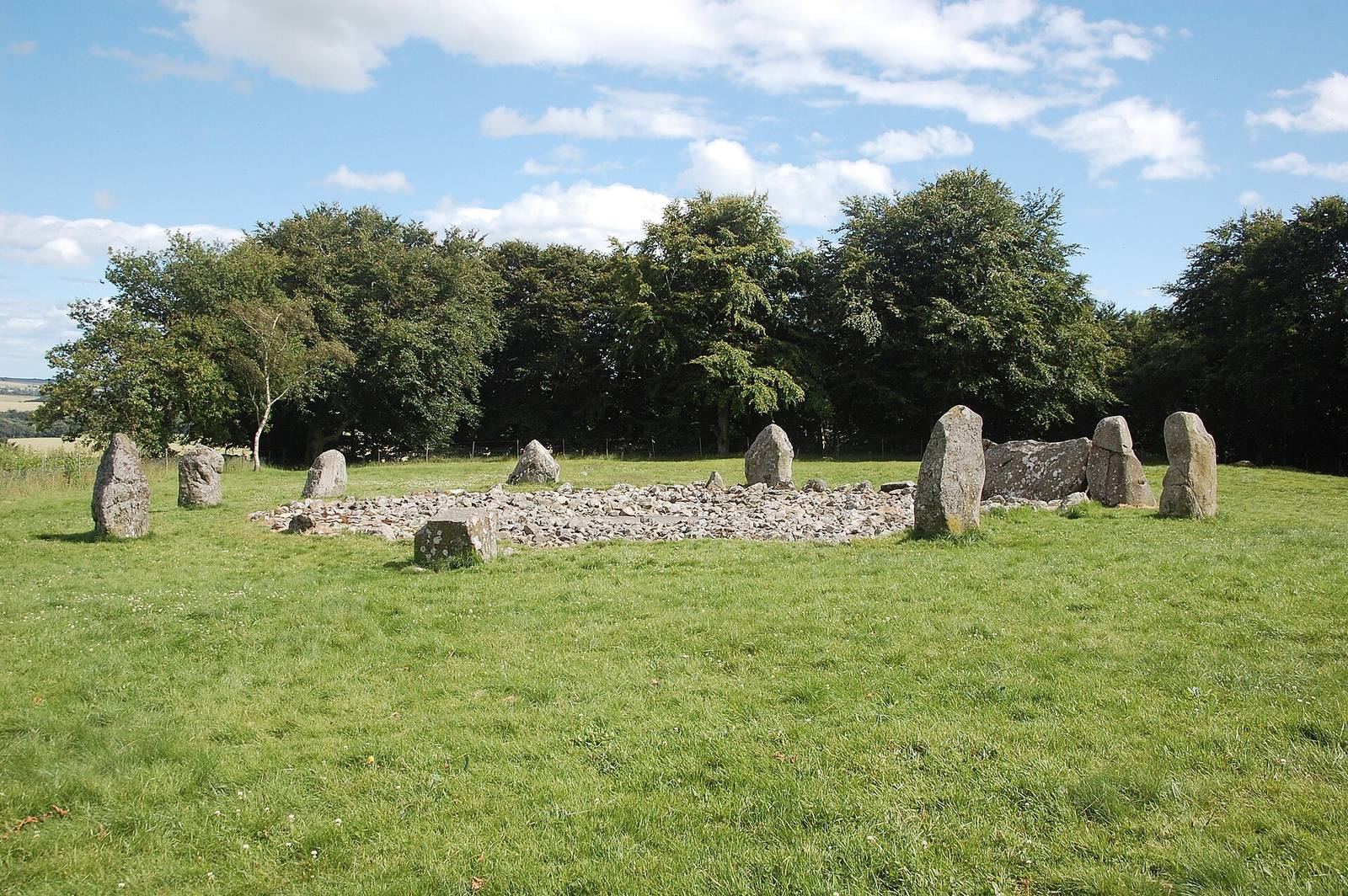
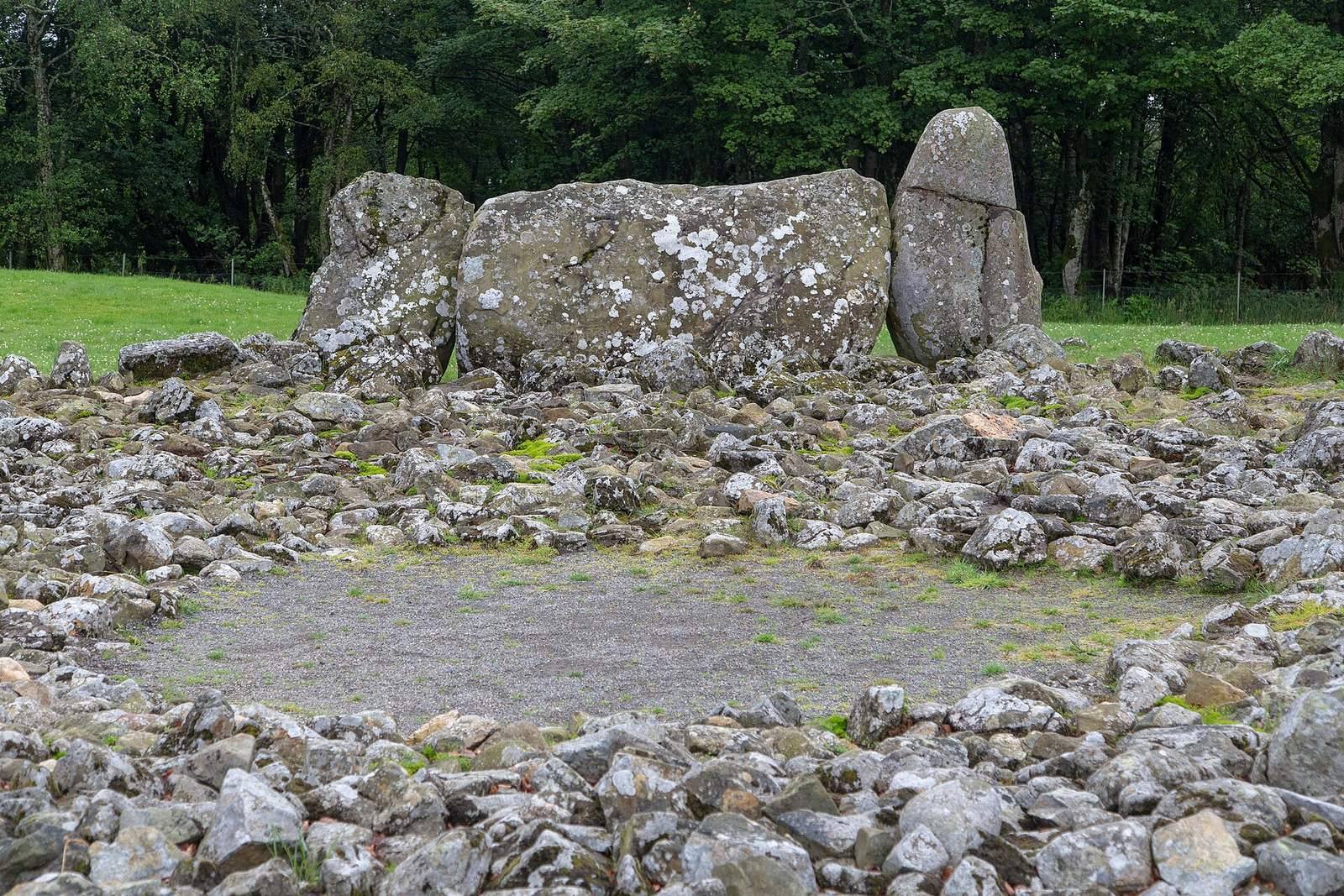
Built from granite, the circle is about 21 metres in diameter and stands on a ridge above Daviot. A reconstructed ring cairn, a circular stone structure edged by a kerb, occupies the center. The recumbent setting lies on the south-southwest side of the ring, while the cremation cemetery is east-southeast of the circle.
Stone circle
Recumbent stone and flankers
The recumbent stone angles slightly south and is split lengthwise along a natural weakness, giving it the appearance of two parallel slabs. It was originally about 3.4 metres long, and its taller inner slab is about 1.8 metres high. The stone weighs about 12 tonnes. It and its flankers stand on a raised base of boulders. Measurements place the setting’s direction from the circle’s center between 196 and 202 degrees.
The western flanker is about 2.26 metres high, making it the tallest stone in the circle; its top was replaced during the 1934-1935 restoration. The eastern flanker, about 1.73 metres high, was reset in its original socket after falling. One cupmark appears on its inner face just above ground level.
Upright stones
The eight upright stones, or orthostats, complete the circle. On the east, they decrease in height from south to north. The western stones are generally similar in height, although the sloping ground makes them appear to descend in sequence. The stone beside the eastern flanker bears 12 shallow cupmarks, and the next stone has two.
Central ring cairn
The roughly polygonal cairn measures about 16 metres across and stands up to 0.3 metres high. Its reconstructed state makes its original shape difficult to determine. Around the southern edge, 38 kerb stones increase in size toward the recumbent setting; behind that setting, the kerb forms a double line. A stone platform once extended beyond the kerb and upright stones, and a small portion remains visible. The cairn’s open central area forms a court about 4.3 metres across, though its original arrangement is uncertain. Kilbride-Jones interpreted the central feature as either an open court or a large pit; a pit is now considered the more likely explanation. Excavation recovered cremated human remains and more than 100 pottery fragments. Most are considered probably late Bronze Age, while the earliest belong to the Early Neolithic, or New Stone Age.
Cremation cemetery
The cemetery includes a low enclosure about 10 metres across, with two entrances opposite one another. It was first interpreted as a sunken stone wall and is now thought more likely to have been a timber structure, later burned and packed with stone. Successive funeral pyres and deposits represent at least 31 people, with remains placed in urns and pits. A small stone-built burial container, or cist, at the enclosure’s northern edge measured 0.56 by 0.32 metres internally. It held cremated bones and an incense cup, a small vessel associated with burning incense. A central pit contained partly cremated bones of a man and a stone pendant apparently associated with him. Smaller pits and urn burials also formed part of the cemetery.