Barra Castle: An L-Plan Tower House in Scotland

Site at a Glance
- Rating
- 4.5
- Popularity
- Very Low
- Country
- United Kingdom
- Primary era
- Early Modern
- External website
- Open
- Eras represented
- Early Modern
- Civilizations
- Kingdom of Scotland
- Site type
- Military
- Remains
- Castle
On this page9 sections
History
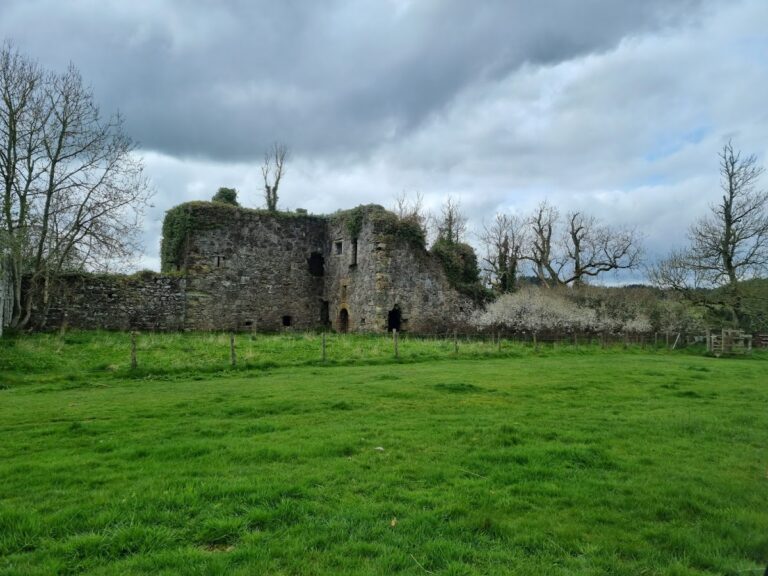
Barra Castle is an unusual L-plan tower house in Scotland, United Kingdom, standing above the Lochter Burn in Bourtie, near Oldmeldrum. Its present form dates principally from the early 16th century, although the site had been occupied by a castle since the mid-13th century. The building reflects several centuries of aristocratic ownership, legal development, domestic alteration, and reuse.
Medieval origins and conflict
By the mid-13th century, Barra was the seat of the King family. An earlier castle associated with Blackhall may have been incorporated into the present main block and south-eastern wing. Blackhall held the hereditary offices of Forester and Coroner of the Garioch, administrative and judicial positions connected with the district.
Barra was also the scene of a battle in 1308. Robert the Bruce, the Scottish king who led the Scottish cause during the Wars of Scottish Independence, defeated John Comyn, Earl of Buchan, a major nobleman who opposed Bruce.
Seton and the barony
The current form of the castle is attributed mainly to George Seton. Seton was chancellor of the University of Aberdeen, tutor of Meldrum, and Vicar of Meldrum. He received the estate in 1598, and a charter issued in 1599 raised the lands of Barra into a free barony, a feudal estate with baronial status and associated jurisdiction. A second charter, granted in 1615, designated the fortalice of Barra as the barony’s chief seat.
The Reid and Ramsay estates
James Reid, an advocate from Aberdeen, possessed Barra by 1630, and the Reid family retained the estate until 1754. Dame Margaret Abercrombie, the wife of John Reid, who became a baronet in 1703, refitted parts of the house and may have been responsible for the fireplace in the Great Hall.
John Ramsay of Melrose, a merchant engaged in trade with Russia, purchased the estate in 1754 and added the north wing. Ramsay preferred his estate at Straloch, and after his death in 1787 Barra Castle was used as a farmhouse. His descendants continued to own the property. In the early 20th century, a Ramsay heiress married Andrew Irvine of the Irvines of Drum.
Restoration and protection
During the first decade of the 20th century, the castle was restored as a dower house, a residence provided for a widow after her husband’s death, to plans by George Bennet Mitchell. Barra Castle is now designated a Category A listed building in Scotland, the highest level of statutory listing for buildings of special architectural or historic interest in the country.
Remains
Plan and exterior
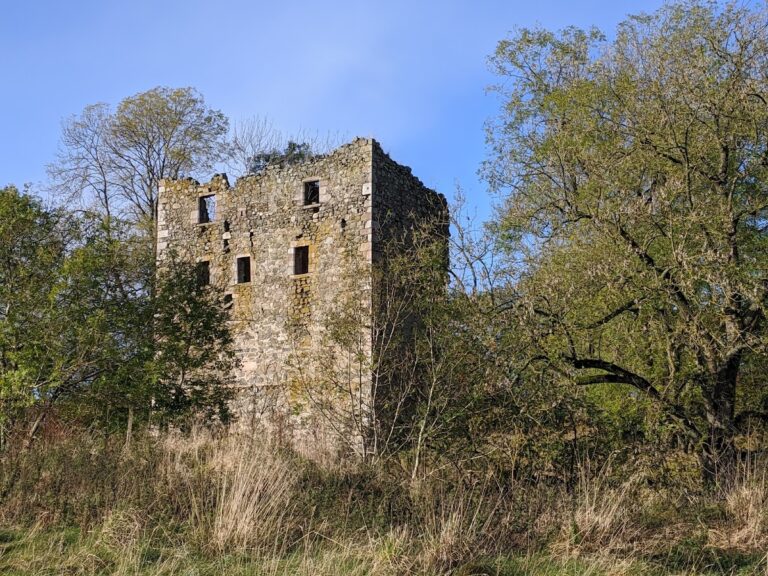
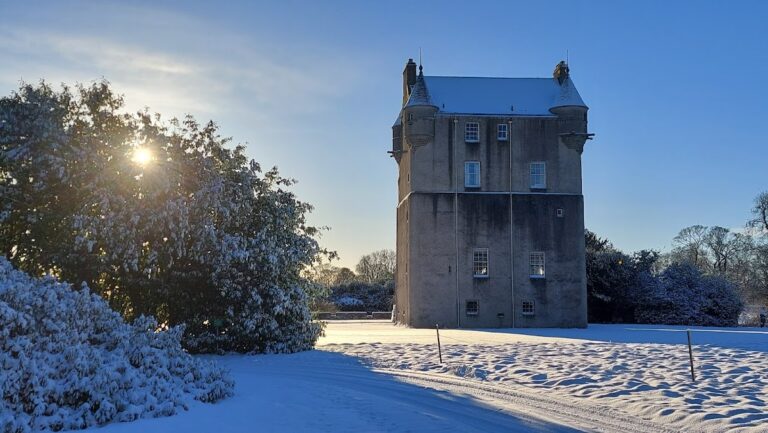
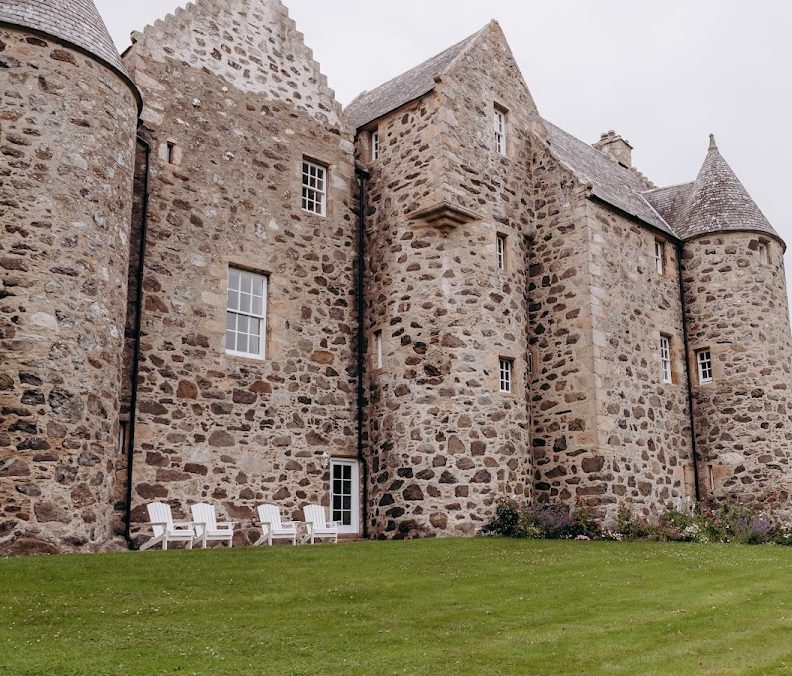
Barra Castle stands above the Lochter Burn and has an unusual variation of the L-plan, with its main block extending from north to south. A circular tower occupies the south-west corner. At the south-east is a D-plan tower, formed by a straight side joined to a curved outer wall, which contains the principal staircase and entrance. The tower projects through successive courses of masonry to become square at the top, creating a watch room, or elevated lookout space, and connects with a large square wing.
A second circular tower marks the north-west angle of the large wing. The entrance lies in the principal re-entrant angle, where the two main ranges meet, and the towers carry conical roofs. An 18th-century addition extends eastward from the northern end of the main block. An eastern wall containing the entrance completes the fourth side of a square courtyard.
The buildings surrounding the courtyard are three storeys high and built of pinned boulder rubble. Their principal gables have crow-stepped profiles, with stepped lines along the slopes, a characteristic feature of Scottish architecture.
Interior features
The panelled drawing room contains a large chimneypiece, a decorated fireplace surround, into which a later chimneypiece was inserted. The first-floor bedroom in the south-eastern wing has panelling from the early or middle part of the 18th century. The north wing contains a panelled sitting room.
Objects and artistic views
The Hunterian Museum and Art Gallery in Glasgow holds a hammerstone from Barra Castle, a stone tool used for striking, pounding, or flaking other materials. Aberdeen Art Gallery holds two paintings of the castle interior by James Cassie, The Kitchen of Barra Castle, Aberdeenshire and On the Terrace, Barra Castle, Aberdeenshire.
Nearby sites