Dynge Castle: A Medieval Fortification in Sweden


Site at a Glance
- Rating
- 4.2
- Popularity
- Very Low
- Country
- Sweden
- Primary era
- Medieval
- External website
- Open
- Eras represented
- Medieval
- Civilizations
- Norwegian
- Site type
- Military
- Remains
- Castle
On this page4 sections
History
Dynge Castle is a medieval ruin in Uddevalla Municipality, Sweden, built around 1250 when Bohuslän was under Norwegian rule. Formerly known as Dyngehus, it remained in use until the beginning of the sixteenth century, when a fire destroyed the castle. It is one of the few surviving medieval structures in the municipality, together with Dragsmark Abbey and Bokenäs Old Church.
Medieval fortress
The castle occupied a defensible position in central Bohuslän and formed part of the region’s medieval landscape during the period of Norwegian rule. Its use continued for roughly two and a half centuries before the destructive fire brought its active history to an end.
Excavation and interpretation
Wilhelm Berg excavated Dynge Castle in 1912 and 1913. Berg was a Swedish archaeologist and antiquarian who served as secretary of the Gothenburg and Bohuslän Antiquities Association. His earlier work included excavations at the contemporary Ragnhildsholmen fortification at Kungahälla during the 1880s and at Olsborg in Tanum.
Remains
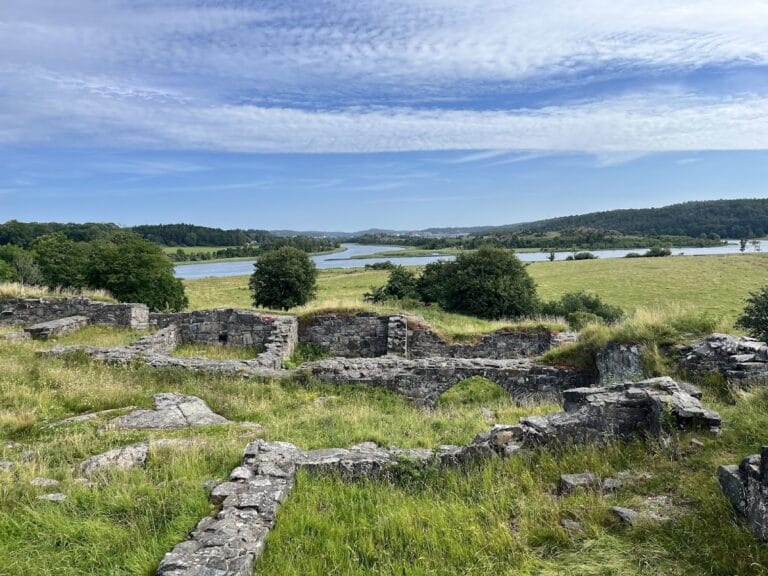
Dynge Castle had a form resembling a motte-and-bailey, a medieval arrangement with a fortified mound and an adjoining enclosed courtyard. Its principal building was a stone keep, meaning the castle’s main fortified tower or strong central structure. The keep stood on a cliff overlooking Gullmarsfjorden, while a small moat surrounded or protected the stronghold.
The foundations of the central keep’s walls remain clearly visible. The moat also survives, allowing the main defensive arrangement of the ruined castle to be identified in the landscape.