Rock Carvings in Tanum: Bronze Age Rock Art in Sweden
Site at a Glance
- Country
- Sweden
- Primary era
- Bronze Age
- Eras represented
- Bronze Age, Iron Age
- Civilizations
- Unclassified
- Site type
- Civic
- Remains
- Rock Art
On this page17 sections
History
The Rock Carvings in Tanum are a concentration of prehistoric images carved into rock in Tanum, Sweden, made principally during the Scandinavian Bronze Age, about 1800–500 BC. Carving continued into the Iron Age, and the area’s exceptional concentration of rock art later led to its inscription on UNESCO’s World Heritage List in 1994.
Communities and beliefs
The communities associated with Vitlycke depended on farming and animal husbandry, alongside fishing with nets, hunting with bows and traps, and gathering berries and fruit. They kept cattle, sheep, goats, pigs, dogs, and horses. Most tools were made from wood, bone, and stone. Bronze, an imported alloy of copper and tin, was used mainly for weapons and ornaments.
Weapons, ornaments, grain, livestock, carts, and ploughs were offered in lakes and waterways. Offerings by fire are considered possible, as are human sacrifices during the early Iron Age. Local beliefs appear to have included separate deities linked with the sun, sea, and fertility. Interpretations of particular carved scenes and symbols remain disputed.
Burial practices changed during the Bronze Age, as large burial mounds on hilltops came to be used for single people. This change has been interpreted as a sign that power was becoming concentrated in individuals or families. The end of carving may have followed changes in religious belief and the introduction of new deities.
Carving chronology and study
Carving was most prolific during the Bronze Age, but some images belong to the Iron Age. The carvings at Fossum date to about 700–600 BC. Figures at Vitlycke holding square shields are thought to be no earlier than about 300 BC.
The first known copies were made by Peder Alfsön in 1627. In 1792, antiquary Carl Gustaf Gottfried Hilfeling made ink drawings for Pehr Tham, a nobleman; one depicted a figure called a giant warrior. From 1815 to 1817, Carl Georg Brunius used a grid to make drawings of more than 100 panels. His book appeared after his death in 1869 and included 15 of those drawings. Axel Emanuel Holmberg’s 1848 book also presented some carvings from Vitlycke.
Danish draughtsman Lauritz Baltzer published two volumes on Bohuslän’s rock art, in 1881–1891 and 1891–1908, reproducing 248 figures. Debate over the carvings’ age continued through the nineteenth century. In its later decades, Oscar Montelius and Viktor Rydberg advanced arguments for a Bronze Age date. Early twentieth-century study increasingly considered the images’ meaning, while research in the late twentieth century supported their Bronze Age dating.
UNESCO inscribed the area in 1994 under criteria recognizing creative achievement, testimony to a cultural tradition, and an outstanding example of a landscape illustrating a stage in human history.
Remains
The World Heritage area contains thousands of images on about 600 panels, concentrated in distinct places along a stretch of roughly 25 km. The carved surfaces cover about 51 hectares. The images were pecked into flat granite or quartzite with hard stone hammers. On the naturally smoothed rock, the pale marks stand out against the darker surface. The carvings were made when the area was coastal. About 3,000 years ago, the sea stood roughly 25 m higher than it does today, and subsequent land rise changed the shoreline. The climate was comparable to that of present-day southern France, with oak, elm, ash, and lime forests.
Vitlycke
Main panel and surrounding groups
At Vitlycke, about 2 km south of Tanumshede, seven groups of carvings extend across the site. The main panel is inclined about 30–35 degrees from horizontal and measures roughly 7 m high by 22 m wide. It contains more than 400 images and symbols, including about 250 figures and 165 cup marks. Six smaller, more weathered groups lie farther south, across a total distance of about 500 m. The second group includes an unusual boat with a curved deck. The fourth shows long-necked birds, possibly cranes, being hunted by a man raising an axe.
Boats
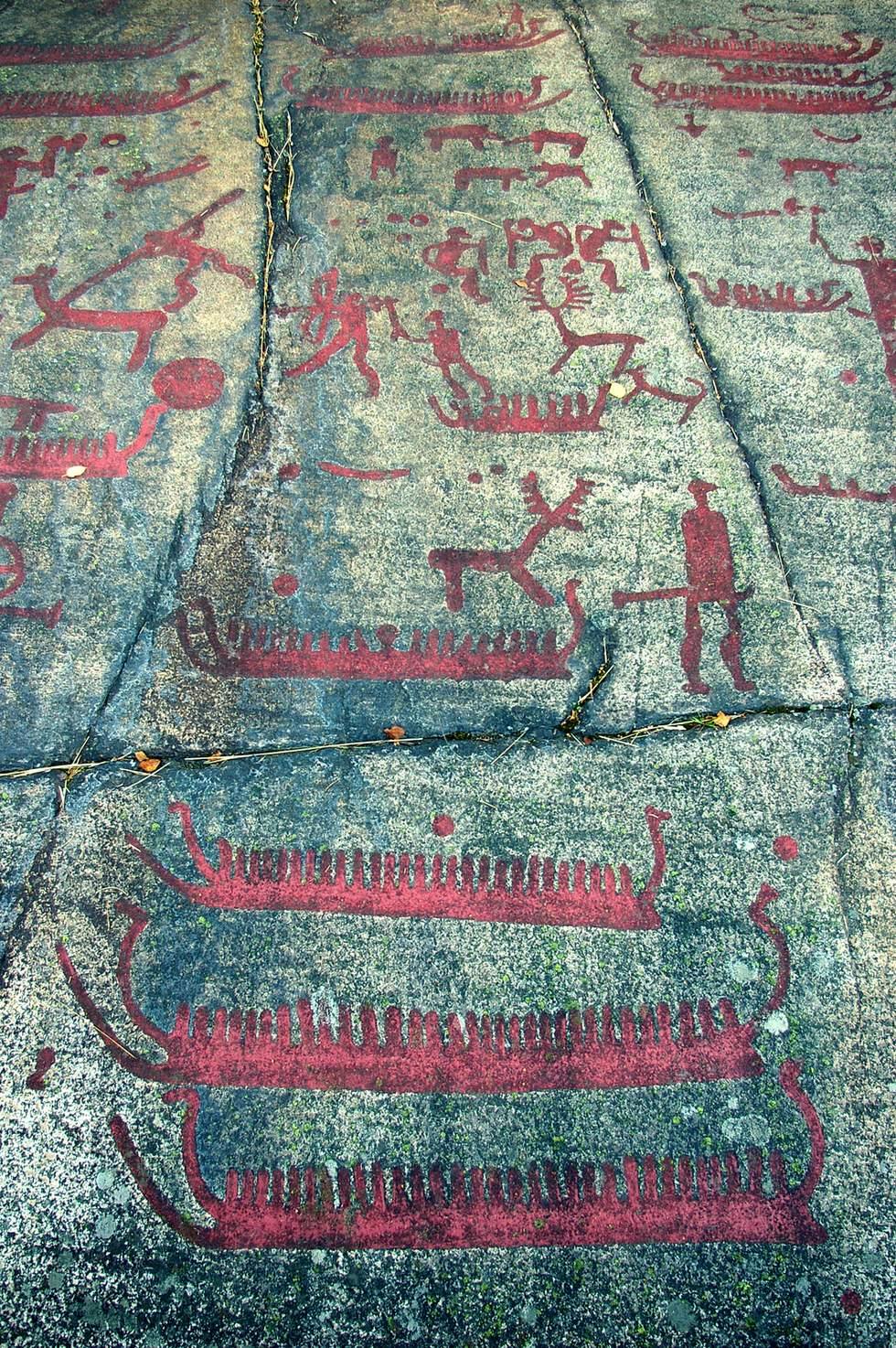
About 90 boats appear on Vitlycke’s main panel, ranging from roughly 15 cm to 3.6 m long. Crews are usually shown as short upright strokes, sometimes with cup-shaped heads, while oars are not depicted. Small craft may represent dugout logs, and larger vessels may have been covered with hides, with strokes or crosses indicating joins. Some resemble Hjortspring-type boats, an early Scandinavian plank-built vessel known from a find in Denmark, and may have carried about a dozen people. Some large boat-shaped images have also been interpreted as sledges.
A boat in the sixth group has one standing figure holding a curved object above his head and six others kneeling or crouching, their hands raised and objects in their grasp.
Cup marks and solar images
Small circular hollows called cup marks occur on most of the rocks. They are about 2–5 cm across and roughly 1 cm deep. Vitlycke’s main panel has about 165; on its right side, 68 form a line about 7 m long.
About a dozen images at Vitlycke combine a circle and a cross, a form often interpreted as solar imagery. These appear alongside cup marks, people, and boats. One larger-than-usual human figure near the long line of cup marks has concentric circles at the stomach; the bodies of two others are formed from solar crosses. Another figure holds a disk that may represent the sun or a drum. A small disk surrounded by four branching forms has been read either as the sun with rays or as the earth with plants. The connection between these images and a solar cult, and the importance of such a cult to the carvings as a whole, remain contested.
Human figures and scenes
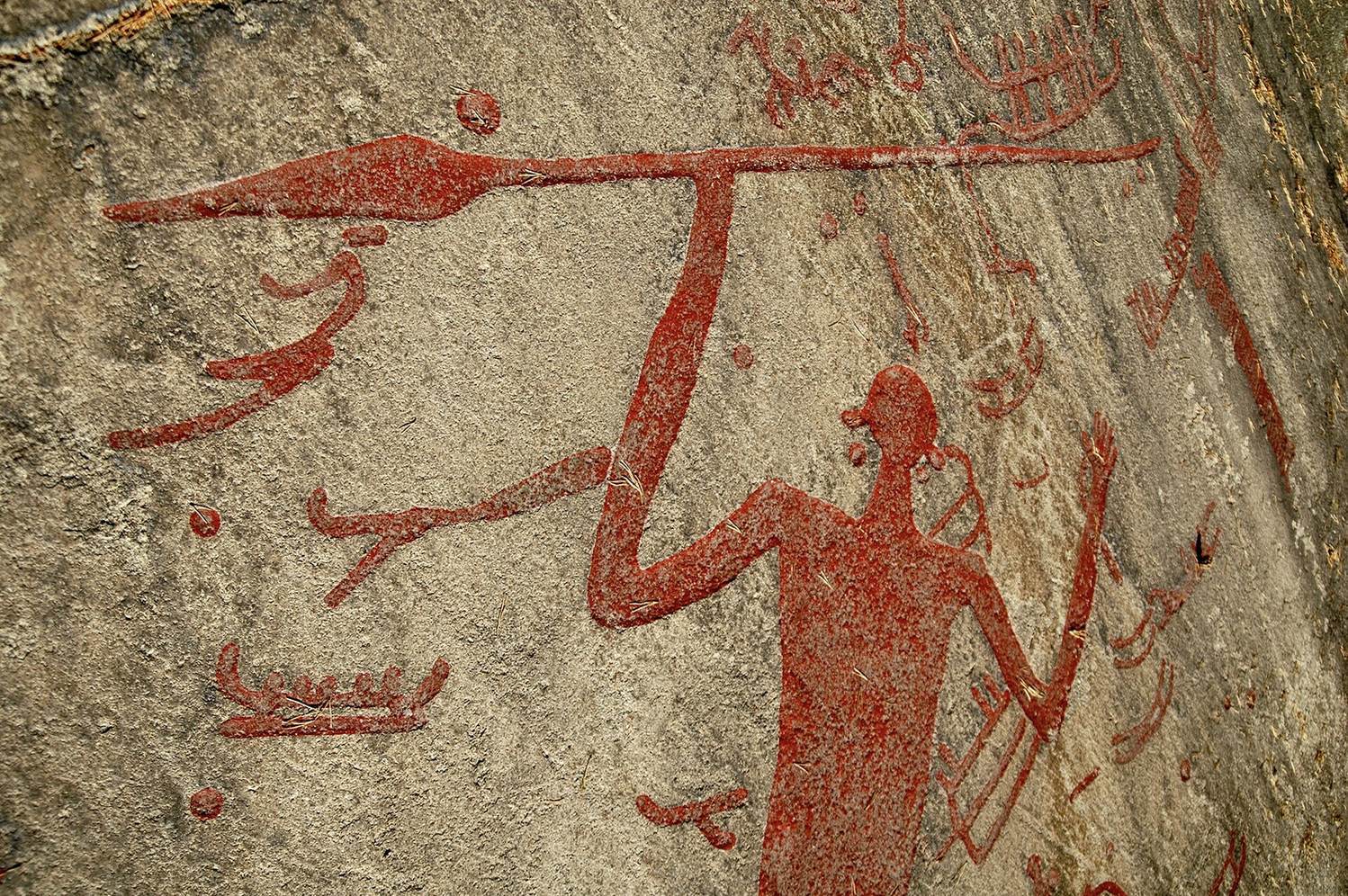
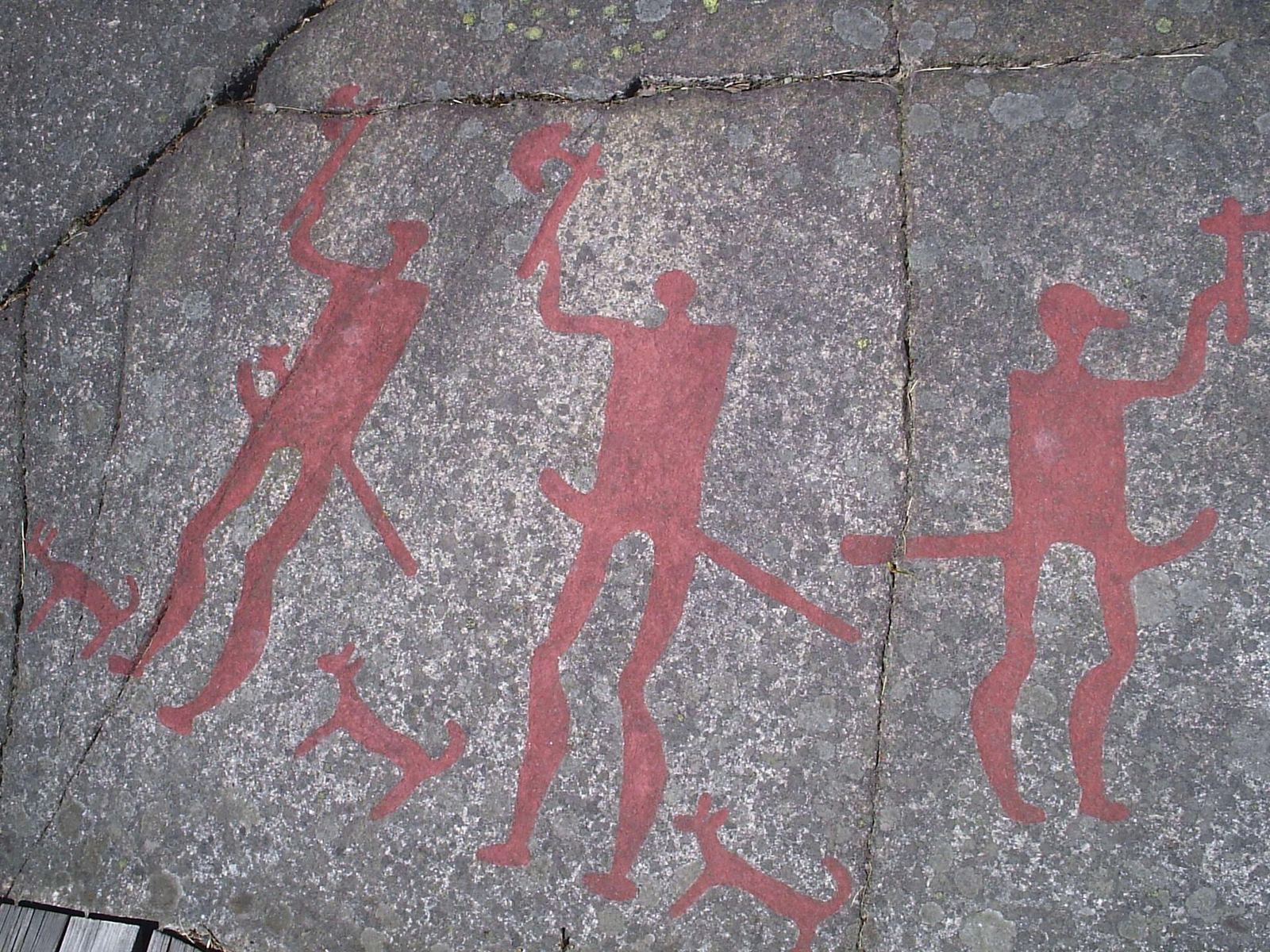
More than 50 human figures appear at Vitlycke. One, with arms stretched horizontally, is 4.5 m long and may depict a priest. Many figures raise their hands; others carry swords, spears, bows, or axes. Some have elongated phallic forms, prominent chins, horns, or other head adornments. Two figures can be identified as female by their braids or fuller hair. One, with bent knees, resembles figures with raised hands shown aboard boats.
A scene often called the young married couple shows a man embracing a long-haired woman. Beside them stands a figure twice their size, raising an axe. The larger figure may be a deity associated with thunder or lightning. The scene has also been interpreted as a ritual marriage and as the symbolic fertilization of a mother goddess.
In another scene, a kneeling woman leans over a sword-bearing man whose feet touch a boat. One interpretation sees mourning for a dead fertility deity, with the boat departing in autumn and returning in triumph in spring. Seven smaller figures with raised hands before a much larger figure may represent that return and the deity, or its cult representative. A struggle near the top of the panel, on either side of the cup-mark line, may be ritual rather than a real fight and has been read as a contest between representatives of summer and winter.
Animals and related motifs
About a dozen animals are carved at Vitlycke, though many are hard to identify. Two small deer are recognizable; other images include four-legged animals often interpreted as dogs or horses, a horned animal that may be a cow or ox, and a whale. Some occur alongside people. One scene places an ox and a man above a circle, while another appears to show a man leading an animal. A mounted figure is rendered as a vertical stroke, like some passengers aboard the boats.
One carving shows a horse harnessed to a cart driven by a horned figure, possibly a deity or cult representative, with a snake in front of the figure’s sexual organ. The cart has been interpreted as a ritual vehicle meant to imitate thunder and call for fertilizing rain. At the lower right of the main panel, a figure with raised arms faces a snake, a composition associated with fertility.
Burial mounds and reconstructed features
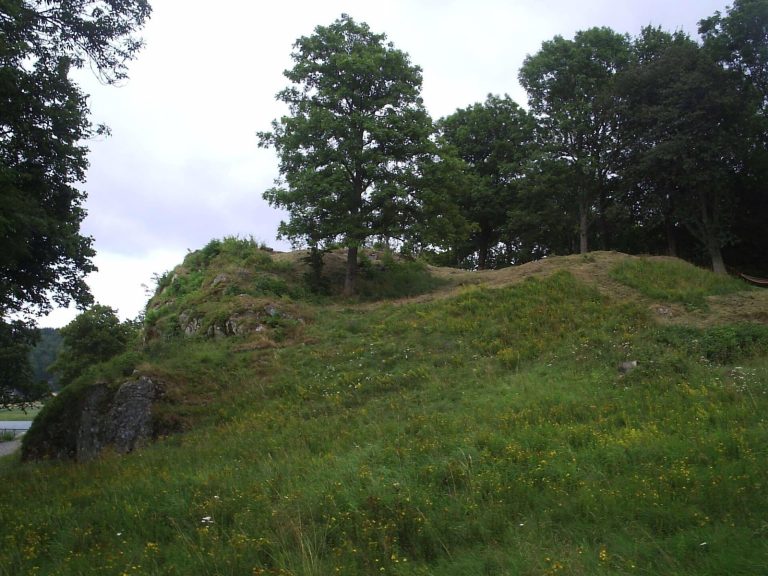
Two stone-built burial mounds stand on higher ground at Vitlycke. The site also includes a museum devoted to the carvings and a reconstructed farm representing the period.
Other carving areas
Aspeberget
Aspeberget lies about 1 km south of Vitlycke. Its carvings include herds and herders, an archer, a ploughman, and a cart. One image shows a person working a plough drawn by two oxen and holding an object that may be a branch or a goad made from strips of hide.
Litsleby
About 1 km southwest of Aspeberget, Litsleby has cup marks, footprints, and human and animal figures. Its carving of a man carrying a sword and spear stands more than 2 m tall and is described as the largest identified human figure of its period.
Tegneby
Tegneby lies about 100 m from Litsleby and includes an image of a man mounted on horses.
Fossum
Fossum, about 3 km northeast of Tanum, has roughly 200 carvings, including numerous boats and people carrying swords and axes.
Footprints and preservation
Footprint carvings show either the outline of a foot, sometimes crossed by a line that may represent a sandal or shoe strap, or a complete foot with toes, probably bare. They have been interpreted as divine footprints and signs of protection, and have also been connected with beliefs about the dead. Most carvings have been painted red since the 1950s to make them easier to see, though it is unknown whether they were colored originally. The painting practice has drawn criticism for changing the carvings’ authenticity. Acid rain erodes the rock, and some carvings are covered permanently or during parts of the year.