Västerlanda Church: A Medieval Parish Church in Sweden
Site at a Glance
- Country
- Sweden
- Primary era
- Medieval
- Eras represented
- Medieval, Early Modern, Modern
- Civilizations
- Norwegian, Swedish
- Site type
- Religious
- Remains
- Church
On this page9 sections
History
Västerlanda Church is a Romanesque church built in the thirteenth century in Kyrkeby, Lilla Edet Municipality, Sweden. It belongs to Västerlanda Parish in the Church of Sweden and is now part of the Diocese of Gothenburg, a territorial administrative area of a church. Its earlier affiliation was with the Diocese of Oslo until 1658, the year of the Treaty of Roskilde, a settlement between Denmark-Norway and Sweden.
Expansion and religious customs
The original church had a nave and a narrower, lower chancel. In 1671, the building was extended seven metres to the west. An eastward extension followed in 1704, when the old chancel was demolished and replaced by one with a three-sided end.
Long after the Reformation, the movement that brought about the establishment of Protestant churches in Europe, people continued to celebrate the feast of Saint Olaf at a spring named for Olaf II Haraldsson, a Norwegian king later venerated as a saint. The spring lies just under 10 kilometres south of the church and two kilometres west of Lödöse. The celebration was banned in 1690. The stated reason was that large gatherings, including people travelling from as far as Halland, were associated with disorderly conduct.
Christian von Schönfeldt painted the church ceiling between 1728 and 1733. The paintings were lost around 1809, when the interior ceiling was replaced. A western porch and another on the south side are believed to have stood during the eighteenth century; both were removed during the rebuilding of 1896–1897.
Rebuilding and later restoration
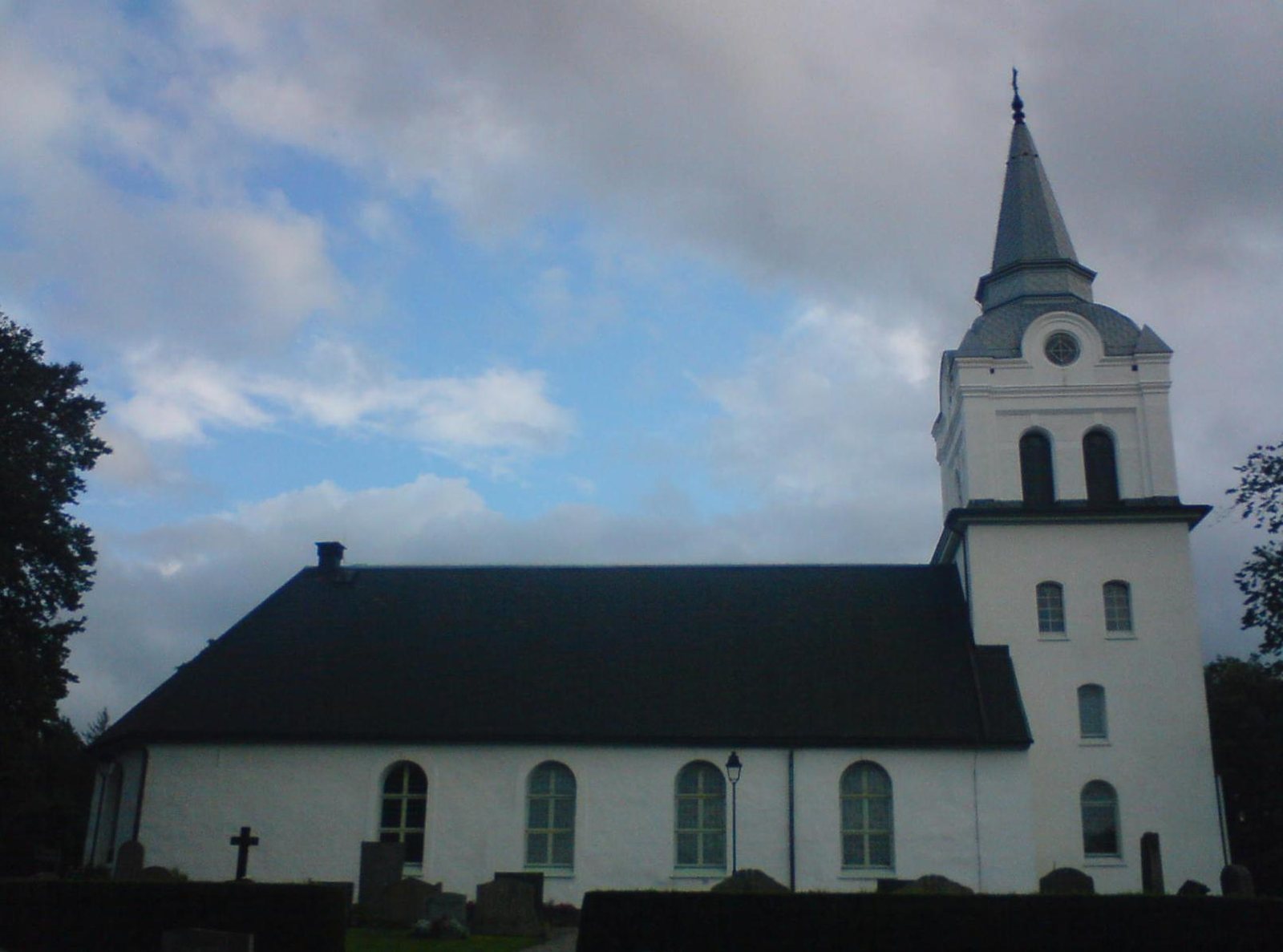
The 1896–1897 rebuilding added a tower at the west end. Workers demolished the nave’s west wall and rebuilt it in brick, joined to the tower. They enlarged existing windows and added three more. The interior was also altered: wooden panelling covered the walls, the barrel-vaulted wooden ceiling was divided into coffers, and the old pews were replaced.
Electric lighting was installed around 1932. A renovation in 1954–1955 sought to recover parts of the interior’s pre-1896 appearance. It removed the wall panelling and ceiling coffers and made further changes to the church interior. In 2002, the tower was replastered and painted, and its metal roof was relaid with decayed sections replaced.
Remains
Building
The church’s nave extends to a three-sided eastern end, while a tower is attached at the west. The building is constructed of brick and stone, with a plastered exterior. The nave roof is a slate-covered gable; the tower’s spire has zinc-sheet cladding with a scale pattern. Inside, a partition at the chancel separates the sacristy and vestment room from the church. The chancel’s south window and the open pews date from the 1954–1955 renovation.
Furnishings and organ
Baptismal font
The sandstone baptismal font dates to the mid-thirteenth century and is made in two parts. It stands 84 centimetres high. Its hemispherical bowl has a rope-like molding near its base, a short stem, and a noticeable hollow near the rim. Beneath the hollow, a 13-centimetre band carries a ring-chain pattern. The round, cone-shaped foot is unornamented and made of stone slightly lighter in colour than the bowl. A drainage hole runs through the centre, and the font is cracked.
Altarpiece and pulpit
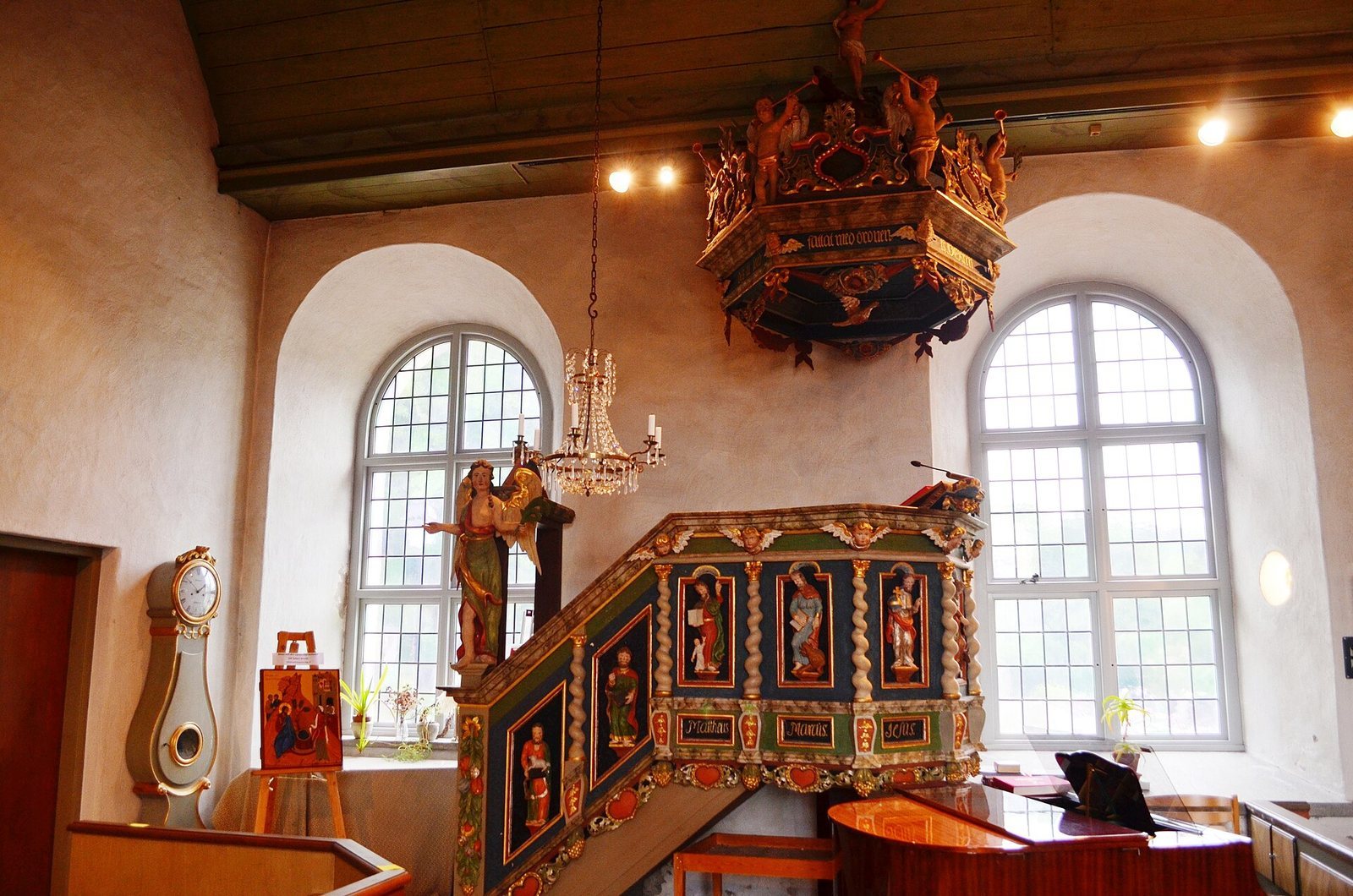
Marcus Jäger the Elder made the altarpiece in 1704. Its predella, the lower section beneath the main panel, was renovated by Teodor Wallström in 1918. The altarpiece and pulpit were repainted during the 1896–1897 rebuilding, and earlier paintwork was uncovered in 1954–1955. Michael Schmidt made the pulpit, which the church acquired in 1751.
Organ
Johannes Magnusson built the church’s first organ in 1896, and its façade survives. In 1971, a new instrument made by the Grönvalls organ-building workshop was installed, incorporating older pipework. It has 16 stops, sets of pipes producing different tones, played through two hand keyboards and a foot keyboard.