Wasserschloss Mitwitz: A Renaissance Water Castle in Germany



Site at a Glance
- Rating
- 4.5
- Popularity
- Medium
- Country
- Germany
- Primary era
- Early Modern
- External website
- Open
- Eras represented
- Medieval, Early Modern
- Civilizations
- Holy Roman Empire
- Site type
- Military
- Remains
- Castle
On this page11 sections
History
Medieval origins and noble ownership
Wasserschloss Mitwitz is a Renaissance water castle in Germany, with origins documented in 1266. At that time, it was held as a Bamberg fief, an estate granted by the prince-bishopric of Bamberg in return for service and allegiance, by the von Schaumberg barons. The lower storeys of the north wing and the northern corner tower already formed part of the complex.
In 1425, the knightly von Rosenau family acquired the castle. The family held extensive estates in the surrounding area, and its descendants later formed a Coburg family of mint masters. They subsequently became owners of both the castle and the village of Mitwitz.
Destruction and Renaissance rebuilding
During the German Peasants’ War, a widespread uprising of 1525, the castle was plundered and partly destroyed by fire. Only makeshift repairs followed until Hieronymus von Würtzburg acquired the property in 1575.
At the end of the sixteenth century, Hans Veit I von Würtzburg commissioned the master builder Daniel Engelhardt to rebuild the castle and enlarge it into its present external form. This work created the Renaissance character of the complex. Engelhardt had previously planned the expansion of Rosenberg Fortress in Kronach.
Ownership and modern uses
The castle remained with the von Würtzburg barons until Ludwig Freiherr von Würtzburg died in 1922. Ownership had already begun to pass to the Cramer-Klett family through the 1903 marriage of his daughter Annie von Würtzburg to Theodor von Cramer-Klett junior, the son of industrialist Theodor von Cramer-Klett.
At the end of the Second World War, the Frankfurt City Library was relocated to Wasserschloss Mitwitz. Between 1977 and 1989, Kronach District renovated the castle and received a 99-year right of use in return. The complex now houses the Upper Franconian Ecological Education Centre and the Upper Franconian Beekeeping School, including a small beekeeping museum. A purchase contract signed in December 2019 transferred the castle from the Cramer-Klett family to Kronach District at the beginning of 2020.
Remains
Moated castle complex
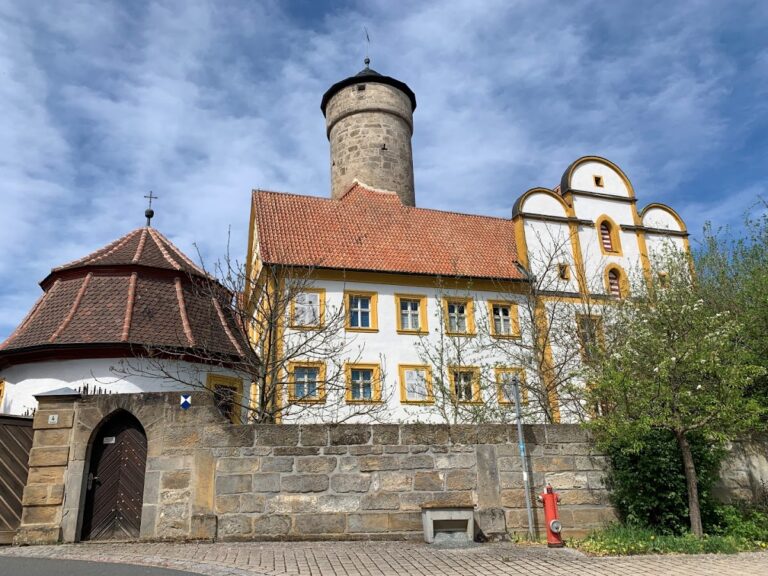
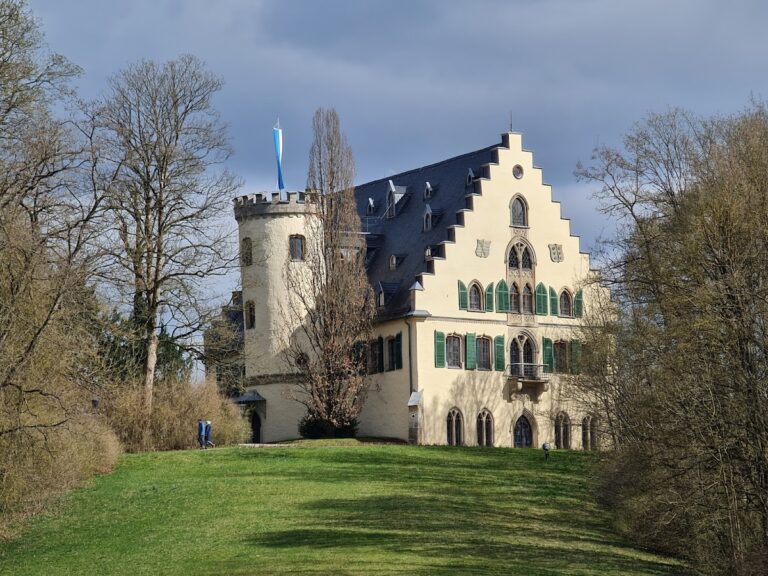
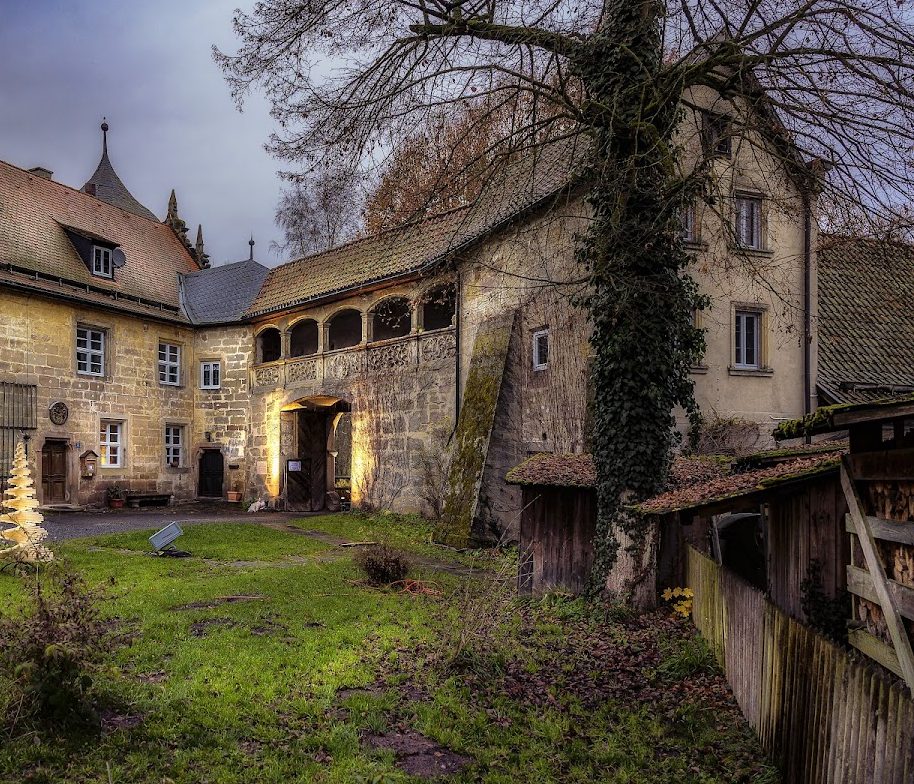
Wasserschloss Mitwitz is enclosed by a moat and arranged as a three-storey, four-wing complex with gabled roofs and four corner towers. The lower levels of the north wing and the northern corner tower belong to the medieval structure known from 1266, while the late-sixteenth-century rebuilding gave the wider complex its Renaissance form.
Interior and grounds
Courtyard fountain and statue
The inner courtyard contains an eighteenth-century Neptune fountain. Neptune, the Roman god associated with the sea and water, appears in such fountains as a mythological water deity. The courtyard also holds a copy of The Franconian Knight, a sandstone statue made by the sculptor Pankraz Wagner between 1572 and 1577. The original stands on the town fountain in Weismain.
Chapel and historic furnishings
The west wing contains the castle chapel. The upper storeys preserve numerous original furnishings dating from the sixteenth through the twentieth century, extending the surviving interior fabric across several periods of the castle’s history.
Mirror Room paintings
The Mirror Room contains a cycle of paintings from 1755 attributed to the painter Georg Anton Urlaub.
Associated buildings and park
A gatehouse and a tea house are associated with the castle complex. An adjoining park forms part of its setting.
Nearby sites