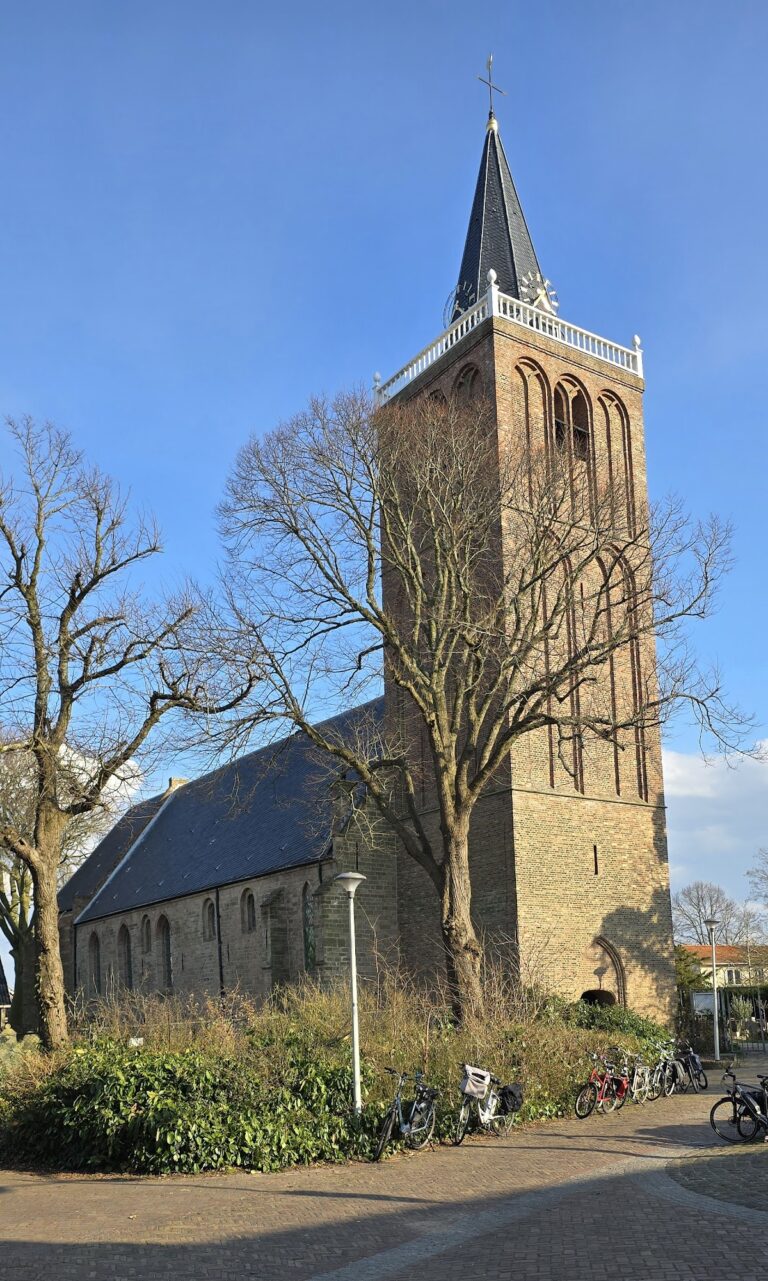
Dorpskerk, Wijk aan Zee: A Late-Gothic Church in the Netherlands


Site at a Glance
- Rating
- 4.4
- Popularity
- Very Low
- Country
- Netherlands
- Primary era
- Medieval
- Eras represented
- Medieval, Modern
- Civilizations
- Holy Roman Empire
- Site type
- Religious
- Remains
- Church
On this page10 sections
History
Dorpskerk, Wijk aan Zee, is a late-Gothic church in the Netherlands, built around 1420 in the brick-Gothic tradition of the Low Countries. It was originally dedicated to Saint Odulphus, a medieval Christian saint. The church was constructed with a cruciform plan consisting of a nave, transepts, and a choir, and was approximately two-thirds larger than the building that survives today.
Medieval foundation and wartime destruction
The church suffered severe damage in 1573 during the Eighty Years’ War, the long Dutch revolt against Spanish Habsburg rule. The destruction affected the choir, part of the nave, and the transepts, leaving much of the building in ruins. The surviving structure was later shaped by the needs of a Reformed congregation, which was established in Wijk aan Zee in 1601 and took over the church.
Reformed use and restoration
In 1609, the four-bay nave and tower were restored for worship. The ruined sections remained standing until they were cleared in 1855, and the choir was no longer considered necessary for Reformed services. Further restoration work took place in 1756, 1853, and 1936–1937. The last major restoration established the church’s present form. Before that work, the nave had a hipped roof at its eastern end; the eastern gable visible today was built in the twentieth century.
Modern religious and legal history
The Dorpskerk is owned by the Protestant congregation of Beverwijk-Wijk aan Zee and belongs to the Protestant Church in the Netherlands, the country’s principal Protestant denomination. Since 1980, Wijk aan Zee has had no resident minister of its own. The church is protected as a Rijksmonument, a building or site legally protected for its national cultural and historical significance. The organ was added to the protection of the church as a whole in 2001.
Remains
The present Dorpskerk is a brick Gothic building formed around the restored nave and tower of the medieval church. Its surviving fabric combines the early twentieth-century exterior with seventeenth-century furnishings and later additions. The eastern gable does not display the decorative forms associated with the North German variant of brick Gothic because it was constructed only in the twentieth century.
Tower and surviving medieval evidence
The tower rises 33 metres and contains three bells. The oldest is a Hemony bell cast in 1658, weighing 364 kilograms. The other two bells were made by Eijsbouts in 1959 and weigh 205 and 145 kilograms. At the bottom of the tower, a non-functioning seventeenth-century tower clock is displayed. Tombstones dating from 1480 to 1769 can be seen in the tower floor and the entrance vestibule.
Interior furnishings
The pulpit and baptismal screen are the oldest parts of the interior and date from the seventeenth century. The central blocks of pews were installed in 1905, while the remaining pews date from 1937. Beside the pulpit hang two Gothic-style boards. One carries the injunction to love one’s neighbour from Luke 10:27, and the other presents the Creed.
Seventeenth-century copper chandeliers and baptismal arches remain in the church. Several of the eight wall sconces were installed in 1912. The stained-glass windows display the coats of arms of Baron W. J. d’Ablaing van Giessenburg, Wijk aan Zee, and the Lindeman family. The church also preserves Communion silver comprising four cups, three dishes, a chalice, and two candlesticks. The oldest piece dates from 1684, and the objects continue to be used four times a year during Holy Communion.
Ship model and consistory room
A ship model hangs from the vault. It represents a pinas, a sailing merchant vessel that could also be armed, of the type used by the Dutch East India Company on maritime routes and in its Asian colonies. The model is a 1911 copy of a seventeenth-century original now held by the National Maritime Museum in Amsterdam.
A door beside the pulpit leads to the consistory room, used for the administrative and pastoral work of a Protestant congregation. The room and adjoining kitchen were built against the church in 1930. Two boards inside list the ministers of Wijk aan Zee and Duin from 1601 to 1980.
Organ
The church’s organ was made in 1905 by the Utrecht builder Michaël Maarschalkerweerd for 3,200 guilders. It has two keyboards, ten stops shared between the Great and Swell divisions, and two pedal stops. An organ stop is a controllable set of pipes producing a particular tone. The instrument’s sound is oriented mainly toward Romantic music, while its case is relatively large for an organ containing more than 600 pipes.
By 1969, the organ had deteriorated so severely that it remained out of use for twenty years. It was restored and returned to service in 1989, then received further refurbishment in 2001.
Archaeological remains beneath Julianaplein
Remains of the original church survive beneath the present Julianaplein. They were exposed and archaeologically investigated in December 2005, revealing numerous graves dating from before the Reformation. After examination, the skeletal remains were reburied.
Nearby sites