Saint Anne Church in Grodziszcze: A Roman Catholic Parish Church

Site at a Glance
- Rating
- 4.5
- Popularity
- Very Low
- Country
- Poland
- Primary era
- Early Modern
- External website
- Open
- Eras represented
- Medieval, Early Modern
- Civilizations
- Holy Roman Empire, Kingdom of Bohemia, Kingdom of Prussia
- Site type
- Religious
- Remains
- Church
On this page12 sections
History
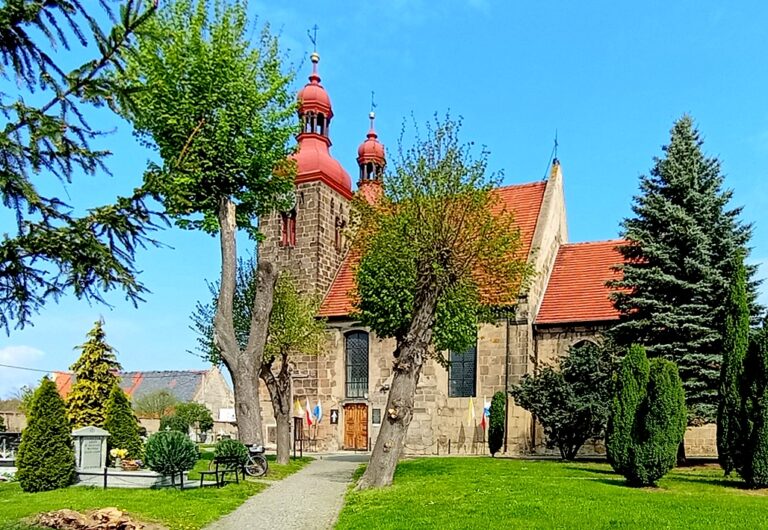
Saint Anne Church in Grodziszcze, Poland, is a Roman Catholic parish church with origins reaching back to the thirteenth century, although its foundation date is unknown. The present building was constructed mainly in the sixteenth century. Dedicated to Saint Anne, traditionally regarded in Christianity as the mother of Mary, the mother of Jesus, the church stands in one of Lower Silesia’s oldest settlements.
Grodziszcze before the present church
Historically known as Gräditz, Grodziszcze has been inhabited since the Neolithic period, the prehistoric age associated with settled farming and polished stone tools. In the eleventh century, it was the seat of the Gramolin castellany, a medieval territorial district organized around a fortified administrative and military center. The castellany was mentioned in a papal bull of 1155, issued during the pontificate of Pope Hadrian IV. Its military functions were later transferred to Świdnica.
The church was first recorded in 1259, when Thomas I, bishop of Wrocław, assigned its pastoral responsibility so that Gräditz would serve only the village of Goglau. A parish priest named Nicholas appears in the records in 1343, providing an early indication of the church’s established parochial role.
Reformation and Catholic restoration
During the Reformation, the church was used by a Protestant congregation. Catholic control was restored in 1653 as part of the Counter-Reformation, the Catholic effort to reform its institutions and reassert religious authority in areas affected by Protestantism.
That change involved a dispute over church patronage. Nikolaus von Zedlitz and Anna Marie von Tschirnhaus, née Rothkirchen, claimed the right of patronage, while the prebendary of the Holy Cross in Wrocław also asserted a claim. The church keys were taken to Wilkau before they were finally handed to imperial commissioners, who took possession of the building. Catholic worship resumed, Mass was celebrated, and the Dominican prior Crispinus Mücke of Świdnica, the head of a Dominican religious community, was given temporary pastoral responsibility. A contemporary report stated that only the bells were present at that time.
Later changes and parish history
The church was remodelled during the eighteenth and nineteenth centuries. Further renovation took place in the 1930s and the 1980s. Before 1945, the parish served Gräditz and Kreisau and had filial churches at Wierischau and Faulbrück. The present Saint Anne parish includes churches in Grodziszcze, Boleścin, Krzyżowa, and Krzczonów.
Saint Anne Church is protected as an architectural monument under designation A/1790/1677. It entered the state register of architectural monuments on 12 May 1966.
Remains
The surviving complex consists of a single-nave rubble-stone church set within an old walled cemetery. The roof carries an octagonal wooden bell tower, while the church interior combines a wooden flat ceiling over the nave with a cross-vaulted rectangular chancel, the area around the main altar reserved for the clergy.
Church building and furnishings
Structure and historic fittings
The entrance to the sacristy, the room used for liturgical vessels and vestments, has a Gothic portal made of sandstone. The furnishings include a Neo-Gothic altar and a Late Gothic baptismal font dated 1585. A Baroque organ made in 1783 by Johann Jakob Michael Burger of Neiße was rebuilt in 1925 by the Schlag & Söhne organ company of Świdnica.
Bell tower and bell
The octagonal wooden tower contains a bell measuring 72 centimetres that was donated in 1506. Its inscription calls on the King of Glory to come with peace and asks Mary for help.
Cemetery and parish buildings
Walled cemetery
The church is surrounded by an old cemetery enclosed by a wall with three entrance gates. Scattered German gravestones from the eighteenth and nineteenth centuries remain within the grounds. Two medieval penitential crosses, crosses associated with atonement or the settlement of wrongdoing, stand against the cemetery wall.
Farm building and rectory
The church complex also includes a farm building and a rectory dating from the eighteenth to nineteenth centuries.
Archaeological remains
Excavations on a hill behind the Peile River revealed the remains of a circular rampart, adding an archaeological feature connected with the fortified history of the surrounding settlement.
Nearby sites