Assumburg: A Castle and Historic Estate in the Netherlands


Site at a Glance
- Rating
- 4.5
- Popularity
- Low
- Country
- Netherlands
- Primary era
- Medieval
- External website
- Open
- Eras represented
- Medieval, Early Modern
- Civilizations
- Duchy of Burgundy, Dutch, Holy Roman Empire
- Site type
- Domestic
- Remains
- Castle
On this page10 sections
History
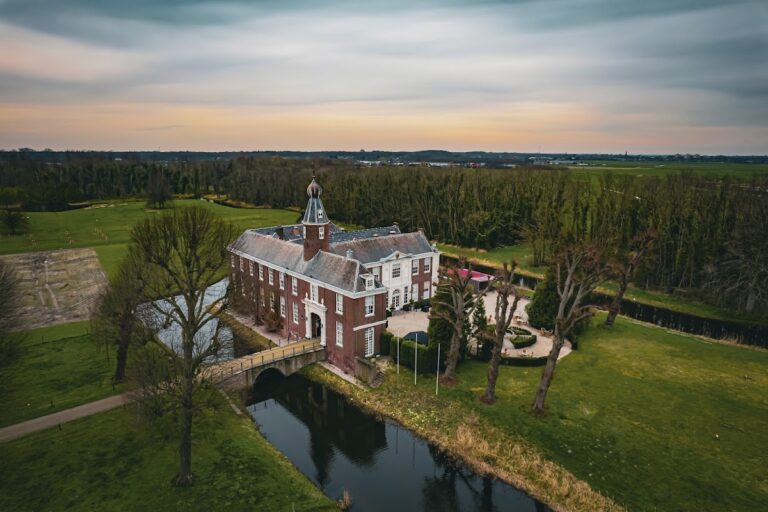
Assumburg is a castle in the Netherlands, located in Heemskerk, North Holland. The present building is generally dated to around 1450, although the site probably originated in the thirteenth century and was renovated in 1546. Its medieval appearance reflects a later imitation of a fortress rather than a castle built for serious siege warfare. The name comes from the hamlet of Assum, between Heemskerk and Uitgeest.
Medieval origins and the Van Assendelft family
Assumburg replaced an earlier medieval complex. Large medieval bricks, earlier pottery, and the results of a 2021 electromagnetic-conductivity survey indicate that the present castle was not the first structure on the site. Historical records describe an earlier moated house on a flattened hill. Between 1399 and 1446, this raised mound was levelled and replaced by an orchard.
During the thirteenth and fourteenth centuries, the castle was known as Williaems Woninghe van Velsen and was associated with the Van Velsen family. In 1322, Jan van Rietwijk van Velsen received half of Assumburg through enfeoffment, a feudal grant of property rights in return for service and allegiance. He sold his share to Barthout van Assendelft on 17 May 1328. Barthout later transferred the entire property to Jan I van Polanen, lord of Oud Haerlem, who granted it back to Barthout on 5 June 1335.
After Barthout probably died in 1345, his eldest son Dirk inherited Assumburg but died without children. His younger brother Gerrit occupied the castle from 1348 and married Stevina van Haarlem. The Van Assendelft family subsequently incorporated the Van Haarlem coat of arms into its own. When Barthout II van Assendelft was exiled by Duke William VI, his brother Dirk II moved into Assumburg in 1413 and received formal possession of it on 20 April 1421.
Later aristocratic ownership
Gerrit VIII van Assendelft, lord of Assendelft and Assumburg, was the last male member of the Van Assendelft family to live at the castle. After his death in 1617, his sister Anna received Assumburg as a feudal holding in 1618. She died in 1626, and members of the Van Renesse family continued to live at the castle for several decades.
The merchant Johannes Wuijtiers purchased Assumburg in 1669. Jean Deutz acquired it in 1694 and reshaped the estate according to contemporary taste, including a French garden with water features and ornamental grounds. The medieval-looking building consequently became part of a formally designed country estate.
Decline, reuse, and twentieth-century restoration
Jacob Maarten Deutz van Assendelft was the last Deutz resident and died at Assumburg in 1858. After his wife, Josina Johanna Willink, died in Amsterdam in 1867, the castle ceased to function as a substantial country retreat. Its contents were auctioned in October 1868, the landholdings were sold, and the surrounding park lost its former character.
After being rented for a year to Hugh Hope Loudon, a member of The Hague city council, Assumburg served several institutional purposes. It was used as a hospital during a cholera epidemic in 1881 and later became a school. In 1906, Hugo Gevers van Marquette arranged for the main hall panelling, marble chimneypieces, and four doors with their frames to be transferred to Marquette Castle.
The nearly ruined castle was sold to the Dutch state on 18 September 1911 for one guilder, on condition that it be restored. Assumburg became a youth hostel in 1933, with the first young people accommodated there on 15 July. Unemployed members of the youth-hostel movement carried out substantial restoration work. German troops occupied the castle during the Second World War, and after liberation it was temporarily used to detain about thirty political prisoners.
Restoration commissioned by the Government Buildings Agency, the Dutch state institution responsible for public-building restoration and maintenance, was completed around 1980. The nearby orangery had already been restored around 1965, and the castle walls were repaired in 2020. Assumburg remained state-owned until 15 January 2016, when it was transferred to the National Monuments Organization, a Dutch heritage body that manages protected historic buildings. The castle is protected as a cultural monument.
Remains
Assumburg consists of the present castle and a separately organized garden estate. Archaeological evidence places an earlier moated complex immediately north of the existing building, while the surviving castle presents a medieval fortress-like appearance. Its thin walls reveal the building’s character as a coulissenkasteel, or stage-set castle, designed to create a defensive image without the heavy construction needed to withstand a siege.
Medieval predecessor
Moated tower and bailey
The predecessor stood immediately north of the present castle. It comprised a circular bailey, an enclosed courtyard adjoining a medieval tower or mound, measuring approximately 12 metres across and surrounded by a moat. At its centre was a circular brick tower about 9.5 metres in diameter. The complex was associated with a raised artificial mound, or motte, used as the base for a fortified residence. The mound was later levelled between 1399 and 1446, after which an orchard occupied the area.
Castle and estate garden
Present castle
The present castle dates generally to around 1450 and was renovated in 1546. Its form imitates a medieval fortress, but the walls are thin and the structure was not designed to resist a prolonged siege. A theory that demolition material from Oud Haerlem Castle was used to build Assumburg has been rejected. The castle’s historic fabric includes the consequences of later use and conservation, including wall repairs completed in 2020. The main hall panelling, marble chimneypieces, and four framed doors were removed in 1906 and transferred to Marquette Castle.
Eighteenth-century garden
Jean Deutz’s remodelling of the estate in 1694 established the garden in its later formal character. The eighteenth-century layout contains a fruit orchard, a rose garden, and a vegetable and herb garden, together with a large formal area and a court pond. The garden was restored from 2009 and opened to the public in 2011. The nearby orangery, a building intended to protect citrus trees and other plants from cold weather, was restored around 1965.
The castle and garden remain distinct parts of the site. The garden forms part of the Assumburg nature and recreation park created in 2003, while the castle currently functions as a hostel within the Stayokay network.