Doornenburg Castle: A Late-Medieval Water Castle in the Netherlands


Site at a Glance
- Rating
- 4.5
- Popularity
- Medium
- Country
- Netherlands
- Primary era
- Medieval
- External website
- Open
- Eras represented
- Medieval
- Civilizations
- Holy Roman Empire
- Site type
- Military
- Remains
- Castle
On this page8 sections
History
Doornenburg Castle is a late-medieval castle in the Netherlands, developed principally during the fourteenth century and completed in the fifteenth. It grew from an earlier fortified estate and became one of the largest water castles in the country, as well as one of its best-preserved castles.
Early origins and medieval development
A fortified estate called Villa Dorenburc occupied the site in the ninth century. A modest stone castle emerged there during the thirteenth century, providing the foundation for the larger complex that followed.
The present main castle was constructed in the fourteenth century and completed during the fifteenth. The outer bailey, an enclosed subsidiary area for service buildings, accommodation, storage, and additional defenses, was established in the fifteenth century. Its principal works were finished by the end of that century.
Residence, decline, and wartime destruction
Doornenburg remained inhabited until the nineteenth century and served as the residence of its successive owners. Repeated changes of ownership were followed by decline. From the middle of the nineteenth century, parts of the complex were used as a warehouse, while other parts were left vacant.
The Stichting tot Behoud van den Doornenburg, a Dutch foundation established to preserve the castle, was founded in 1936. Restoration began in 1937 and was completed in 1941, but the planned opening to visitors was disrupted by the Second World War, the global conflict that affected the Netherlands between 1939 and 1945.
Near the end of the war, Doornenburg was almost completely destroyed. The damage was long attributed to explosives used by retreating German forces, but it was later established that a major British aerial bombardment in March 1945 had caused the destruction.
Postwar reconstruction and protection
Reconstruction began in 1947 and continued for more than twenty years. The restored complex opened in 1968. The work rebuilt or repaired the buildings and also restored and cleaned the surrounding moats. The preservation foundation remains the castle’s owner and preservation body.
Doornenburg is designated Rijksmonument 8942. This status identifies it as a Dutch national monument protected for its cultural and historical importance.
Remains
Islands, moats, and access
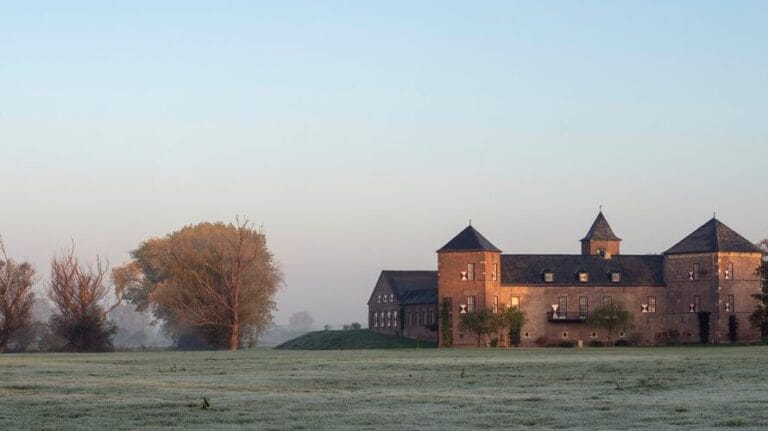
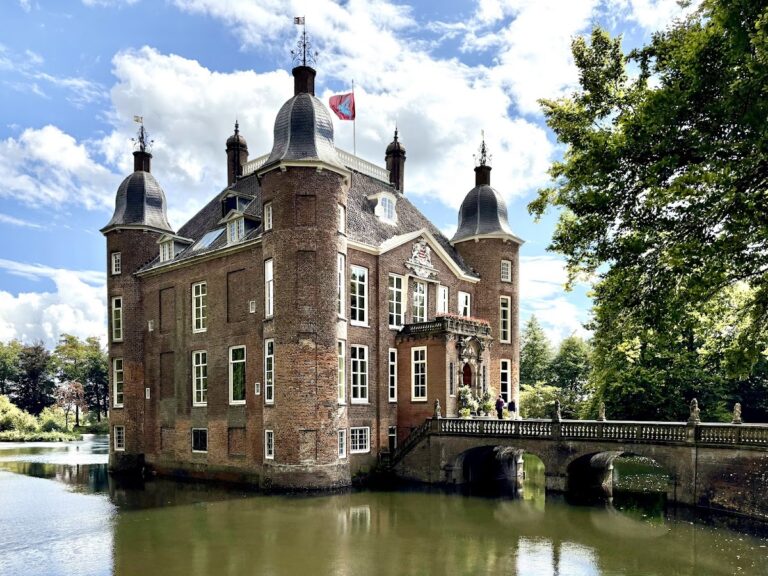
The castle is arranged as a main fortress, or citadel, and an outer bailey. Each occupies a rectangular artificial island surrounded by a broad moat. The water was supplied by the River Linge, which flows north of the castle. Two drawbridges crossed the moats, while access to the citadel led through the outer bailey. A narrow wooden bridge connects the two sections.
Main fortress
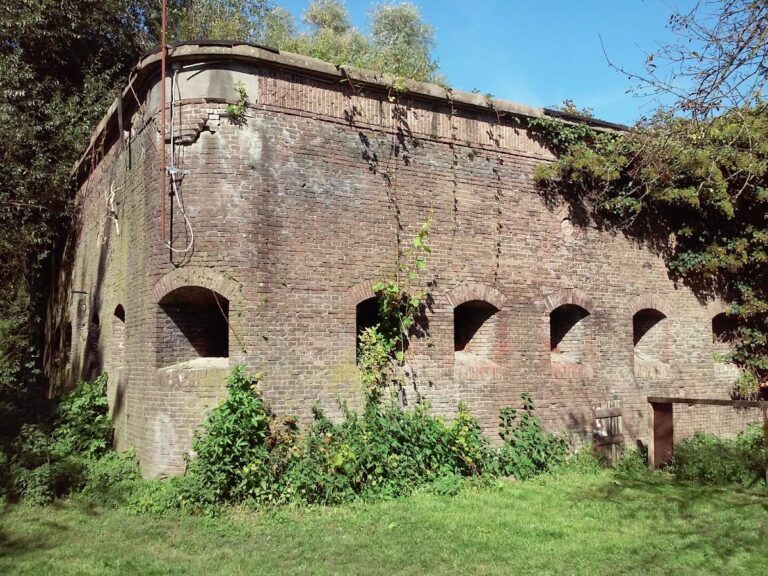
The main building stands on the southern island and has a square plan. Brick walls enclose the restored structure, with small corner turrets capped by conical roofs. Battlements crown the upper walls, and the relatively narrow windows resemble loopholes, giving the building the appearance of a medieval fortress. The restoration broadly retained the appearance associated with the fifteenth century.
Outer bailey and associated buildings
The outer bailey has a rectangular plan and was enclosed by its own brick wall with towers. Two round towers on its northern side protected the drawbridge. Within this fortified area were defensive works, storage areas, living quarters, a chapel, and a stable or farm building. The inclusion of a farm is described as unique among Dutch castles.
The restored complex includes the main building, the outer-bailey buildings, chapel, bridge and gate structures, towers, inner court, and surrounding moats. The chapel and other buildings were reconstructed or restored after the wartime destruction, leaving the principal parts of the castle arranged around their enclosed islands and water defenses.
Nearby sites