Fort Beneden-Lent: A Dutch Defensive Fort at Nijmegen


Site at a Glance
- Rating
- 3.6
- Popularity
- Very Low
- Country
- Netherlands
- Primary era
- Modern
- External website
- Open
- Eras represented
- Modern
- Civilizations
- Dutch
- Site type
- Military
- Remains
- Fort
On this page5 sections
History
Fort Beneden-Lent, also known as Nieuw Knodsenburg, is a Dutch defensive fort in the Netherlands, west of Lent near Nijmegen. Built in 1862, it was intended to defend Nijmegen, which the Dutch state had designated as a fortified city.
Construction and changing military role
Its construction took place under the Kringenwet, Dutch legislation that restricted building and demolition around fortified cities to preserve their defenses and maintain clear fields of fire. Under these rules, Nijmegen’s fortifications could not be demolished, while construction outside them was prohibited.
The Vestingwet, a Dutch fortification law introduced in 1874, changed Nijmegen’s position. The city was then allowed to dismantle its defenses and expand. Around the same period, a railway bridge over the Waal connected Nijmegen with the Dutch railway network. Fort Beneden-Lent consequently lost its role in defending the city, but it was retained to protect the strategically placed bridge.
Military service and later occupation
The fort was manned during the First World War and again at the beginning of the Second World War. From the 1970s onward, it was occupied several times by squatters. The first period of occupation continued until 1986. Staatsbosbeheer, the Dutch public organization responsible for state-owned land and cultural landscapes, has managed the fort since 1983, and the property later became its responsibility. Former occupants were officially permitted to manage the site under a leasehold arrangement, in which property owned by one party is used by another for an agreed term in return for payment.
In 2015, a substantial rise in the leasehold charge led to the fort becoming vacant again. Staatsbosbeheer subsequently rented it through an anti-squatting arrangement, which provides temporary occupancy as a security measure rather than ordinary tenancy rights. The building was definitively vacant by 2018. Squatters returned in March 2019, but Staatsbosbeheer sought their eviction partly because it considered the building too dangerous for habitation. On 19 April 2019, a preliminary court proceeding ordered the occupants to leave immediately.
Remains
Fortification layout
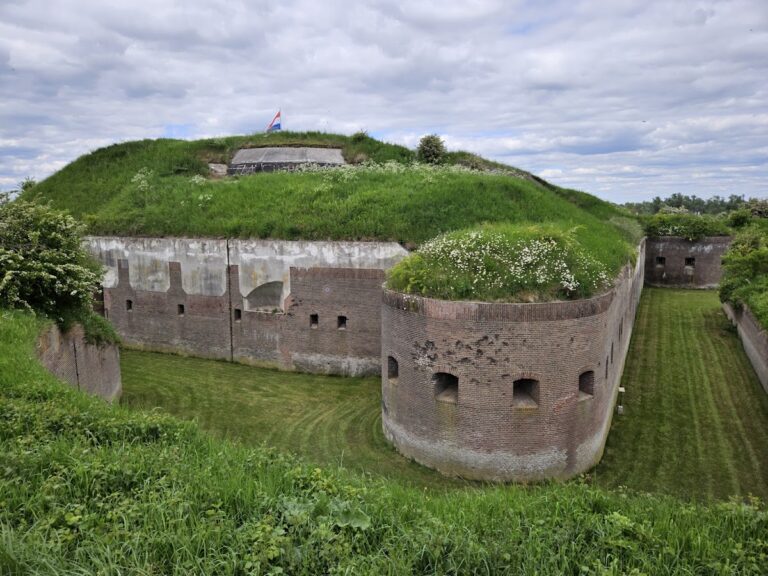
Fort Beneden-Lent stands on the north bank of the Waal, west of Lent. The surviving fort consists of a bombproof lodging building, meaning a structure designed to protect occupants and installations from artillery or explosive attack. This building is enclosed by an earthen redoubt, a small defensive earthwork protecting troops or a strategic position, and surrounded by a moat. Together, these elements form the fort’s principal defensive arrangement.