Dolmen Lo Morrel dos Fados: A Prehistoric Passage Tomb in France
Site at a Glance
- Popularity
- Medium
- Country
- France
- Primary era
- Stone Age
- Eras represented
- Stone Age, Bronze Age, Modern
- Civilizations
- French
- Site type
- Burial
- Remains
- Tomb
On this page11 sections
History
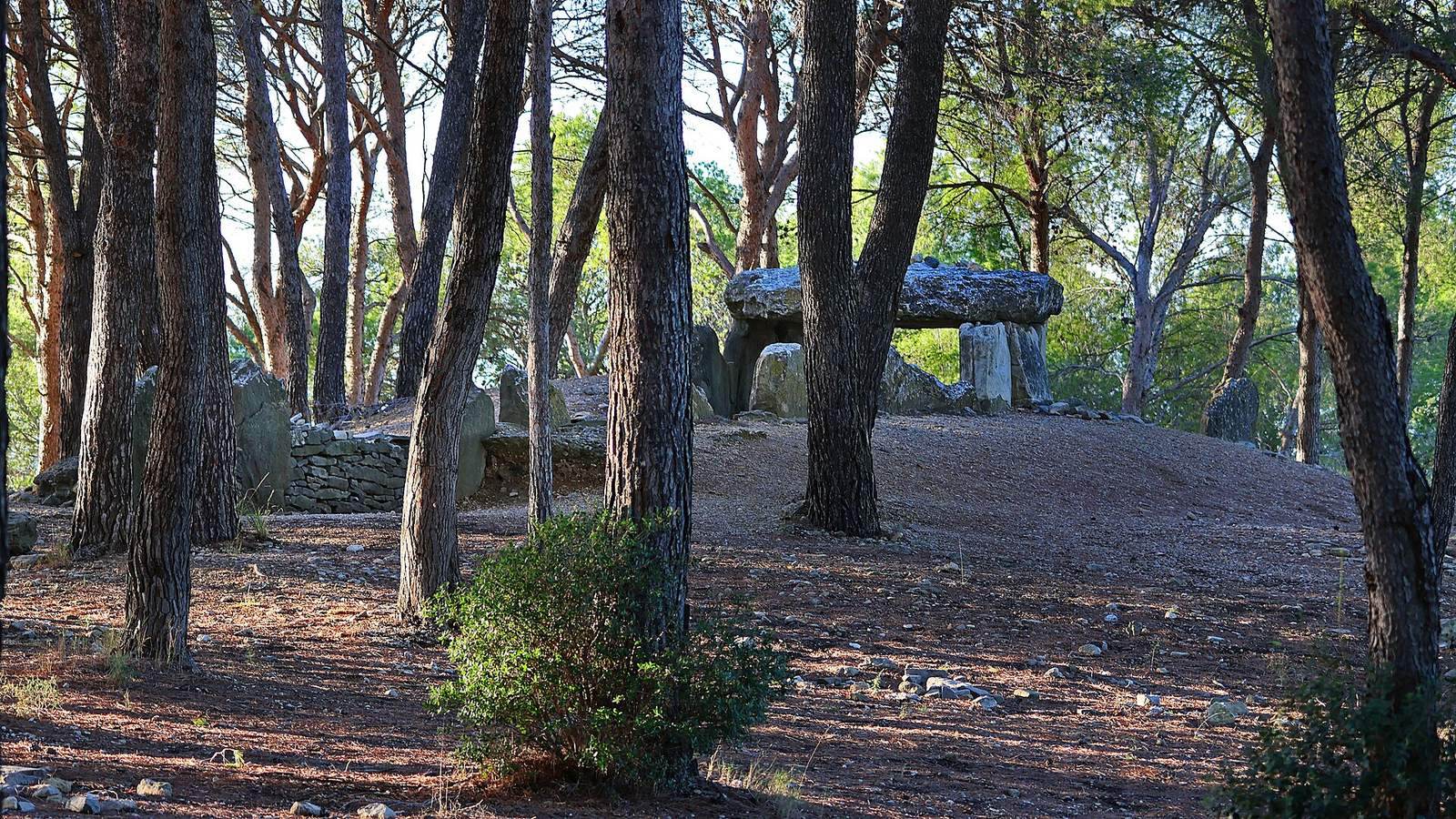
Dolmen Lo Morrel dos Fados is a prehistoric passage tomb in France, probably built around 3500 BC by people of the Véraza culture, a prehistoric culture of southern France. A dolmen is a burial structure made from large stones, and a passage dolmen has an entrance corridor leading to a burial chamber. The monument is the largest passage dolmen in southern France. A later construction date, around 3000 BC, has also been proposed because some of its stones have smoothly finished surfaces.
Medieval record and local traditions
A Carolingian charter from 836 describes the dolmen as a boundary marker, calling it a “chest made in ancient times.” The charter, a formal legal document, places it in the territory of the rural estate of Monte Filinense, identified with present-day Montflanès or Saint-Michel north of the monument. It also locates the dolmen before two other estates associated with La Mignarde in Pépieux. The reference is probably among the earliest medieval mentions of a dolmen.
Local traditions imagined the monument as a home for fairies, giving rise to the alternative name Dolmen of the Fairies. It was also known as Palet de Roland, or “Roland’s throwing disc,” and as the Giant’s throwing disc. One tale claimed that Roland, a legendary Frankish hero associated with Charlemagne, left a handprint on the stone. Another explained monumental stones as discs thrown by a giant hero.
Excavation and protection
Germain Sicard de Rivière partly excavated the monument in 1891. A test excavation in 1946, involving Jean Arnal, exposed more of the structure and confirmed its passage-dolmen form. Jean Guilaine led further excavations from 1962 to 1965, focusing especially on undisturbed areas and installing support beneath the heavy covering slab. He directed another excavation in 1993 to examine the mound’s condition and structure.
The monument was consolidated in 1972. In 1989, the municipality of Pépieux purchased the dolmen’s plot and two adjacent plots, forming an enclosure of 1.53 hectares. The surrounding area entered France’s historic-monument register in 1943, and the dolmen itself received classification in 1969. A major restoration followed in 1997–98.
Remains
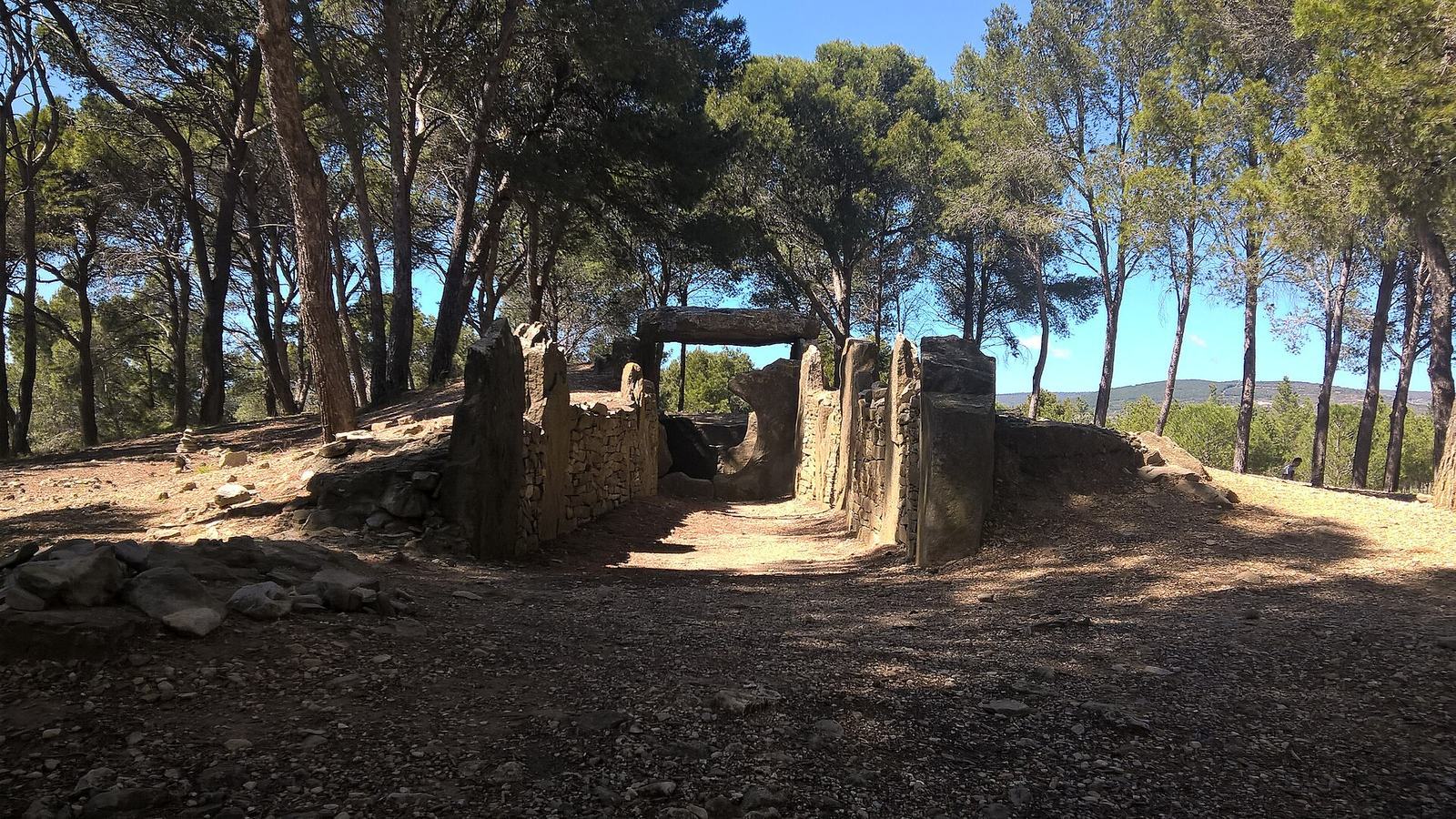
The monument stands on a low, pine-covered hill overlooking the Aude valley. Its gallery runs broadly south to north, with the entrance at the southern end. The dolmen lies within a mound about 35 metres long and up to 2.5 metres high; its megalithic gallery is approximately 24 metres long.
Passage and chambers
Passage
The passage is about 12 metres long. Opposing upright stones alternate with sections of dry-stone wall, built without mortar. Some original walling survives, while reconstructed sections replace areas where supporting stones were lost. The passage is narrower than the burial chamber and was probably not roofed along its entire length, so the monument differs from a long, fully roofed megalithic tomb.
Antechamber
The passage leads through a slab doorway with a porthole-like opening into an antechamber about 6 metres long and 3 metres high. A single large slab covers it, measuring roughly 4.50 by 3.10 metres and 0.40 to 0.55 metres thick. Its estimated weight is 25 to 30 tonnes.
Burial chamber
A second doorway of joined slabs with a porthole-like opening connects the antechamber to the terminal burial chamber, also about 6 metres long. A thick slab closes its far end, and a lateral monolith in the chamber is estimated to weigh about 9.5 tonnes.
Mound and marker stone
Excavation in 1993 indicated that the original mound extended no more than about 3 metres beyond the dolmen’s upright stones. On its northern side, excavators found a large sandstone monolith measuring 3.98 metres long, 0.75 metres wide and 0.40 metres thick. It had been shaped into a regular form, was broken across at roughly one-third of its length, and lay with a setting of small sandstone slabs. It may have served earlier as a pillar or upright marker.
Stonework and restoration
Most structural slabs are red or grey sandstone from nearby outcrops. The covering slab is nummulitic limestone, a fossil-bearing stone probably brought from the Causse de Siran, a limestone upland more than 3 kilometres away. In the early twentieth century, the visible remains included a large tilted limestone slab resting on the ground at one side and on three sandstone pillars at the other. During the 1997–98 restoration, the eastern pillars were raised to their original height, an artificial support pillar was concealed, and fill was added to bring the eroded mound closer to its earlier form. The passage’s dry-stone walls were also repaired.
Excavated finds
Excavations recovered human bones, some with traces of burning, coarse dark pottery fragments, flint, antler tools and two perforated discs made of schist, a layered metamorphic rock. They also yielded a riveted dagger associated with early metalworking in the Minervois around 3400 to 2900 BC, a development encouraged by local copper deposits. The excavated material is held at the repository in Carcassonne, except for the dagger, which is kept at the museum in Olonzac.