Dolmen de Pedrarca: A Prehistoric Tomb in Barcelona, Spain
Site at a Glance
- Popularity
- Very Low
- Country
- Spain
- Primary era
- Stone Age
- Eras represented
- Stone Age
- Civilizations
- Unclassified
- Site type
- Burial
- Remains
- Tomb
On this page13 sections
History
Dolmen de Pedrarca is a prehistoric megalithic tomb on the boundary between Vilalba Sasserra and Llinars del Vallès, in Barcelona, Spain. It is assigned to the Late Neolithic, the later phase of the farming and polished-stone era, and the Chalcolithic, or Copper Age. Its associated archaeological grouping is dated to 2500–1800 BC.
Prehistoric attribution
Finds from the monument allow a possible Late Neolithic attribution, but the stone tools do not establish a more precise cultural or chronological date. Most of the datable material is consistent with a Late Neolithic interpretation.
Damage and archaeological investigation
The dolmen had long been known, but its condition deteriorated while it stood beside a path. Widening the path damaged part of the burial mound, prompting an emergency excavation from December 1992 to January 1993. Archaeologists investigated the mound and chamber with trenches and a test excavation, then the site was rehabilitated.
Remains
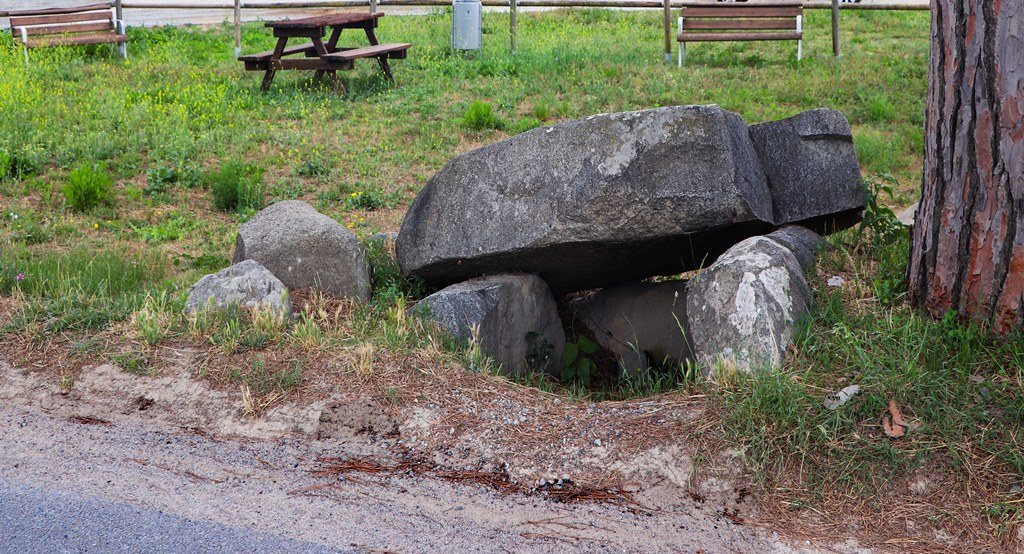
The monument stands at about 211 metres above sea level beside the Ca n’Adrià path, which descends towards the Mogent River. It is about 150 metres from the C-251 road and next to a stone pine. Erosion associated with the tree has displaced the dolmen’s slabs. The structure is a simple rectangular chamber facing west, without a passage.
Chamber and capstone
Chamber
The chamber measures 1.75 metres long by 1.40 metres wide in its preserved form. Three upright granite slabs support the capstone: the left slab measures 1.75 by 1.05 by 0.45 metres, the right 2.10 by 1.15 by 0.35 metres, and the slab at the western end 1.70 by 0.70 by 0.40 metres. The side slabs are braced at their bases. They are set in coarse granitic sand containing quartz and granite pebbles.
Capstone
The granite capstone measures 2.30 by 1.50 by 0.45 metres, with its southwest corner broken away. Its upper surface bears 19 circular, cup-shaped hollows, generally no deeper than one centimetre, although one reaches three centimetres. These hollows are interpreted as contemporary with the monument’s construction and are found on megalithic structures. Engraved letters near the southeast corner have been interpreted either as primitive characters or as a marker of the boundary between the two municipalities. The boundary interpretation accords with the dolmen’s position.
Mound and excavation
Mound and surrounding stones
Small accumulations of stones against the chamber’s side slabs were identified as remains of the burial mound. Delimiting them brought handmade pottery fragments to light. Many large blocks around the chamber had shifted from their original positions. A large block about five metres south of the chamber may be the only surviving stone from a ring around it; another block beside the left slab may also belong to the ring.
Trenches and soil layers
North–south trenches on both sides of the chamber showed that the sequence of deposits continued around it. A granite block measuring 150 by 70 centimetres lay about five metres south of the chamber, where the soil sequence changed; a small group of stones was associated with it. The northern trench extended six metres and revealed a smaller block at about the same distance from the chamber. These blocks may have formed part of a large ring enclosing the mound and chamber. Excavation identified a surface layer of plant-rich soil with handmade pottery and some flint mixed with modern material, over fine, dark granitic sand. Two stone concentrations lay in the upper part of that layer. Below it was coarse granitic sand with quartz and granite pebbles, which also contained handmade pottery.
Excavated materials
Stone tools and pottery
Pine roots, looters’ holes and small-rodent burrows disturbed much of the archaeological material. The material considered undisturbed consisted of pottery and stone artifacts. Most of the flint pieces are small flakes or fragments. Other worked pieces include a notched flake, a scraper made from a flake, a blade fragment broken at its tip with worked edges, and a small blade-shaped tool with its left edge blunted. The pottery is sparse and handmade.
Other finds and coins
A fragment of a sandstone millstone base was found while the chamber was being cleaned, and a small mortar fragment came from the mound. Surface cleaning also recovered two coins. One is a copper 5-centimo coin dated 1878, issued under Alfonso XII, king of Spain from 1874 to 1885, and minted in Madrid. The other is an ardit, a small Catalan coin, of Philip IV of Castile, called Philip III in the Crown of Aragon, who ruled from 1621 to 1665. It was minted in Barcelona, either in 1624–1635 or in 1653–1655.