Dolmen de la Barraca: A Prehistoric Megalithic Chamber in France
Site at a Glance
- Popularity
- Very Low
- Country
- France
- Primary era
- Stone Age
- Eras represented
- Stone Age, Bronze Age, Iron Age, Modern
- Civilizations
- Unclassified
- Site type
- Burial
- Remains
- Tomb
On this page11 sections
History
Prehistoric chronology and later use
The Dolmen de la Barraca is a prehistoric megalithic chamber in France, broadly assigned to the Late Neolithic through the Iron Age. These are successive archaeological periods distinguished partly by changing technologies and material culture. The monument is also known as Dolmen I of Mas Lluçanès. Finds from nearby vineyard plots suggest a settlement of Verazian type, an archaeological culture associated with the Late Neolithic in southern France.
The dolmen was robbed over an extended period and later used as a shelter. Its Catalan name, La Barraca, means hut and reflects this more recent use.
Recording and excavation
Pierre Vidal first mentioned the monument in 1921. It appeared in a publication in 1950, and Jean Abélanet excavated it in 1975.
Remains
Setting and layout
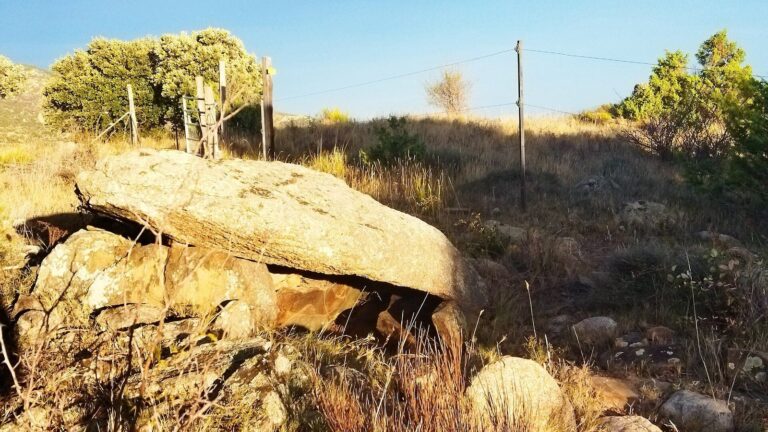
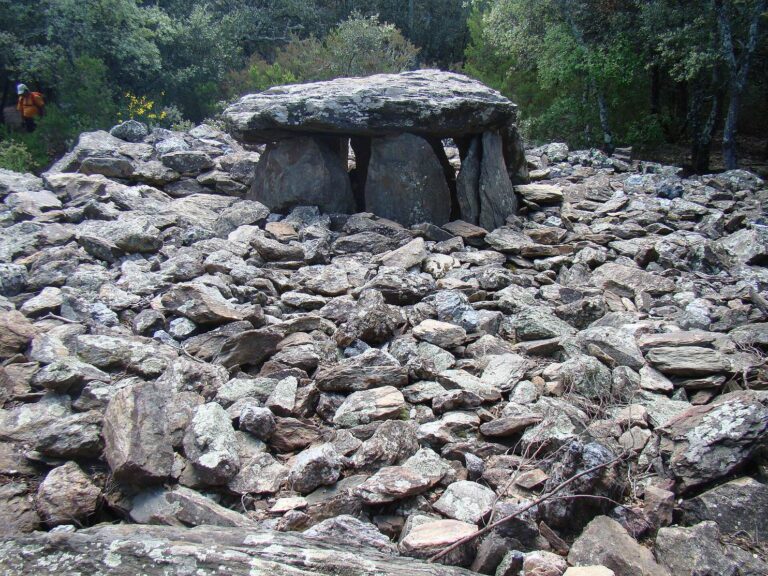
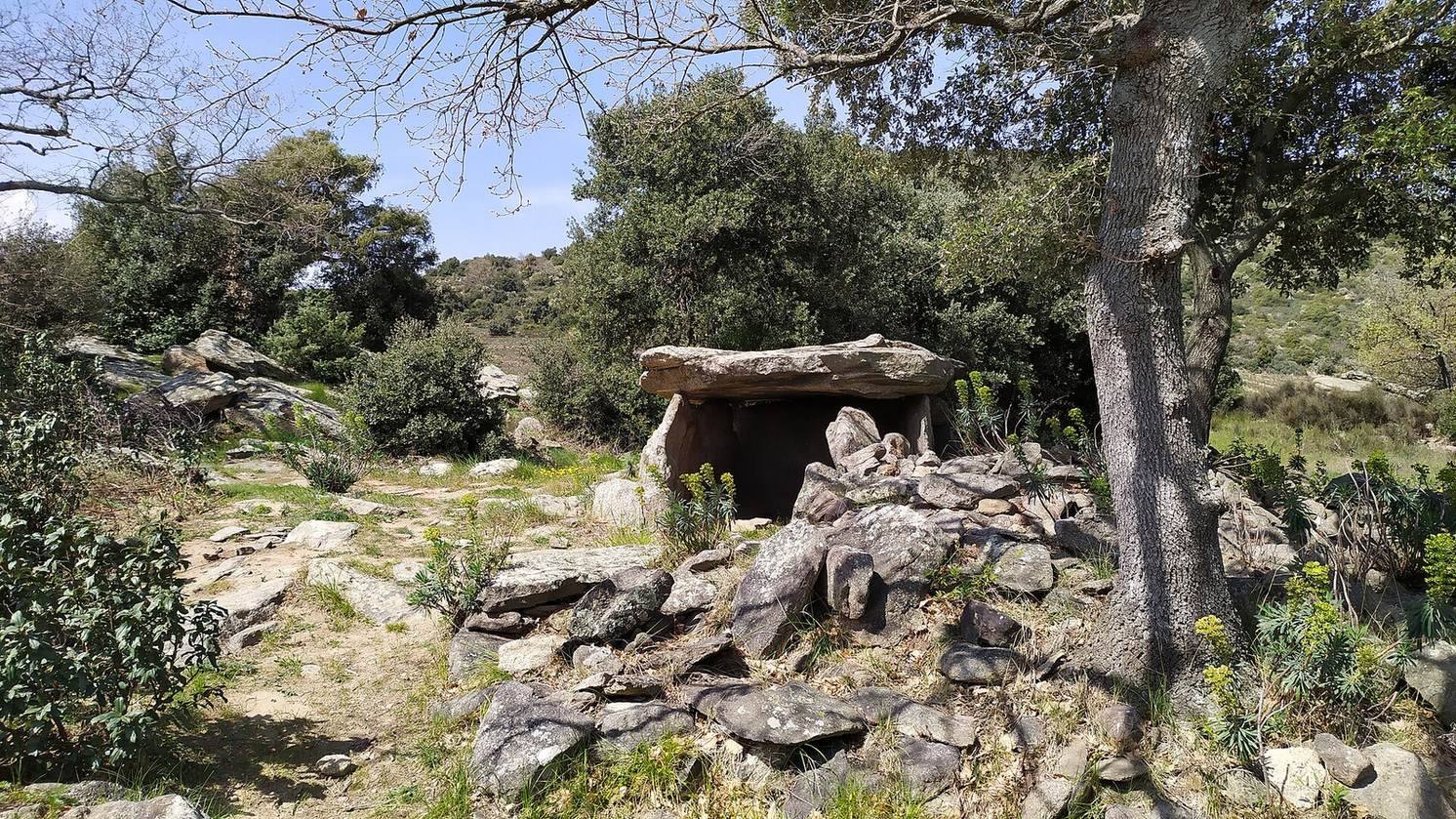
The monument consists of a long, passage-like granite chamber beneath a large capstone, set within a roughly circular mound. It stands on a ridge in the central-western part of Tarerach, northwest of the Mas Lluçanès hamlet and near the boundary with Arboçols; some specialists place it in Arboçols instead. Rocks, holm oaks and juniper bushes surround the site, which lies close to outcrops that may have supplied its stone. Dolmen II is less than 200 metres to the southeast. Two dolmens so close together are unusual in the region, and both belong to the Mas Lluçanès group.
Chamber and mound
Granite chamber
Five upright granite slabs form the chamber, whose outline is roughly trapezoidal, a four-sided shape with one pair of parallel sides. The end slab measures 2.35 metres long and 0.14–0.18 metres thick. Two western slabs are each 1.30 metres long and 0.20 metres thick; the eastern slabs measure 1.60 by 0.15 metres and 1.05 by 0.20 metres. The chamber opens approximately south-southeast. Its massive granite capstone is 3.30 metres long, 2.35 metres wide and about 0.25 metres thick. The monument stands approximately 1 metre high.
Mound and entrance
The mound measures about 6 metres across. A small archaeological excavation in 2013 found traces of what was probably a wall around its edge. Smaller slabs narrow the entrance. They are thought to be later additions, possibly installed when the chamber was adapted as a shelter.
Excavated material
Finds from the dolmen
Material recovered at the dolmen includes remains from the Middle Ages and the seventeenth to nineteenth centuries, as well as prehistoric objects. The prehistoric finds include pottery attributed to the Early and Late Bronze Age and Iron Age; they have also been described as including Neolithic, Late Bronze Age and Early Iron Age material. Other finds include fragments of flint or quartz, a large cockle shell and an unfinished greenstone object, apparently part of a disc or ring, measuring 65–70 millimetres across.
Finds from nearby vineyard plots
Nearby vineyard plots yielded Late Neolithic pottery decorated with smooth raised bands, about ten quartz hammerstones and three disc-or-ring objects resembling the unfinished fragment from the dolmen.