Castle of Bélesta: A Medieval Fortified Residence in France


Site at a Glance
- Rating
- 4.2
- Popularity
- Low
- Country
- France
- Primary era
- Medieval
- External website
- Open
- Eras represented
- Medieval
- Civilizations
- Crown of Aragon, French
- Site type
- Military
- Remains
- Castle
On this page9 sections
History
The castle of Bélesta is a twelfth-century fortified residence in France, established with the village of Bélesta in the historical region of Fenouillèdes, probably on the site of an earlier construction. Its position later gave it an important role in monitoring the frontier between the French and Aragonese crowns.
Medieval frontier stronghold
The castle is recorded in 1210 as belonging to Béatrix de Bellstar, who was also co-lady of Vernet in Roussillon. The 1258 Treaty of Corbeil, an agreement that settled territorial relations between the French and Aragonese crowns, placed their frontier near Bélesta. Louis IX, king of France from 1226 to 1270, then had the castle fortified.
In 1312, the castle appeared as castrum de Pulchro Stare, a Latin rendering of the Catalan name Belhestar or Bel Estar, meaning “the beautiful farm.” The lordship subsequently passed through several families. Jean de Belcastell held it during the second half of the fourteenth century and sold half of Bélesta to Bérenger III d’Oms in 1371. Jean d’Aiguebelle was recorded as lord of Bélesta in the sixteenth century.
Changing lordship and decline
Through marriage, the fief and castle later passed to the Niort family. François de Niort was lord of Bélesta in 1662, and the family retained Bélesta and its surrounding lands until the French Revolution expelled them. The last occupant was Raymonde-Raphaëlle de Niort (1759–1810), who died at Ille-sur-Têt after emigrating.
The 1659 Treaty of the Pyrenees, which moved the France–Spain frontier farther south, ended Bélesta’s strategic importance. The castle was temporarily requisitioned during the revolutionary period, then abandoned and gradually fell into ruin.
Restoration and museum use
An important archaeological site discovered at the Caune de Bélesta in 1983 produced Neolithic objects. The Neolithic was the later part of the Stone Age, associated with settled communities, agriculture, pottery, and polished stone tools. In response to the discovery, the municipality purchased the castle and restored it in 1984 for use as a museum. The Museum of Prehistory opened in 1992, and the municipality of Bélesta owns the castle.
Remains
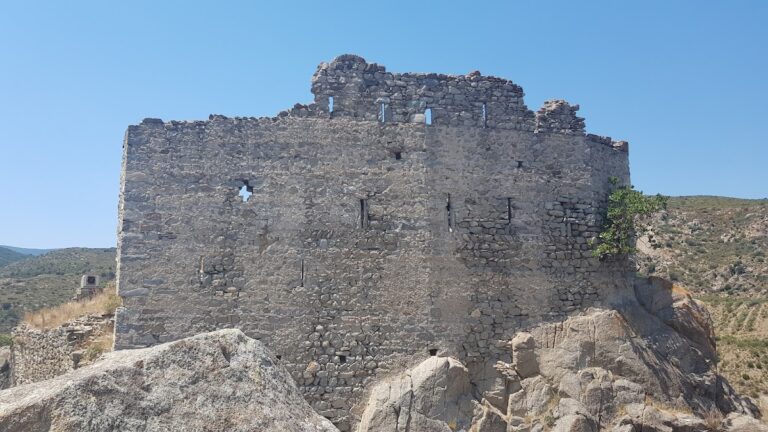
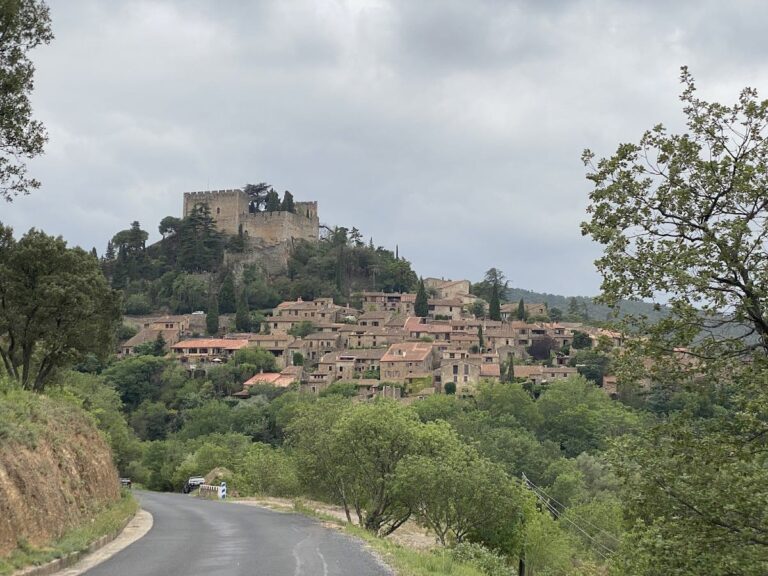
Built on a rocky pinnacle in the centre of the village, the castle is arranged across five levels. The fortified complex combines a quadrangular tower from the twelfth century with a rectangular residential building, while other structures formed an interior courtyard. From the eastern foothills of the Pyrenees, the site overlooks the valleys of the Agly and Têt rivers as they descend toward the Mediterranean.
Fortified structures
Tower and defensive features
Surviving elements include a signal tower with walls 1.45 metres thick and a vaulted ceiling. A cistern retains part of its waterproof coating, while an arms room preserves evidence of the castle’s defensive and residential functions. At the entrance, a pointed arch made of dressed stone remains among the features preserved during the restoration of the 1980s.
Castle chapel
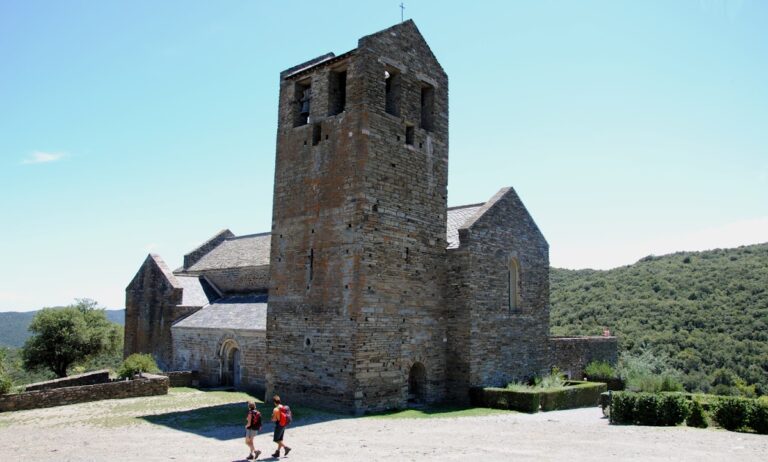
The castle chapel is Romanesque, a medieval style characterized by massive masonry, rounded arches, and heavy forms. Originally dedicated to Mary Magdalene, it was fortified in 1173 and served as the castle chapel until 1648. It then officially became Bélesta’s parish church under the dedication of Saint Bartholomew.
Museum spaces
The Museum of Prehistory occupies approximately 1,000 square metres in 15 spaces arranged as a circuit. Its displays address archaeological science, the excavations at the Caune de Bélesta, Neolithic life, local discoveries including pottery and tools, and the megaliths of Roussillon, monuments built from large stones. One room is reserved for annual temporary exhibitions. Panels also present the castle’s history and the remains preserved during the restoration of the 1980s.