Dobczyce Castle: A Royal Fortress and Renaissance Residence in Poland


Site at a Glance
- Rating
- 4.5
- Popularity
- Medium
- Country
- Poland
- Primary era
- Medieval
- External website
- Open
- Eras represented
- Medieval, Early Modern
- Civilizations
- Kingdom of Poland, Polish–Lithuanian Commonwealth
- Site type
- Military
- Remains
- Castle
On this page9 sections
History
Dobczyce Castle is a royal castle in Dobczyce, Poland, probably fortified by the early fourteenth century as a medieval Gothic fortress. The surrounding lands were likely part of the Polish king’s personal domain, and the castle later protected a customs chamber connected with the route through the area.
Royal stronghold and administrative centre
The castle was first mentioned in writing in 1362, although an established fortified site already stood there. In 1311, during the revolt of Albert, Krakow’s mayor, King Władysław I Łokietek issued a document at Dobczyce confiscating the property of rebellious Krakow burghers. A customs chamber may have existed from the thirteenth century, and its operation is recorded in 1359. That year, the castle and its surrounding lands were placed under the administration of Mikołaj Wierzynek. His family retained control until 1379, when the estates returned to the Crown.
In 1390, King Władysław Jagiełło granted the castle and its estates to Klemens of Moskorzów as a reward for his services. After Klemens died, his descendants administered the property through the Kamieniecki and Lanckoroński families. Jagiełło and his wife, Jadwiga, stayed at Dobczyce in 1398, confirming the castle’s place within the royal landscape of medieval Poland.
Education, conflict, and noble ownership
The castle also became associated with the education of the children of King Casimir IV Jagiellon. The historian and diplomat Jan Długosz taught the princes Sigismund, Alexander, Władysław, Frederick, John, and Casimir at Dobczyce. Prince Casimir spent several months there in 1473 after an unsuccessful attempt to claim the Hungarian crown.
In 1467, the castle was seized by the “Beggar Brothers,” unpaid Polish soldiers expelled from the army. Forces led by Mikołaj Pieniążek, the Krakow starosta, soon expelled them and captured their fortified headquarters at Wapienna Hill. A starosta was a royal official responsible for governing a district or managing royal estates, with related administrative and military authority.
Stanisław Czarny of Witowice held the Dobczyce estate from 1519 to 1549 and received the castle for life in 1527. The fortress later passed through the Burzeński and Boner families before coming into the possession of the Lubomirski family in 1585.
Renaissance transformation and destruction
Under Sebastian Lubomirski, who served as starosta from 1585 to 1613, Dobczyce flourished. In 1593 and 1594, he transformed the Gothic fortress into a Renaissance residence, adapting the medieval stronghold to the needs of an aristocratic household. In 1611, the castle hosted the wedding of his daughter Barbara and the Polish magnate Jan Zebrzydowski. Piotr Tylicki, bishop of Krakow, attended the celebrations.
The castle survived the first Swedish invasion of Poland in the 1650s, part of the conflict known as the Swedish Deluge, when Swedish forces invaded the Polish-Lithuanian Commonwealth. Its walls were deteriorating by 1660, prompting the starosta Michał Jordan to strengthen them. Swedish forces destroyed the castle during the second invasion in 1702, and a fire in 1735 caused further damage.
Abandonment, conservation, and museum use
By the beginning of the nineteenth century, the castle had been abandoned. Local peasants dismantled walls and towers, reusing stone and wooden beams in their own buildings. This process continued through much of the nineteenth century. Conservation and structural-protection work began in 1901, although the site remained abandoned for several more decades.
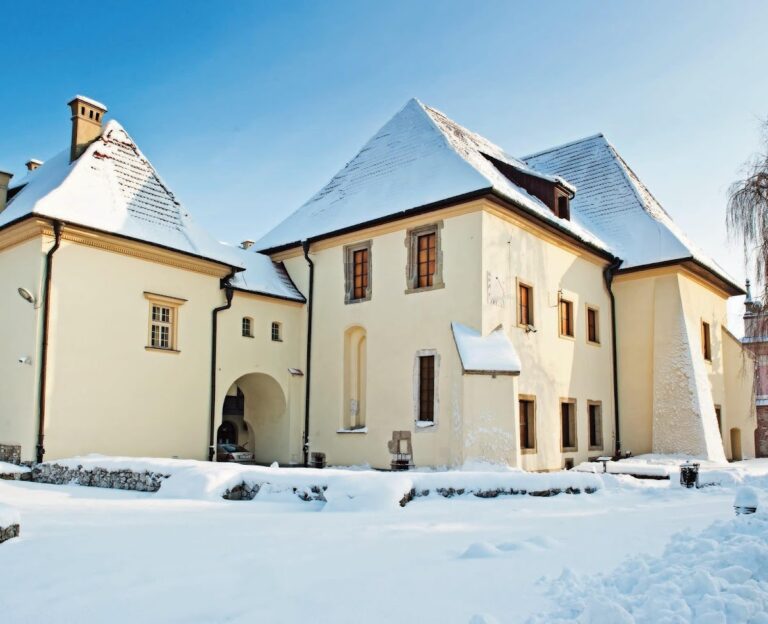
Archaeological excavations on the castle hill began in 1960 through the initiative of the local teacher Władysław Kowalski, who later became the castle’s curator. After many years of work, part of the complex was restored and reconstructed, and a museum of the Polish Tourist and Sightseeing Society was established there. The castle now has protected cultural-heritage status in Poland, while the castle gate is registered as monument A-435, dated 25 October 1976.
Remains
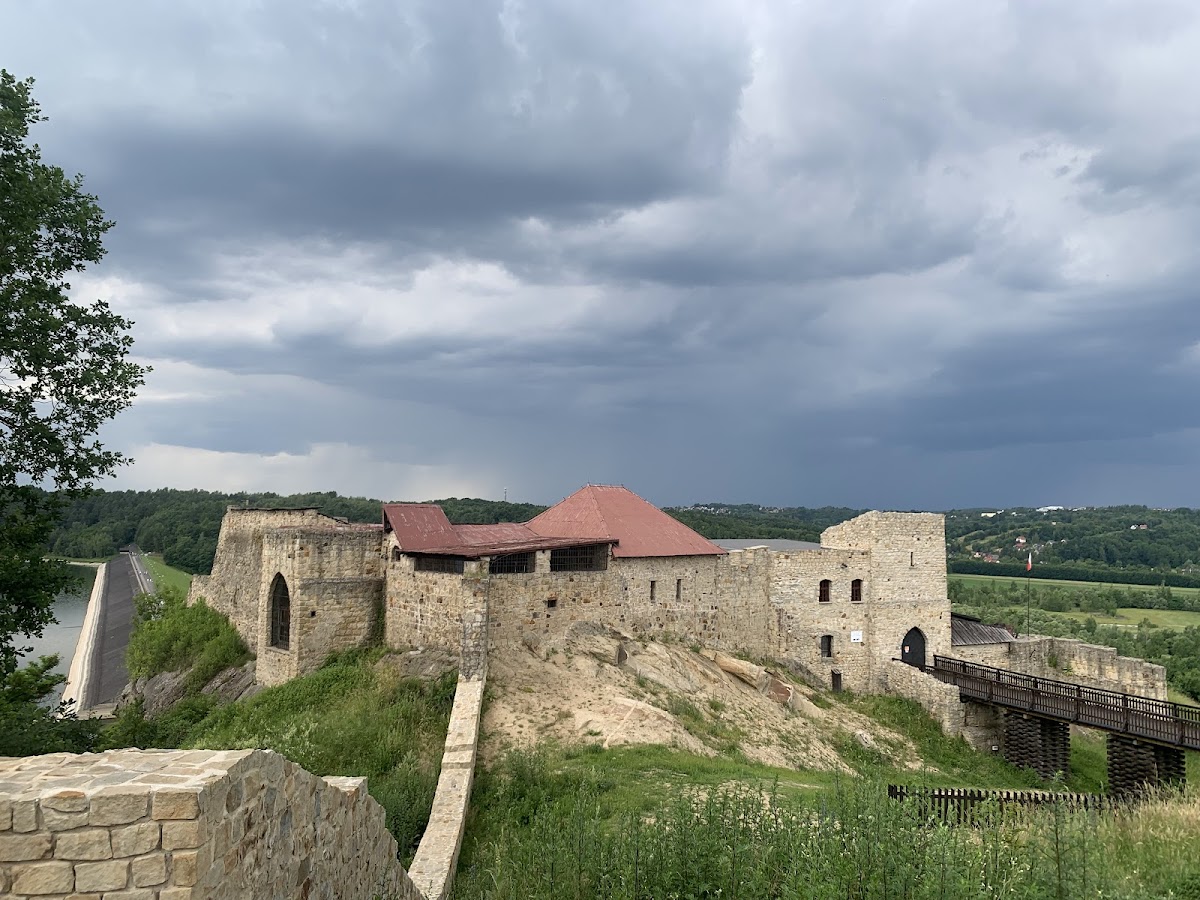
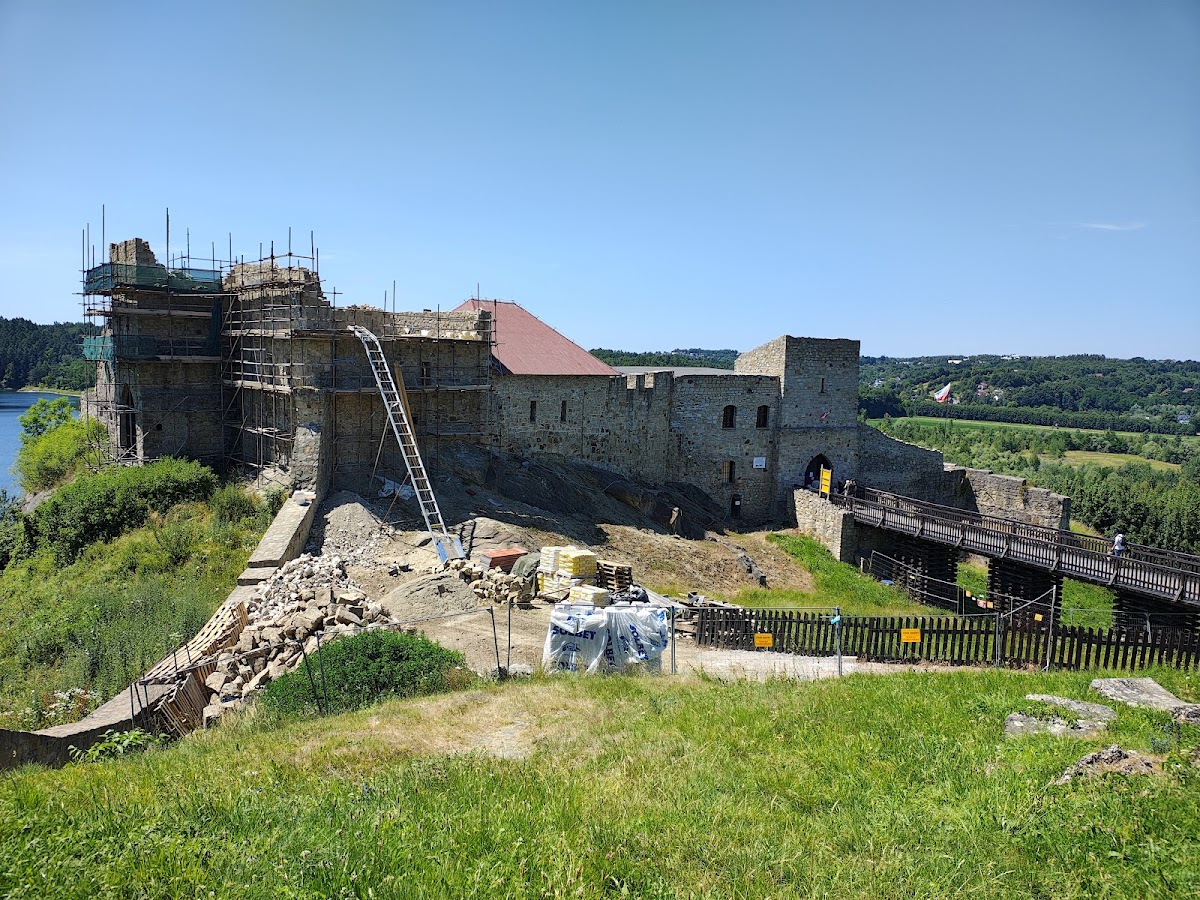
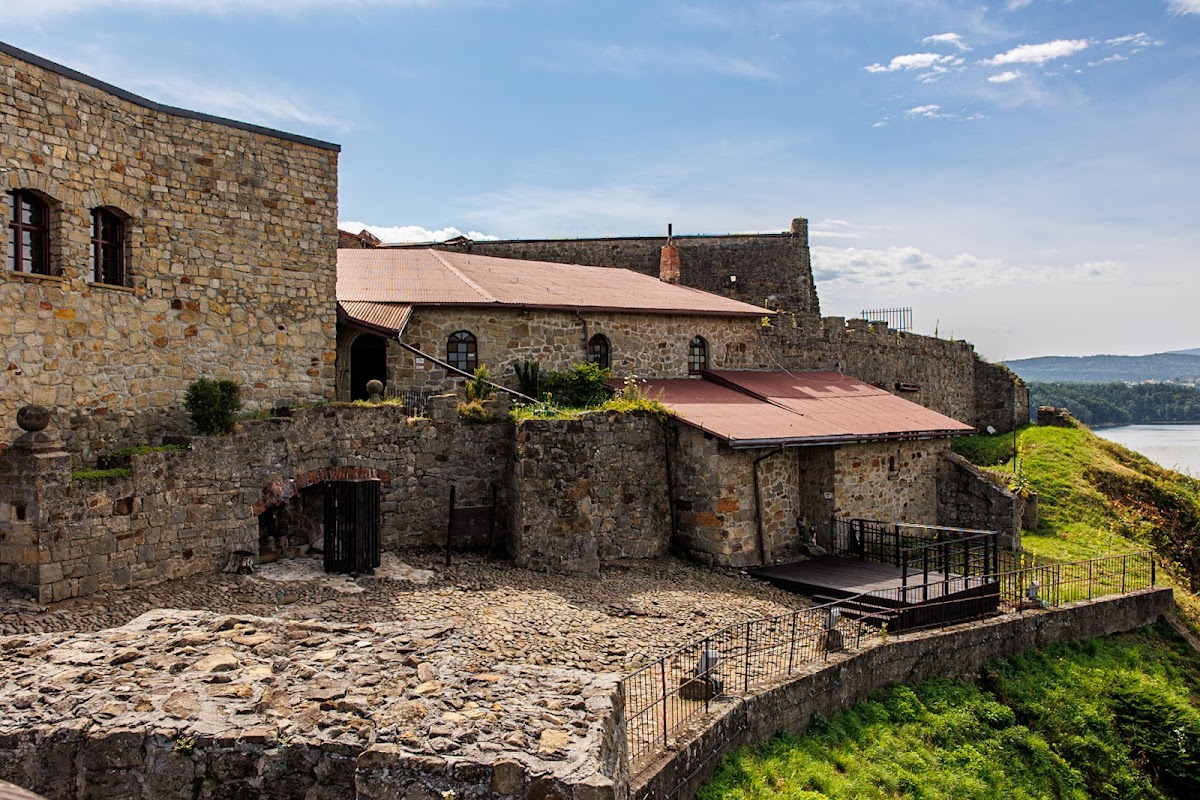
Dobczyce Castle occupies a high, rocky hill above Dobczyce Lake, a reservoir created by impounding the Raba River. The lake’s dam reaches the castle hill. The complex developed from a small early stronghold into a stone fortress divided into an upper castle and a lower castle, with a bridge and gate providing entry, defensive walls and towers enclosing the site, and residential and religious buildings within it.
Early fortress and medieval walls
The earliest castle occupied the highest part of the hill. It probably consisted of a cylindrical tower about 9 metres in diameter, surrounded by timber-and-earth fortifications. During the fourteenth century, the stronghold was enlarged and rebuilt in stone. Under King Casimir III, the walls reached 5 metres in thickness and measured up to 9 metres in some sections, creating the principal defensive framework of the upper and lower castle.
Renaissance residence
The rebuilding of 1593 and 1594 altered both the appearance and internal character of the fortress. A clock was added to the main tower, a chapel was built on the site of the thirteenth-century gate, and a fountain was installed inside the castle. By 1620, the residence contained 70 rooms, while its outer wall was defended by three towers.
Surviving complex and reconstructed museum
The surviving complex combines restored and reconstructed sections with the remains of the former fortress. Its physical elements include the bridge and gate, defensive walls, towers, chapel, fountain, and interior rooms. Nineteenth-century demolition and dismantling altered the medieval fabric, while later conservation returned part of the castle to use as a museum. Observation platforms have been installed on the castle towers, and the castle hill overlooks the surrounding lands, Dobczyce Lake, the foothills, and the Beskids.