Church of St. Mary in Myślenice: A Gothic Parish Church and Marian Sanctuary
Site at a Glance
- Rating
- 5
- Popularity
- Very Low
- Country
- Poland
- Primary era
- Medieval
- External website
- Open
- Eras represented
- Medieval, Early Modern, Modern
- Civilizations
- Austria-Hungary, Austrian Empire, Habsburg, Kingdom of Poland, Polish–Lithuanian Commonwealth
- Site type
- Religious
- Remains
- Church
On this page12 sections
History
Church of St. Mary in Myślenice is a Roman Catholic parish church and Marian sanctuary in Myślenice, Poland, completed in 1465 as a Gothic building and dedicated to the Nativity of the Virgin Mary. Its liturgical feast is celebrated on 8 September. The church stands near the Market Square and became associated with devotion to the image of Our Lady of Myślenice.
Gothic church and later additions
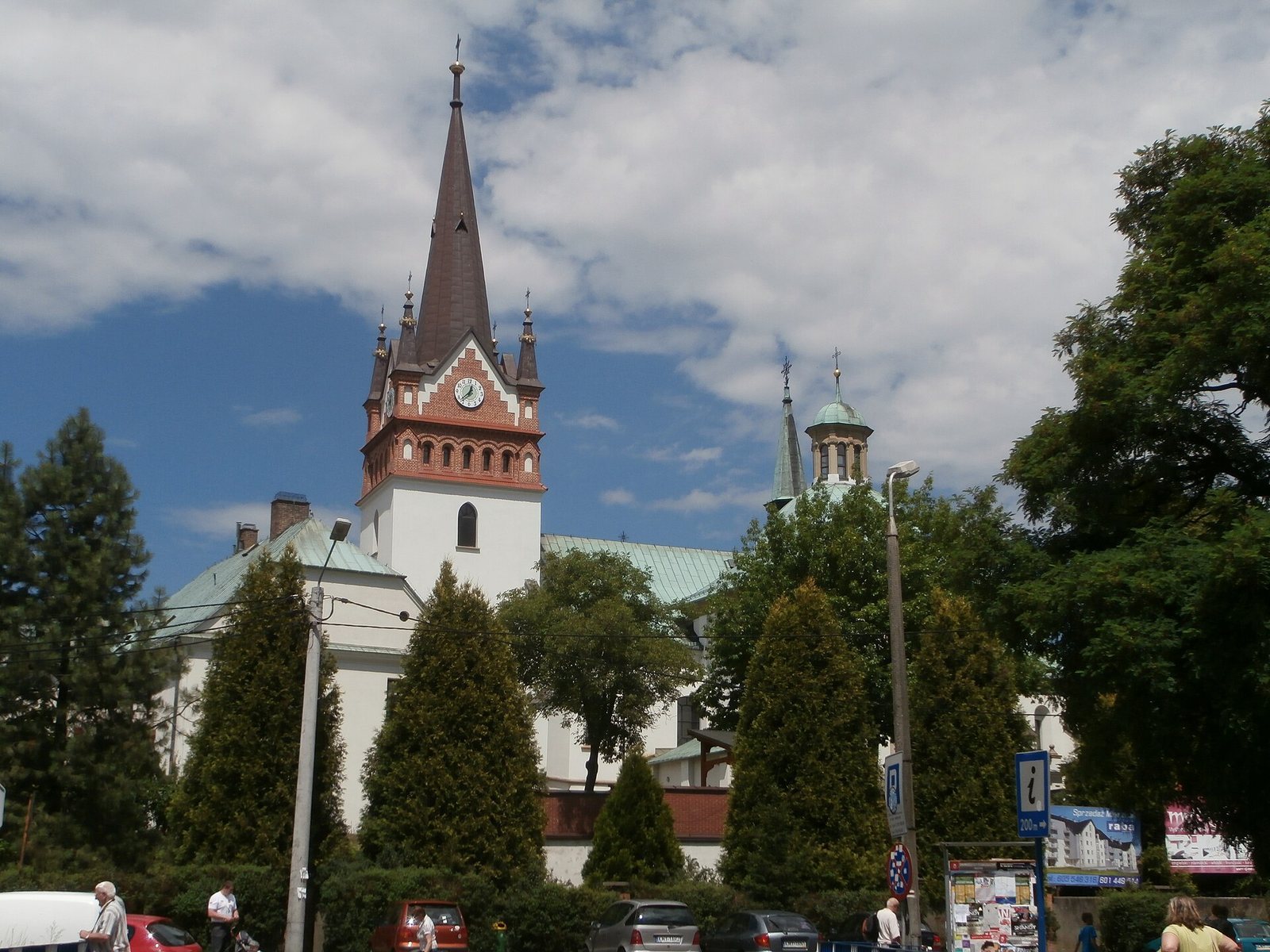
The church tower was built in 1543. Its upper part was reconstructed in the Neo-Gothic style in 1900–1901, following a design by the Polish architect and architectural historian Jan Sas-Zubrzycki, who was known for historicist and Neo-Gothic work.
An early Baroque chapel was added between 1642 and 1646 with financial support from the Koniecpolski family. It was built to house the venerated image of Our Lady of Myślenice, which had initially been placed in the sacristy after arriving at the parish church.
The image and its cult
Marcin Grabysz, a Myślenice-born official of Prince Jerzy Zbaraski, transferred the image to the parish church in 1633. Its earlier history was linked to Pope Sixtus V, who left it in 1590 to a relative serving as an abbess in a Venetian convent. In 1596, the abbess reportedly gave it to Jerzy Zbaraski, a diplomat and castellan of Kraków. During a plague in Kraków, the image was moved to a safer place and later came into Grabysz’s possession.
Cardinal Adam Stefan Sapieha visited the church during observances of the image’s 300-year cult, when efforts began to secure papal crowns. Approval was granted in 1967, and Cardinal Karol Wojtyła crowned the image on 24 August 1969 in the presence of 20 bishops, including Jerzy Ablewicz, Franciszek Jop, and Antoni Baraniak. Wojtyła became Pope John Paul II in 1978.
The image’s artistic origin remains debated. It was formerly attributed to an unidentified Italian painter, while later research connected it with the Prague Mannerist circle, a late-sixteenth-century style associated with the court culture of Rudolf II. Possible origins include Bohemia or Kraków, and the closest comparisons have been made with works by Hans von Aachen, a German Mannerist painter active at Rudolf II’s Prague court.
Modern protection and conservation
The church entered the register of immovable monuments of the Małopolskie Voivodeship on 22 January 1970. A comprehensive renovation of the historic building began in 2011. The chapel facade received memorial plaques for the 300th and 350th anniversaries of the image’s cult, installed in 1933 and 1983.
Remains
Near Myślenice Market Square, the surviving church forms a single-nave Gothic building with Renaissance and Baroque elements. It has one tower approximately 53 metres high, five altars, and an organ with 21 stops, two manuals, and a pedal. The attached early Baroque chapel extends the church complex and preserves the setting created for the venerated Marian image.
Church structure and furnishings
Tower and nave
The single-nave church retains its Gothic form, while later Renaissance and Baroque elements reflect subsequent changes to the building. The tower combines its sixteenth-century lower history with an upper section constructed in Neo-Gothic style in 1900–1901.
Main altar
The main altar dates from 1829 and contains a painting of the Nativity of the Virgin Mary by Sebastian Stolarski. The present tabernacle and the figures of Saints Peter and Paul are retained elements from an earlier Rococo altar. The figures were moved to the Chapel of the Crucified Christ.
Tomb slabs
Two historic tomb slabs are set into the floor before the main entrance. They commemorate Zofia Gorączko, who died in 1765, and Kazimierz Gorączko, who died in 1730.
Marian chapel and image
Early Baroque chapel
The chapel attached to the church was constructed between 1642 and 1646 specifically for the image of Our Lady of Myślenice. Its facade contains two memorial plaques, dated 1933 and 1983, commemorating the 300th and 350th anniversaries of the image’s cult.
Our Lady of Myślenice
The image is an oil painting on a wooden panel measuring 51 by 68 centimetres. Created in the second half of the sixteenth century, it shows the Virgin and Child in the Eleusa type, a devotional composition in which they touch or embrace affectionately. Its precise authorship and place of production remain uncertain.
A copy of the image decorates the facade of the tenement at number 27 on Myślenice Market Square. The painting also served as the prototype for the image of Our Lady of Kalwaria.