Saint James the Greater Church in Myślenice: A Roman Catholic Filial Church
Site at a Glance
- Popularity
- Low
- Country
- Poland
- Primary era
- Modern
- Eras represented
- Early Modern, Modern
- Civilizations
- Austria-Hungary, Austrian Empire, Habsburg, Polish–Lithuanian Commonwealth
- Site type
- Religious
- Remains
- Church
On this page15 sections
History
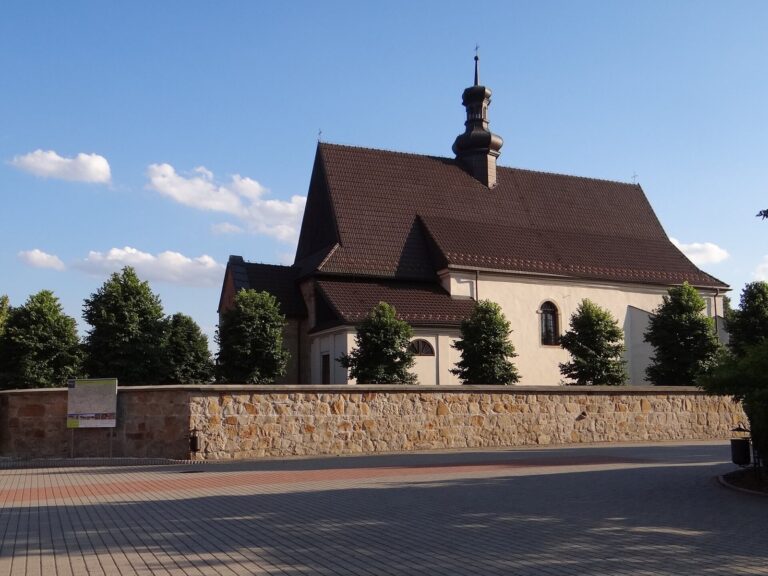
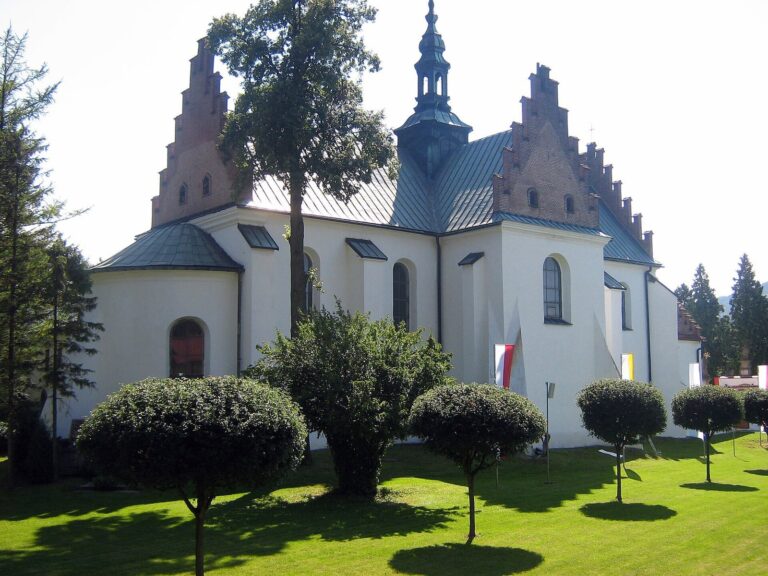
Saint James the Greater Church is a Roman Catholic filial church, an affiliated church that is not a parish’s principal building, in Myślenice, Poland. It belongs to the parish of the Nativity of the Blessed Virgin Mary. The present masonry church was built in the fifteenth century and is described as Gothic, with Neo-Gothic features, a later revival of Gothic architecture. Its dedication to Saint James the Apostle dates from 1815.
Early settlement and church
A settlement stood east of Stradom Hill in the thirteenth century, with a wooden church dedicated to the Nativity of the Blessed Virgin Mary. The church is recorded in 1325 and remained in existence in 1480. The present masonry building belongs to a later phase of the settlement’s history.
Destruction and renewed use
Swedish forces destroyed the church in 1655. It was restored more than a decade later. From 1800 to 1810, the building served as a military storehouse, after which it was offered at auction for demolition. Jan Traczowski, a townsman of Myślenice, purchased it and carried out extensive repairs. He transferred it to the town in 1815, the year it received its dedication to Saint James.
Nineteenth-century changes
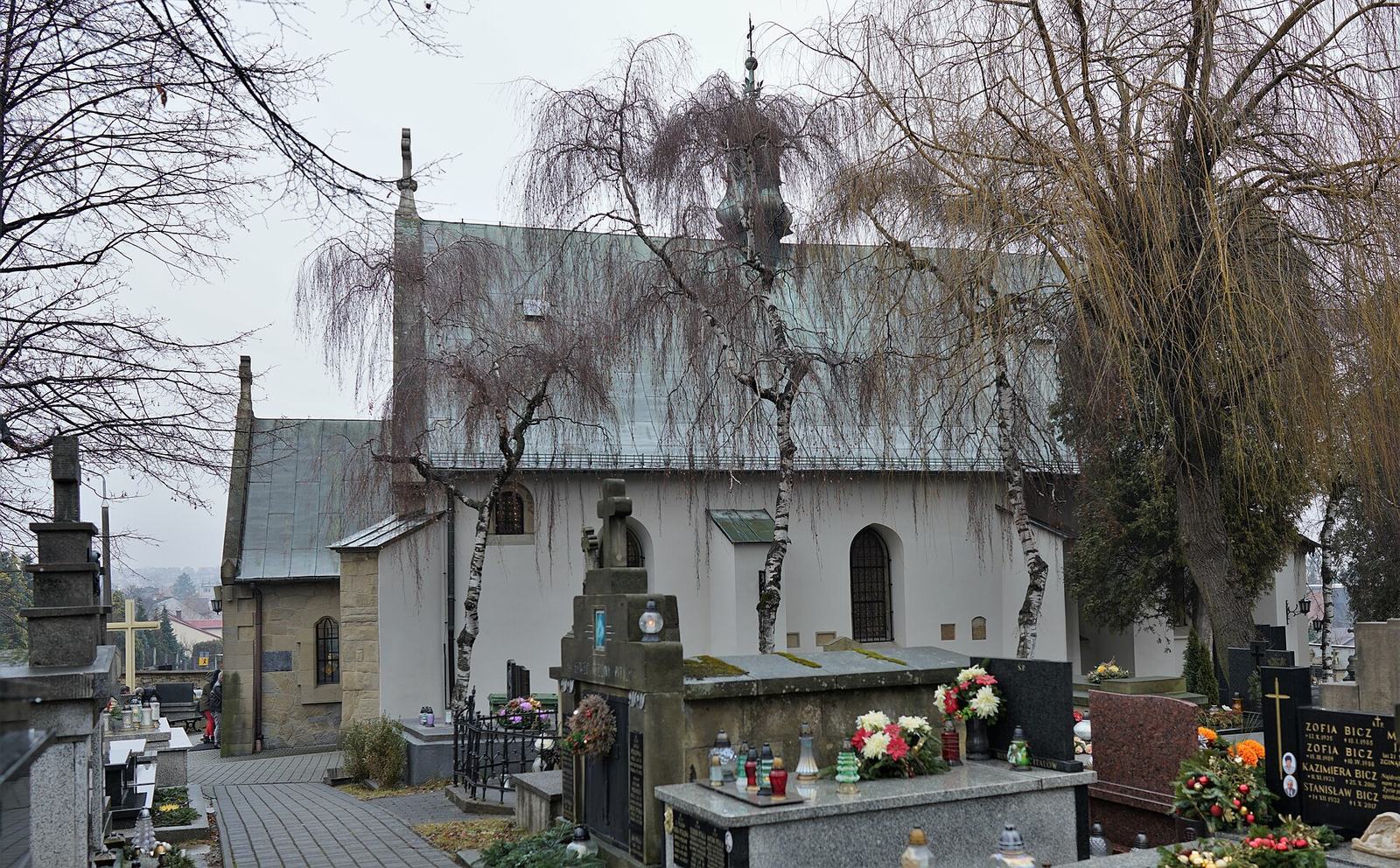
During the early nineteenth century, the cemetery was transferred from the area of present-day Orkana Street to the church’s immediate vicinity. It was enlarged westward around 1845.
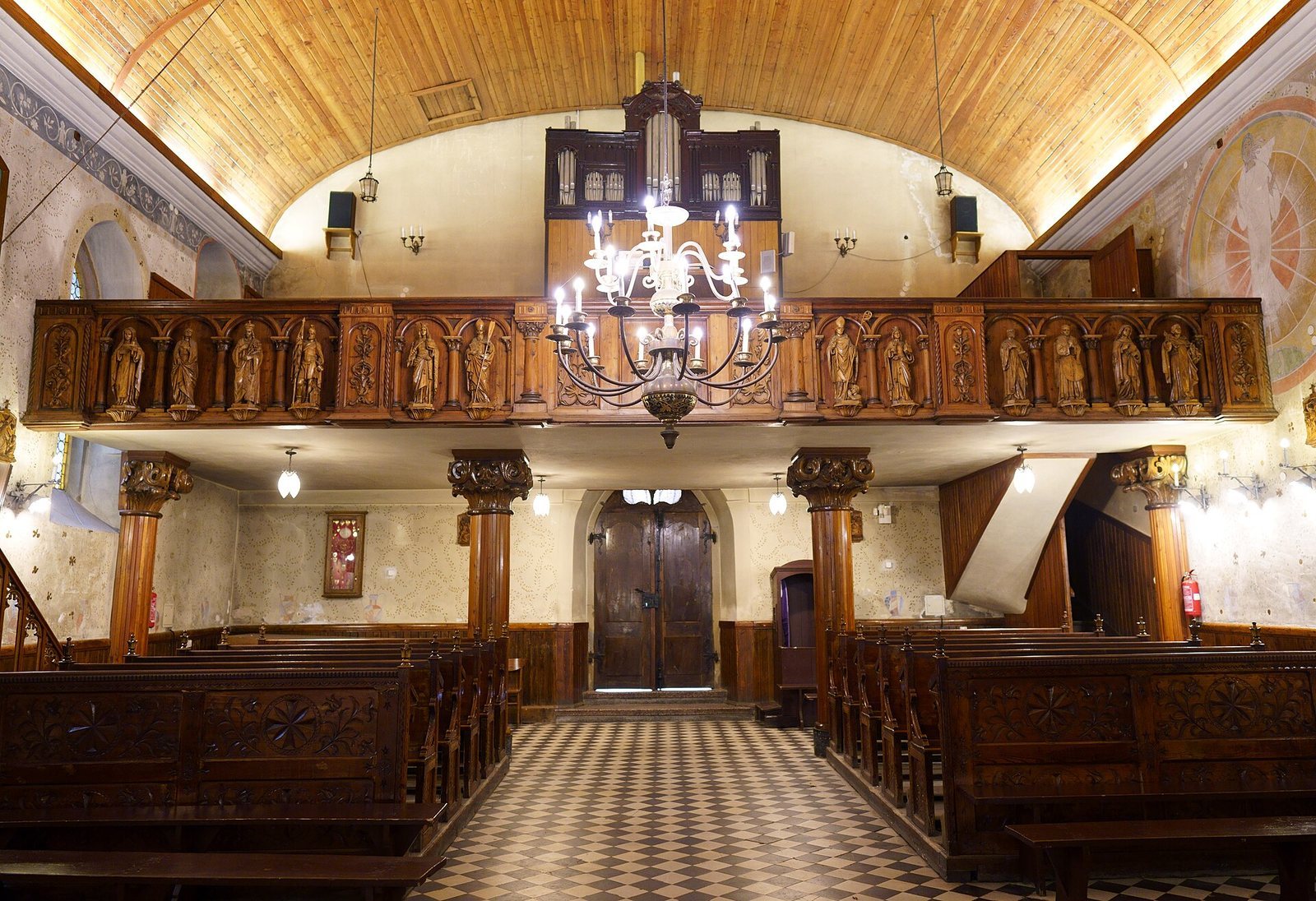
A new wooden ceiling was installed in the nave in 1886. In 1891, a bell tower, sacristy, and porch on the west side were added. Most of the church’s wooden furnishings were made to the designs of Walenty Wisz, an artist and woodcarver from Radziszów, during the 1880s and 1890s. Wit Wisz made the pulpit, funded by Henryka Gumińska in 1895.
Remains
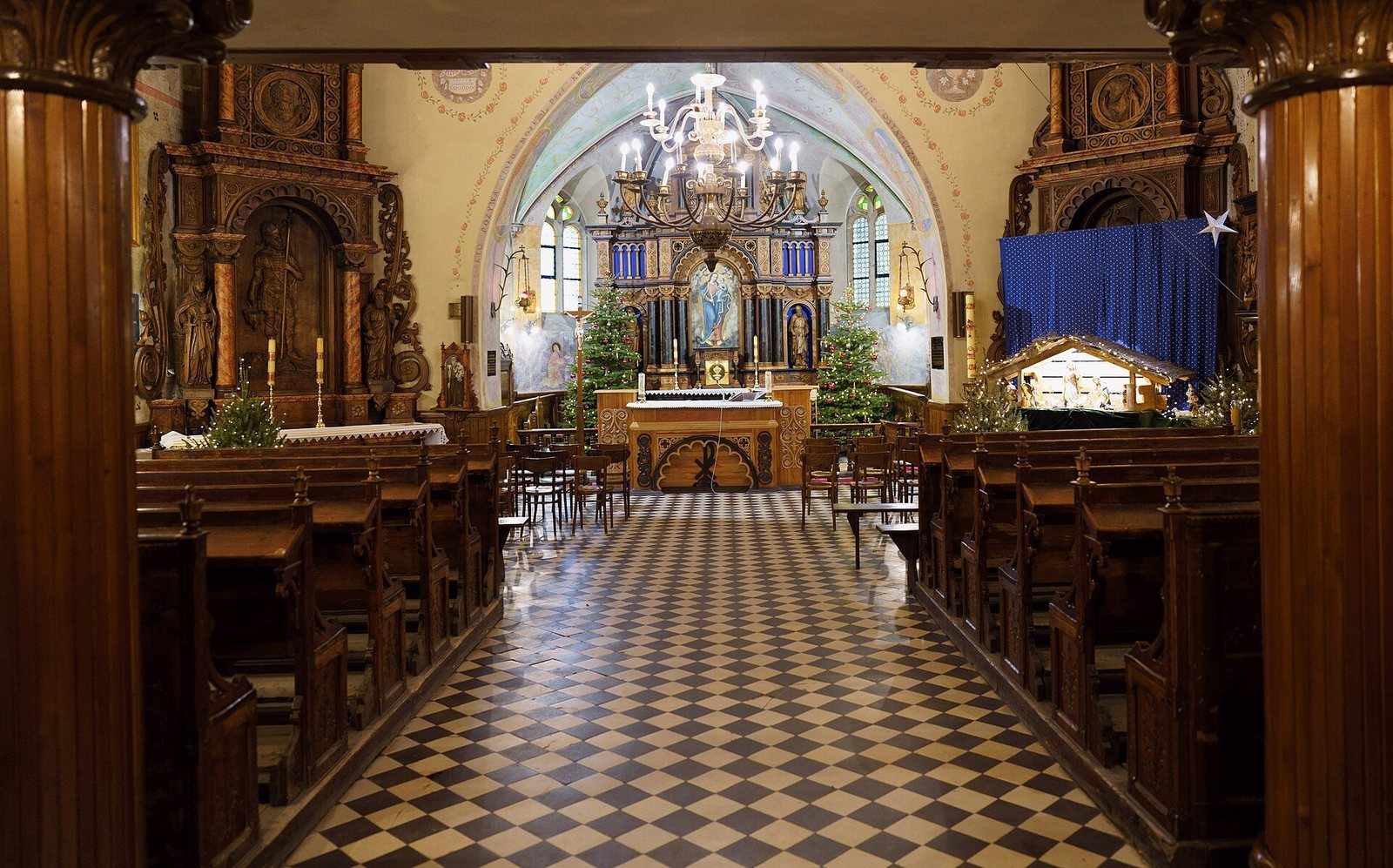
The church is a brick masonry building with a single nave, exterior buttresses, a narrower presbytery, and a three-sided eastern end. The presbytery, the area containing the main altar, is one step above the nave and enclosed by a railing. A west porch, sacristy, and single bell tower form part of the building. A pointed-arch doorway opens on the left side of the nave.
Altars
Main altar
The three altars were installed in 1886. The main altar has an eclectic design, chiefly Neo-Romanesque, a later revival of Romanesque architecture. Its two-tier decorated structure rises from a base. The central painting of the Virgin and Child was made by Jan Jerzyczko in 1814, after an earlier painting had been destroyed. A sliding panel carries a relief of Saint James the Less. Saints Paul and Peter stand in rounded-top niches between shallow wall-mounted columns, while a medallion of the Archangel Gabriel appears above them amid rays. The column surfaces imitate black marble, and the niches are Prussian blue. An inscription signed with the initials W.W. reserves the right to reproduce the altars.
Side altars
The two-storey altar to Saint Florian stands on the left side of the nave. Its central statue of Florian is flanked by Barbara and Simon, with a medallion showing Mary Magdalene above. Across the nave, the altar to the Archangel Michael has a central relief of Michael, figures of Saint Andrew the Apostle and Saint Catherine of Alexandria, and an upper medallion with John the Baptist. The sculptures and carvings are unpainted. Both altars have wing-shaped side ornaments, and their cornices and column shafts are marbled in reddish ochre.
Interior furnishings
Pulpit
The pulpit, a raised platform from which clergy preach, is supported by a tree-trunk-shaped column. Its branches and roots extend into a three-step stone base, with carved symbols of the Evangelists between them: an angel for Matthew, an ox for Luke, a lion for Mark, and an eagle for John. Figures of the four Evangelists decorate the pulpit itself. On its back, a relief depicts Christ carrying the Cross and bears the signature W. Wisz. Plant ornament decorates the straight steps. The openwork railing has semicircular arches with black-painted strips and cornices. Above, a canopy shaped like bound palm leaves shelters a dove representing the Holy Spirit within a radiant frame.
Choir loft
The elevated gallery for singers or musicians was made by Wisz in collaboration with Wojciech Samek, who operated an artistic sculpture workshop in Bochnia from 1885. Its figures include Stanislaus the Bishop and Martyr, Adalbert, Hedwig of Silesia, Kinga, Florian, John Cantius, Casimir, Vincent Pallotti, Stanislaus Kostka, Jolenta, Teresa of Avila, Hyacinth, and Michael the Archangel, positioned in the middle.
Other interior features
A window in the southeast wall at the end of the presbytery has mullions, which divide it into sections, and tracery, ornamental framework within the window. Other features include two late-Baroque benches, in the ornate style associated with seventeenth- and eighteenth-century Europe, and a wooden Baroque crucifix from the seventeenth century. Several modest epitaphs commemorate townspeople of Myślenice. A small shrine on the presbytery’s east wall contains a seventeenth-century fresco, Head of Christ.
Cemetery
Individual graves
The oldest surviving grave and monument in the cemetery is that of Wojciech Mossor, dated 1849. The cemetery also holds the graves of Piotr Pitala, Emil Schünke, Jan Schally, Edward Klebert, and Andrzej Marek, participants in the January Uprising, the Polish revolt against Russian rule in 1863–1864. Schally served as Myślenice’s mayor in 1868–1870 and 1879–1883, Klebert in 1912–1914, and Marek in 1874–1878. A relief of an angel embracing a child marks the grave of Eugenia Klakurkowa, who died in 1890, and her daughter Maniulka, who died in 1891. Wisz made the relief.
Other named graves include those of Stanisław Majewski; Eugeniusz Uchacz, a soldier of the First Brigade of the Polish Legions, which served during the First World War; and Michał Kostrzewski, a participant in the November Uprising, the Polish revolt against Russian rule in 1830–1831. A symbolic gravestone commemorates Lieutenant Colonel Jan Dunin Brzeziński. The cemetery also contains graves of Jan Szczęsny Płatkowski, Władysław Ponurski, and Rajmund Bergel, as well as seven Polish soldiers. Many gravestones have since been restored.
Collective graves and memorials
Eleven collective grave plots hold 194 Soviet soldiers of the Red Army’s 38th Army, 4th Ukrainian Front. The Tomb of the Unknown Soldier has a slab dated 1925 and a plaque bearing the names of 120 Myślenice residents who fell or were killed between 1939 and 1945.