Hollow Church: An Eleventh-Century Croatian Coronation Church


Site at a Glance
- Rating
- 4.5
- Popularity
- Low
- Country
- Croatia
- Primary era
- Medieval
- External website
- Open
- Eras represented
- Medieval
- Civilizations
- Byzantine, Kingdom of Croatia
- Site type
- Religious
- Remains
- Church
On this page12 sections
History
Hollow Church, formally the Church of Saints Peter and Moses, is an eleventh-century Croatian church in Solin, Croatia, built over an earlier Early Christian cemetery basilica. Located east of ancient Salona and northeast of Our Lady’s Island on the right bank of the Jadro River, it combined early Croatian and pre-Romanesque architecture with forms spread by Benedictine monks during the mid-eleventh century. It was the largest early Croatian church in the region at that time and became closely connected with the ruling house.
From the Early Christian Basilica to the Medieval Church
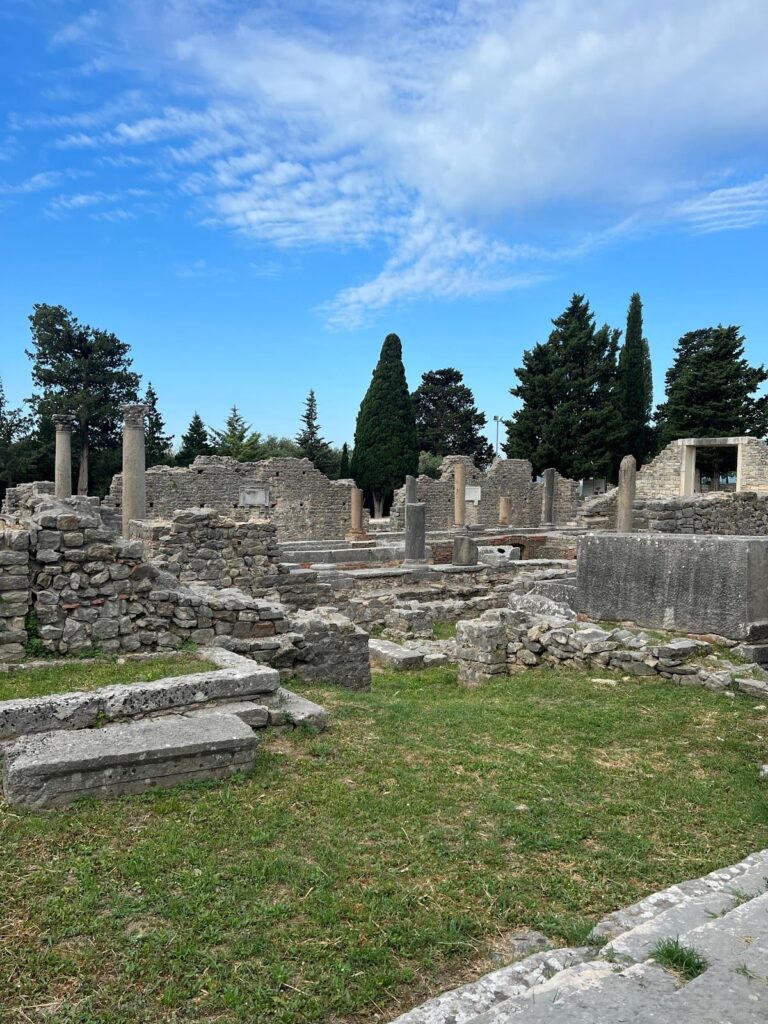
The church replaced a sixth-century cemetery basilica with a transept and a large apse. Before the new building was raised, the earlier church was dismantled, although much of its architectural material was reused. The remains of this first basilica can still be seen within the archaeological site, preserving evidence of the place’s earlier Christian use.
The eleventh-century building stood beside a Benedictine monastery. The monastery’s abbot, Urso, was a friend of King Zvonimir, and this connection helped give the church a central place in the political and religious life of the period. The Benedictines followed the Rule of Saint Benedict, and their presence in this setting accompanied the spread of new monastic and architectural forms in eleventh-century Croatia.
The Coronation of Dmitar Zvonimir
On Sunday, 8 October, in 1075 or possibly 1076, Dmitar Zvonimir was crowned at the church on the feast of Saint Demetrius. Gebizon, an abbot and papal legate, and Bishop Fulk acted as envoys of Pope Gregory VII, who led the Roman Church from 1073 to 1085. They presented Zvonimir with a crown, sword, scepter, and banner as symbols of royal authority.
The ceremony followed the model used for Roman-German emperors and other European kings. Zvonimir is described as the first and last Croatian king crowned in this manner. His coronation established the church as a setting where Croatian royal authority was expressed through both local tradition and wider European ceremony.
Destruction, Changing Ground Levels, and Investigation
A map preserved in the Zadar archives and dated 1571 shows the church with an intact bell tower. During the war between Venice and the Turks, parts of the building and its roof were demolished. In the seventeenth century, the damaged structure became known as Hollow Church, the name used by the surrounding population.
The landscape around the church later changed as alluvial deposits accumulated. A nearby stream carries silt from Rižnica into the Jadro, and the church, once standing above the river level, now has its pavement below it. The site therefore reflects the long-term reshaping of the Solin monument landscape by the river. Archaeological excavations began in the 1920s, followed by restoration work in the 1950s. The most extensive investigations took place from 1990 to 1993, and systematic archaeological research continues. The ruin remains threatened by the waters of the Jadro and by the adjacent road. It is protected as immovable cultural and archaeological heritage under designation Z-6095.
Remains
Overall Form and Earlier Basilica
The surviving church is a three-aisled, three-apsed basilica about 26.30 metres long and 13.60 metres wide. Four columns separated the aisles, while pilaster-like projections on the inner and outer faces of the walls followed the same axes. Roman, pre-Romanesque, and Byzantine elements appear together in the design. The eastern wall had a flat exterior, with a central rectangular apse and two semicircular side apses set within the wall’s thickness, a form associated with Roman building practices.
Visible remains of the sixth-century cemetery basilica lie within the archaeological area. That earlier building had a transept and a large apse, and its reused architectural material became part of the later church. The present ruin is partly submerged because the bed of the Jadro has risen.
Entrance and South Side
Western Narthex
A narthex, or entrance vestibule, occupied the western end of the church. It contains the remains of stairs that may have belonged to a bell tower or to a structure attached to the west side. A Roman sarcophagus was also placed in this area. It may have held an important person from the early Croatian period, possibly a king closely associated with the church, but the identity of the deceased remains uncertain.
South Bell Tower
A bell tower stood on the south side of the church, where several steps survive. Its presence is also shown by the 1571 map, which depicts the tower intact before later wartime destruction altered the building.
Sanctuary and Stone Furnishings
Altars and Chancel Screen
The central altar was dedicated to Saint Peter the Apostle, while the two side altars formed a dedication associated with Saints Peter and Moses. Moses, the biblical prophet and lawgiver, was represented alongside Saint Peter, a central figure in Christian tradition. Above the main altar stood a white-stone chancel screen, a barrier separating the sanctuary from the main body of the church. It had three entrances, an arrangement considered unusual in the region.
One relief slab from the screen shows a ruler or another figure in a proskynesis composition, a courtly gesture of homage before a ruler derived from Byzantine ceremony. E. Dyggve, an archaeologist and architectural historian, interpreted the figure as King Zvonimir receiving the homage of his subjects after his coronation. Other interpretations identify it as Peter Krešimir IV or as Christ Pantocrator, the Byzantine image of Christ as the all-ruling sovereign. The figure’s identity remains uncertain.
Inscription and Carved Panels
A Latin inscription above the royal doorway of the chancel screen reads, “Saint Peter, receive the gift of the honorable Moses, your servant.” Other stone furnishings found inside the church include four fragments bearing human figures. Sculptures from the altar screen may correspond to pieces now kept in Split Cathedral, while some scholars connect the carved stone panels, or plutei, forming the baptismal font in the Church of Saint John in Split with Hollow Church. These identifications remain interpretive rather than certain.
Nearby sites