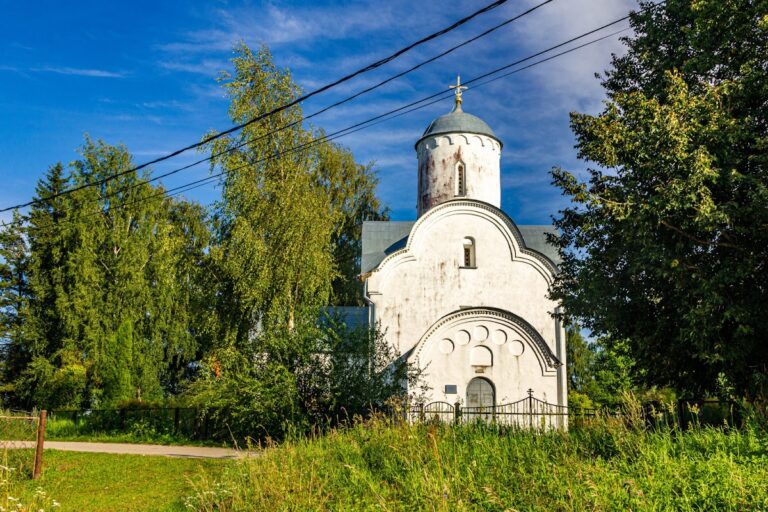
Derevianitsky Monastery: A Former Orthodox Monastery in Veliky Novgorod


Site at a Glance
- Rating
- 4.6
- Popularity
- Very Low
- Country
- Russia
- Primary era
- Early Modern
- Eras represented
- Early Modern, Modern
- Civilizations
- Russian
- Site type
- Religious
- Remains
- Monastery
On this page10 sections
History
Derevianitsky Monastery is a former Orthodox monastery in Russia, located in Veliky Novgorod. Founded in the 1330s, it is first mentioned in 1335, when a chronicle recorded the construction of a stone Resurrection Church at Derevianitsa.
Medieval and early modern monastery
In the fourteenth and fifteenth centuries, the monastery became a place of retirement for former Novgorod archbishops. Archbishop Alexy died there in 1389, while Archbishop John, after taking the monastic schema, lived at Derevianitsa from 1414 to 1417. The monastic schema was a higher degree of Orthodox commitment associated with intensified ascetic obligations.
During the Time of Troubles, a period of political crisis, dynastic uncertainty, foreign intervention, and warfare in Russia in the early seventeenth century, the community of Konevsky Monastery was evacuated to Derevianitsa. The Konevskaya Icon of the Mother of God, associated with Konevsky Monastery on Konevets Island in Lake Ladoga, remained at Derevianitsa until 1799. The monastery’s bells were taken to Sweden during the same period.
Rebuilding the Resurrection church
In 1695, construction began on a new church to replace the dilapidated earlier building. Two masons’ artels, or cooperative work groups, undertook the project: one was associated with Foma Alekseev from Kostroma County and the other with Nikita Kipriyanov from Yaroslavl County. The completed church collapsed to its foundations in 1697.
In 1700, Metropolitan Job instructed the same two artels to build a new Resurrection Cathedral on the site of the two earlier churches. A metropolitan was a senior Orthodox bishop responsible for a major ecclesiastical province. Chapels were added to the cathedral later, completing the central church of the monastery complex.
Women’s monastery and diocesan school
In 1875, Derevianitsky Monastery was converted into a women’s monastery. A school for girls from the clergy was established there and reorganized in 1882 as the Novgorod Diocesan Women’s School. In 1884, a three-story stone school building was constructed to a design by provincial architect R. K. Krzhizhanovsky and consecrated by Isidore, Metropolitan of Novgorod and Saint Petersburg. Archbishop Anthony Znamensky lived at the monastery in retirement during the 1820s.
Modern preservation and status
For many years, the Resurrection Cathedral served as a warehouse for finished products from the nearby Steklovolokno factory. Its deteriorating condition prompted emergency preservation work in June 2015, including temporary roofing over two of its drums. As of 2021, the monastery complex was federally owned. Churches had repeatedly been offered to the Novgorod Diocese and the Novgorod United Museum-Reserve, but neither institution had accepted responsibility for the complex. Derevianitsky Monastery is designated a cultural-heritage property of federal significance in Russia.
Remains
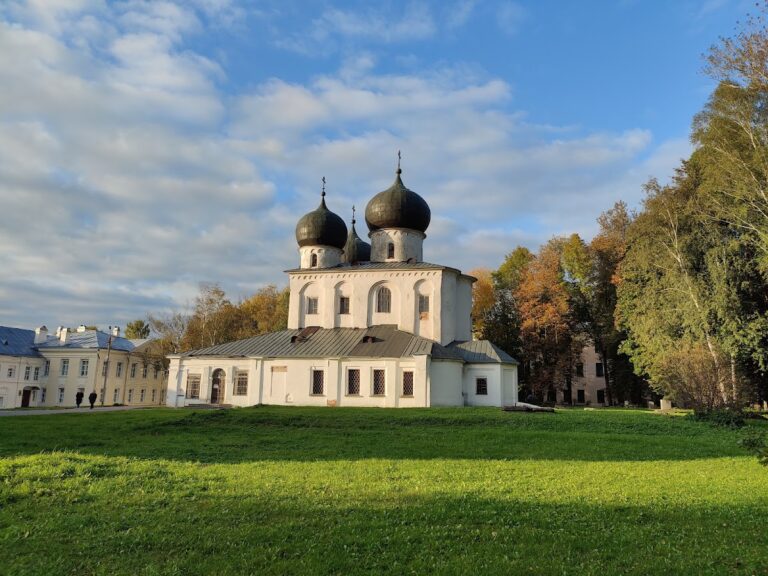
The monastery stands in the Derevianitsa district of northern Veliky Novgorod, on the right bank of the small Derevianka channel. A road through Derevianitsa leads toward Khutynsky Monastery. The surviving complex includes the five-domed Resurrection Cathedral, the Church of the Dormition of the Mother of God with its refectory and bell tower, the former diocesan school, and bronze bells associated with the monastery.
Resurrection Cathedral
The Resurrection Cathedral is a five-domed stone building with a two-pillar plan. Its complex vaulted structures are supported internally by two pillars, an arrangement unusual in Novgorod architecture but widespread in the sixteenth and seventeenth centuries in the Moscow and Volga regions and in the Vologda lands. The cathedral is now in unsatisfactory condition. The cupolas or finials of two domes are missing, while the surviving ones are unsafe. One dome collapsed in 1995, the central dome in October 2013, and a third in March 2021. The collapsed domes had stood since the postwar restoration of 1965.
Church and refectory
North of the Resurrection Cathedral stands the stone Church of the Dormition of the Mother of God, built in 1725. It forms a group with a large refectory chamber and a bell tower, all constructed as part of the monastery’s eighteenth-century expansion.
Former diocesan school
The former women’s school is a three-story stone building erected in 1884. The building now houses the inpatient facility of the Novgorod regional substance-abuse clinic known as Katarsis.
Recovered monastery bells
Two bronze bells associated with Derevianitsky Monastery were recovered in 1987 from the seabed of the Gulf of Finland near Mulon Island by an expedition of the Helsinki Maritime Museum. One of the bells is dated 1596.