Convento di San Fermo: A Benedictine Monastery and Romanesque Church in Bergamo

Site at a Glance
- Rating
- 4.7
- Popularity
- Very Low
- Country
- Italy
- Primary era
- Medieval
- External website
- Open
- Eras represented
- Medieval, Early Modern
- Civilizations
- Venetian
- Site type
- Religious
- Remains
- Monastery
On this page13 sections
History
The convent of San Fermo is a former Benedictine monastery and Romanesque church in Bergamo, Italy, founded in 1154 in the locality then known as Plorzano. Its foundation was confirmed on 19 March of that year by a papal bull, a formal document issued by the pope for major ecclesiastical decisions, from Pope Anastasius IV. The monastery belonged to a community of Benedictine nuns, whose religious life followed the Rule of Saint Benedict and required communal prayer, work, and enclosure. The complex is now integrated into Borgo Santa Caterina, a district that once lay well beyond Bergamo’s urban center.
Foundation and episcopal protection
The monastery was known as in campis, or San Fermo in Plorzano. Plorzano had been the name of the locality since 1020, before it became Borgo Santa Caterina in 1256. A possible connection between the earlier name and a Roman patrician has been proposed, but its origin remains uncertain.
Anastasius IV’s bull placed the monastery’s property under episcopal protection. These possessions included San Maurizio and lands belonging to Bergamo. In 1156, Bishop Gerardo granted the former church of San Giovanni of Antegnano to San Fermo in exchange for an annual payment. Gerardo was later deposed as a schismatic, and the donation connected the monastery closely with the Diocese of Bergamo.
The nuns defended their rights in a series of disputes. They prevailed against the monastery of Santa Margherita in Brembate Sotto over rights to a church, and in 1181 they also contested rights with the churches of Cologno and San Giovanni of Antegnate.
Suppression and continued religious use
The municipality of Bergamo designated the monastery as a lazaretto in 1399 during severe epidemics in the area, although that decision was later revoked. An expansion in 1520 did not secure the institution’s future. On 8 December 1568, Pope Pius V authorized the union of the nuns of Bergamo with the community of San Pietro at Borgo di Terzo.
The remaining nuns resisted the measure until 1575. During a pastoral visitation, Saint Charles Borromeo, the cardinal and archbishop of Milan who played a major role in Catholic reform after the Council of Trent, confirmed an earlier decision by Bishop Federico Cornaro that the convent was too isolated. Its definitive closure was decreed on 15 September 1575. The remaining nuns moved to the monastery of San Benedetto together with the nuns of Valmarina.
The church dedicated to Saint Fermo continued to function after the monastery closed and remained a place of worship. In 1676, Giuseppe Cesareo’s fresco of the Miracle of the Water of Saints Fermo, Rustico, and Procolo was restored, and work was also carried out on the presbytery vault. The monastery later became active again, but it was suppressed during the Napoleonic occupation. A decree of 4 November 1824 authorized its reopening.
San Maurizio and the cemetery
A church dedicated to Saint Maurizio, with an attached cemetery, stood in the Plorzano area and was granted to the abbess of San Fermo in a document of 1154. Its foundation was considered ancient. Donato Calvi, a Bergamo historian and chronicler, possibly associated it with the Carolingian period.
The cemetery was used for plague burials in 1630 because of its proximity to the lazaretto. In 1658, the nuns transferred San Maurizio to Ventura Donadoni and Giovanni Battista Cividini, who established a confraternity for burying the sick. On 17 April 1665, the confraternity buried plague victims from other parts of Bergamo, perhaps because the location stood at a distance from the urban center.
San Maurizio was demolished in 1808 so that the cemetery area could be enlarged. After Bergamo built a single large city cemetery, the site ceased to serve as a cemetery and became part of its peripheral area.
Restoration and maintenance
Luigi Angelini directed a restoration of the church in 1958. The work reopened high openings in the side elevation and contributed to the present understanding of the medieval building. The entire convent complex underwent maintenance in 1989.
Remains
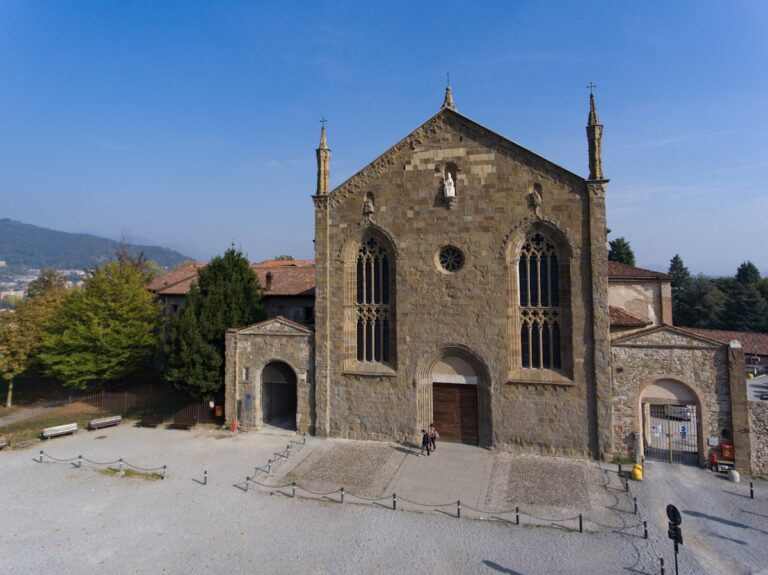
The surviving complex combines a small Romanesque church with elements of the former convent enclosure. The church has a single nave, a gabled front, and a south-side cloister with a covered gallery. Roughly dressed stone is visible in the bell tower, while the church retains its original wooden roof and a presbytery covered by a pavilion vault, whose surfaces rise toward a central crown over a roughly square or polygonal space.
Church fabric and decoration
Facade and side elevation
The church’s gabled facade has an architraved portal. Its left doorjamb incorporates an ancient marble fragment carved with two bucrania, or bull-head motifs, and a garland decorated with ribbons. Along the side elevation, two single-lancet windows and other high openings contribute to the building’s medieval character. Several of these higher openings were reopened during the 1958 restoration. The bell tower is constructed from roughly dressed stone blocks.
Interior and presbytery
Inside, the single nave preserves the original wooden roof. The presbytery has a pavilion vault, and a small number of fifteenth-century frescoes remain visible. The right-hand wall was associated with the relics of Saints Fermo, Procolo, and Rustico, the three saints to whom the church was dedicated.
Relics and painted works
The reliquary ark containing the saints’ relics is set below the church floor. According to the tradition attached to the relics, Bergamese merchants brought them from Verona to Bergamo on 4 January 855. They were kept at Plorzano outside the city walls until 1575, when Saint Charles Borromeo ordered their transfer to the altar dedicated to them in Bergamo Cathedral.
The wall near the reliquary was decorated with Giuseppe Cesareo’s fresco of the Miracle of the Water of Saints Fermo, Rustico, and Procolo, restored in 1676. The church also preserved Gian Paolo Cavagna’s painting of the Miracle of the Water Gushing from the Ark of Saints Fermo, Rustico, and Procolo. That painting was later transferred to San Benedetto in Bergamo.
Convent enclosure
Former matroneum and cloister connection
The church formerly contained a wooden matroneum, an elevated gallery traditionally used by women worshippers or members of a religious community. It was connected with the cloister loggia, an open-sided gallery, allowing the nuns to attend the liturgy and move through the complex while maintaining enclosure.
South cloister and portico remains
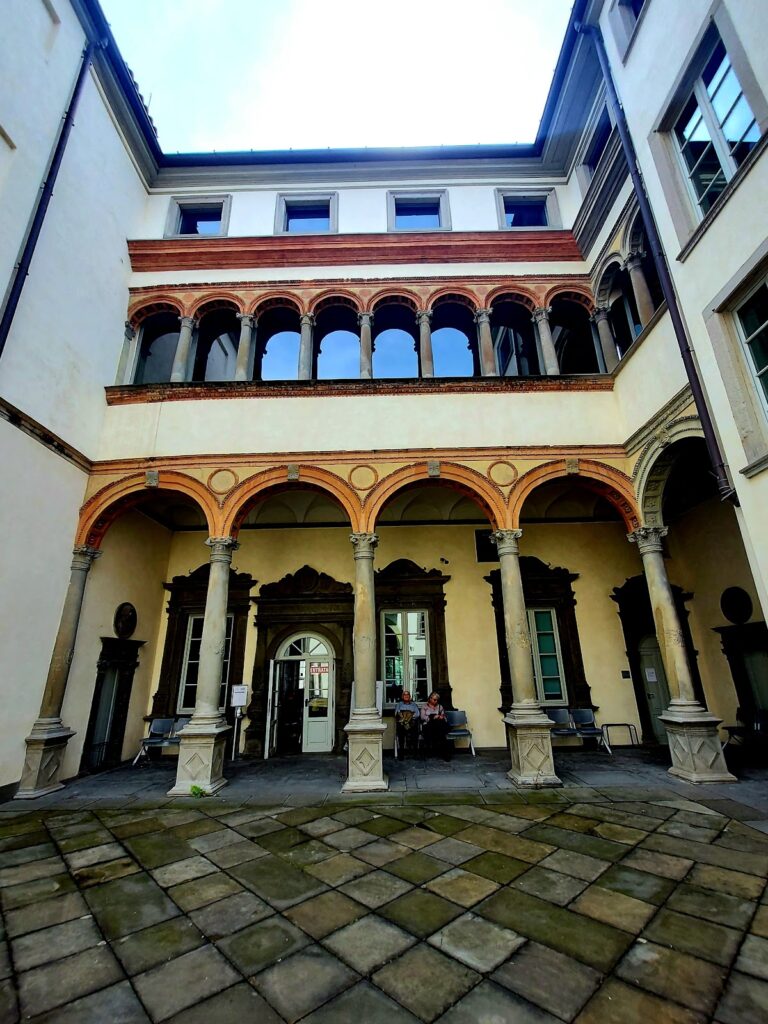
A small cloister survives on the south side of the church. Its loggia occupies three sides and is formed by round arches resting on squat columns with spherical-cubic capitals. Remains of an orthogonal portico are present at two side entrances, preserving further evidence of the convent’s circulation spaces and enclosed plan.
Nearby sites