Franziskanerkloster Greifswald: A Medieval Franciscan Monastery in Germany


Site at a Glance
- Rating
- 4.6
- Popularity
- Low
- Country
- Germany
- Primary era
- Medieval
- External website
- Open
- Eras represented
- Medieval
- Civilizations
- Duchy of Pomerania
- Site type
- Religious
- Remains
- Monastery
On this page9 sections
History
Franziskanerkloster Greifswald was a Franciscan monastery in Germany, founded in Greifswald on 29 June 1262. Also known as the Grey Monastery after the colour of the Franciscan habit, it existed from the thirteenth to the sixteenth century and became an important religious and civic institution in the town.
Foundation and early development
The monastery was established on land donated by the Counts of Gützkow. One of the foundation’s principal purposes was to provide a suitable burial place for the countly family. A long-standing tradition placed the foundation in 1242 and attributed it to Jaczo von Salzwedel and his wife Dobroslawa. From the 1930s, however, this interpretation was challenged. Robert Klempin identified the couple as Jaczo I and Dobroslawa and altered the date to 1242, while Adolf Hofmeister argued in 1937 that they were Jaczo II, a grandson of Jaczo I, and his wife Cecislawa von Putbus. The inscription once associated with the foundation was no longer present by 1743.
The 1262 foundation probably followed Greifswald’s receipt of Lübeck law by twelve years. Lübeck law was an urban legal system used by towns around the southern Baltic, and Greifswald received it from Duke Wartislaw III. The earlier foundation date had been used to suggest stronger external influence over the town, but that interpretation became less plausible because Greifswald was already acting in 1262 as a treaty partner alongside the duke and the Norwegian king. The monastery nevertheless reduced the ecclesiastical influence of Eldena Monastery, which held the patronage of Greifswald’s three parish churches.
The Franciscan convent and the town
The convent belonged to the Stettin Custody of Saxonia, the Franciscan province covering Saxon and northern German territories. A custody was a regional subdivision of a Franciscan province, while a guardian led an individual convent. In 1264 and 1265, the custodian of the Stettin Custody and the guardian of the Greifswald convent appeared as prominent witnesses to documents issued by Wartislaw III. From the late thirteenth century, and particularly during the early fourteenth century, friars from the convent more often witnessed documents and privileges issued for the Greifswald council.
From at least the beginning of the fourteenth century, Greifswald’s town government sought to regulate the growth of its monasteries. Church councillors who belonged to the town council supervised land purchases. In 1305, the council approved a tower with a privy for the monastery at the southern town wall, while keeping authority over the structure. The strip beside the wall remained town property because it needed to stay accessible for defence.
Werner Hilgemann, a member of one of Greifswald’s leading council families, was the first identifiable guardian of the monastery, around 1330. In 1348, the Hilgemann family financed the rebuilding of the church choir and established its burial place there. The church also had a prominent civic function. As the monastery church closest to the market, it had seating reserved for the council, like Greifswald’s parish churches. Before a new mayor was elected, the full council was required to assemble there for Mass, an obligation included in Heinrich Rubenow’s town constitution of 1451.
University and Franciscan reform
The monastery was connected with the founding of the University of Greifswald in 1456. The Franciscan theologian Nikolaus Vermann delivered the university’s inaugural address and taught theology there, while several other members of the convent enrolled as students.
During the fifteenth century, the Franciscan Order pursued the Observance movement, a reform that called for stricter discipline and a renewed rejection of personal property in keeping with the poverty ideal associated with Francis of Assisi. In 1461, the Bishop of Brandenburg and the Archbishop of Magdeburg ordered a visitation of the Greifswald monastery. Reform initially faced resistance, and the university’s law faculty, which had been asked to provide legal assistance, considered itself unable to offer a competent opinion.
The monastery was finally reformed in 1480 under the moderately strict Martinian Constitutions. The reform was supervised by Provincial Eberhard Hillermann, Guardian Nikolaus von Buge, and the Greifswald council. In 1518, the Franciscan leadership divided Saxonia, and Greifswald joined more than seventy monasteries in the Martinian Province of St John the Baptist. In 1550, it became part of the Observant Province of the Holy Cross.
Dissolution and later institutional use
After the Reformation reached Pomerania, the monastery was initially tolerated. It could receive no new members and had to follow the Pomeranian church order, although the Franciscans were allowed to remain there for the rest of their lives. In autumn 1556, the provincial of the Province of the Holy Cross ordered the monastery’s transfer to the town council. The Franciscans retained the foundation charters and parts of the furnishings, while the town converted the buildings for a municipal school and an institution for the poor.
The former monastery library was incorporated into the library of the Dominican monastery in St Nicholas Cathedral after the dissolution. The books had been transferred to Greifswald Cathedral by 1602, where they helped form the foundation of the library of the Spiritual Ministry, the clerical body responsible for church administration. The monastery’s former Guardianshaus later gained new civic uses. Municipal collections moved there in 1928, and the Greifswald Museum opened in the building the following year. The former monastery library subsequently became the administration building of the Pomeranian State Museum.
Remains
Layout and church
The monastery stood southeast of Greifswald’s market square and extended toward the town wall. Its position placed the church close to the market, while the southern edge of the complex reached the defensive boundary of the town. In 1305, a tower with a privy was approved at this wall, but the adjoining strip remained under municipal control so that it could be used for defence. The church contained the choir rebuilt in 1348 with support from the Hilgemann family, who used it as their burial place. The church also held reserved council seating and served as the place where the town council assembled for Mass before a mayoral election.
Guardianshaus and library
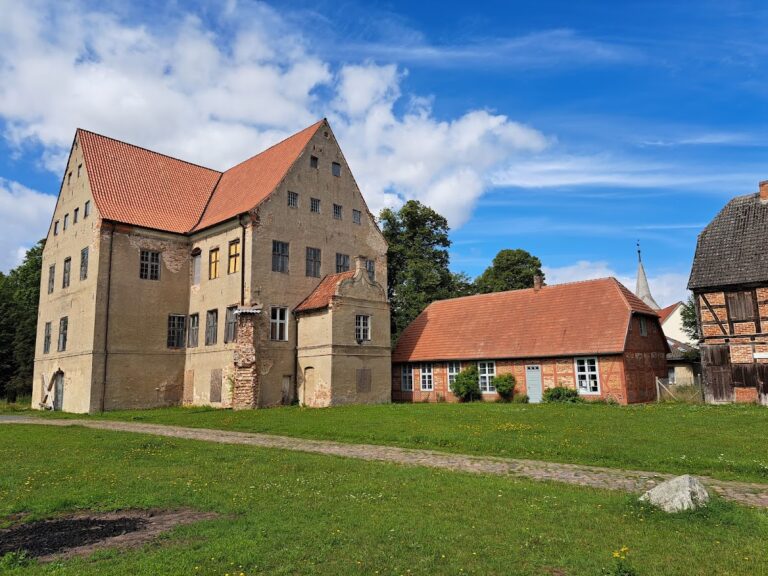
The Guardianshaus, the monastery’s former library building, is the only surviving part of the medieval building fabric. Its later use for municipal collections, followed by its role as the administration building of the Pomeranian State Museum, gave the structure a continuing institutional function. The former monastery grounds now include the Pomeranian State Museum.
The library contained approximately 406 books in 1545. A catalogue from 1599 listed 174 printed works and 44 manuscript volumes, consisting mainly of theological writings alongside smaller groups of legal and philosophical works. Among the collection’s most valuable early printed books was a three-volume biblical commentary by Nicholas of Lyra, a widely circulated medieval commentator on the Bible. Katharina Rubenow, widow of the murdered mayor Heinrich Rubenow, donated the commentary to the monastery in 1484.
Pre-Reformation artworks
Seven terracotta figures were found during renovation work in 1985. They are the only surviving evidence of figural art from the monastery’s pre-Reformation period and preserve a material link to the religious furnishings and artistic culture of the former Franciscan complex.
Nearby sites