Dealu Monastery: A Medieval Wallachian Orthodox Monastic and Printing Centre


Site at a Glance
- Rating
- 4.8
- Popularity
- Medium
- Country
- Romania
- Primary era
- Medieval
- External website
- Open
- Eras represented
- Medieval
- Civilizations
- Ottoman, Principality of Wallachia
- Site type
- Religious
- Remains
- Monastery
On this page13 sections
History
Dealu Monastery is an Orthodox nunnery in Romania, situated on a hill about 6 kilometres north of Târgoviște. Its present church and monastic complex were rebuilt in the late medieval period under Wallachian rulers, with the main reconstruction taking place between 1499 and 1501. The monastery became a religious, educational, political, and dynastic centre, and its church remains associated with the rulers of Wallachia buried there.
Early foundation and princely rebuilding
A monastic settlement at Dealu is known from 1431. Tradition attributes an earlier foundation to Mircea the Old, the Wallachian voivode who ruled from 1386 to 1418. The first community may have been a male monastery with a wooden church, although the surviving complex belongs chiefly to a later rebuilding.
Radu the Great ordered the monastery to be rebuilt from its foundations between 1499 and 1501. The complex was completed during the rule of Vlăduț Voivode between 1510 and 1512 and was further developed under Neagoe Basarab. These princely interventions established the medieval form of Dealu and strengthened its position within Wallachian religious and political life.
Printing, learning, and political activity
In 1508, the Serbian hieromonk Macarie, a monk ordained as a priest, installed a printing press at Dealu. It was the first printing press in Wallachia and may also have been the first in the Romanian lands and the wider Balkans. The press produced the Liturgy Book in 1508, the Octoechos in 1510, and the Târgoviște Four Gospels in 1512. These books were printed in Church Slavonic, the liturgical and literary Slavic language traditionally used by many Orthodox churches, according to the orthographic traditions of the Tarnovo literary school.
Printing at Dealu ended after 1512, when Macarie became metropolitan of Wallachia, a senior Orthodox bishop governing a metropolitan province. The press returned in 1644, when Matei Basarab brought it from Govora. Work continued at Dealu until 1647 and preceded the major printing period of the Târgoviște Metropolitanate. Publications from this second phase included the Teaching Gospel, also called the Homiliary, in 1644, a new Liturgy Book in 1646, and The Imitation of Christ in 1647. Udriște Năsturel translated the last of these from Latin into Slavonic, producing what is described as the first known Slavonic translation of the work in the Romanian area.
Dealu also supported manuscript production and education. Calligrapher monks active at the monastery included Mihail Rusin, who died in 1613, and Matei of Myra, who died in 1624. The monastery served as a princely necropolis, a burial place for rulers, and was connected with political refuge, decision-making, and diplomatic activity.
War, decline, and restoration
On 9 June 1598, Mihai the Brave swore allegiance at Dealu to Rudolf II, the Habsburg emperor. Mihai entered an alliance with the Holy Roman Empire, a major Central European political entity whose Habsburg emperors supported campaigns against the Ottoman Empire. The agreement concerned military operations south of the Danube against the Ottomans and support for the First Tarnovo Uprising, an anti-Ottoman revolt centred on Tarnovo.
Mihai the Brave was killed at Turda on 19 August 1601. His head was brought to Dealu in 1603 and preserved in the monastery church. In December 1610, forces commanded by Gábor Báthory, the prince of Transylvania, plundered the monastery. Four years later, voivode Radu Mihnea found Dealu in decline and attached the village of Satu Nou to it, providing revenues for its support.
During the reign of Constantin Brâncoveanu, the church was repainted. The monastery later deteriorated, and during the Phanariote period, when Ottoman-appointed Greek princes from Constantinople commonly ruled Wallachia and Moldavia, it became largely deserted. Earthquakes in 1802 and 1838 damaged the complex. Gheorghe Bibescu restored it between 1844 and 1854, rebuilding the structures along the enclosure and the bell tower, which thereafter became known as Bibescu’s Tower.
Secularization and twentieth-century renewal
The monastery was secularized in 1863. From 1877 to 1878, the former enclosure was used as a prisoner-of-war camp for Ottoman prisoners. It later served military purposes, including a divisional officers’ school from 1879 to 1883 and an ammunition depot in 1890 and 1891. From 1902 to 1912, the buildings housed a school for army children. Between 1912 and 1940, they accommodated the Nicolae Filipescu Military High School at Dealu, whose pupils included Crown Prince Michael of Romania and, earlier, Corneliu Zelea Codreanu.
On 7 June 1925, a monument to officers, teachers, and pupils of the Dealu school who had fallen in war was unveiled according to a design by the architect Romano de Simon. The military-school buildings that had replaced parts of the former monastic complex collapsed in the earthquake of 1940. The November earthquake also brought down the church towers and the upper part of the bell tower.
The present monastery buildings and the renovation of the church date mainly from the 1950s, especially the campaigns of 1953 to 1959. Under Patriarch Justinian, the complex became a social-assistance institution for elderly priests and monks, which operated until 1988. Restoration in the mid-1950s renewed the church and monastery toward their earlier appearance. Dealu is now an active nunnery, and its museum operates under the Archdiocese of Târgoviște, presenting religious art, medieval monastic life, the history of printing at Dealu, and the princely necropolis.
Remains
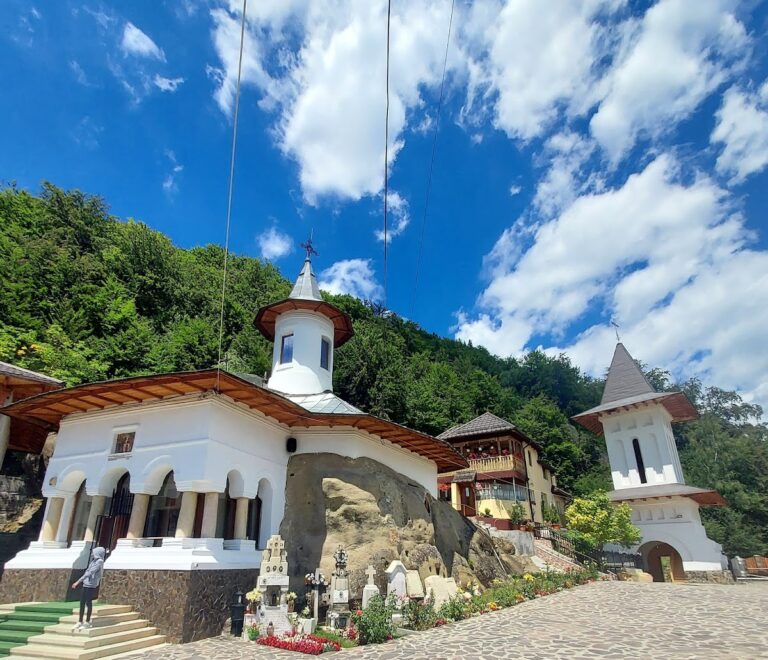
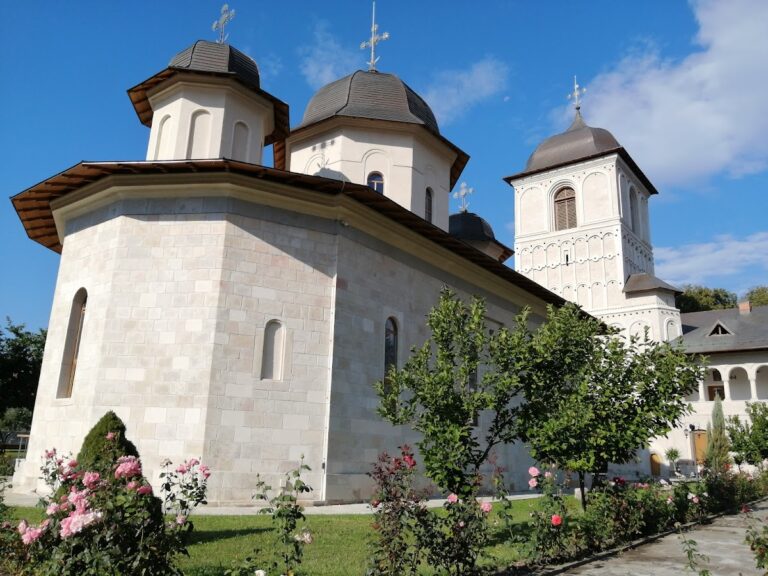
Dealu’s surviving complex is centred on the Church of Saint Nicholas, a slender medieval church with a three-lobed triconch plan, meaning that its eastern and lateral apses form three projecting curves. The church is built in the Vodița II type, a recognized form of triconch planning in medieval Wallachian architecture. It measures 8 metres in width, 21.20 metres in length, and 24 metres in height without the roof. The present monastery buildings belong chiefly to the reconstruction and renewal campaigns of the 1950s.
Church of Saint Nicholas
Plan and exterior
The church has a traditional tower above the naos, the principal congregational chamber, together with two towers over the eastern bay of the extended pronaos, the entrance or western vestibular space of an Orthodox church. This arrangement gives particular emphasis to the funerary purpose of the pronaos and influenced later churches at Tutana, Brebu, and Gura Motrului.
All of the façades are faced with dressed stone. Their decoration is organized in two levels of blind arches, which are recessed arches without openings, together with moulded bands separated by a central belt course. This treatment later became characteristic of sixteenth-century brick monuments in Wallachia. Caucasian ornamental motifs appear on the towers and western façade, and similar designs were later used more densely on the façades of the episcopal church at Curtea de Argeș.
Painting and princely burials
The original interior painting was created in 1515 by Dobromir of Târgoviște with Jitian and Stanciu. A later repainting under Constantin Brâncoveanu preserved the names of the painters Constantin, Preda, Nicolae, and Radu. The present painted decoration dates from 1985, when Archimandrite Sofian Boghiu, a senior monastic cleric, repainted the church.
The pronaos contains the tomb of Radu the Great and the reliquary preserving the head of Mihai the Brave. A reliquary is a container made to preserve a relic or other venerated remains. The marble sarcophagi of the two rulers were made by Frederic Storck in 1912 and 1913. Radu the Great is buried on the left side of the church, while Mihai’s preserved head is kept in a sarcophagus or reliquary in the pronaos.
The princely burials at Dealu include Vlad Dracul and his son Nicolae, Vladislav II, Radu the Great, Jupânița Caplea, Vlăduț or Vlad the Young, Radu Vodă Bădica, Vlad the Drowned, Pătrașcu the Good, Mihai the Brave, and Mihail Movilă, ruler of Moldavia. Together, these burials give the church a distinct dynastic and commemorative character within the monastery.
Enclosure, tower, and memorial
Former monastic enclosure
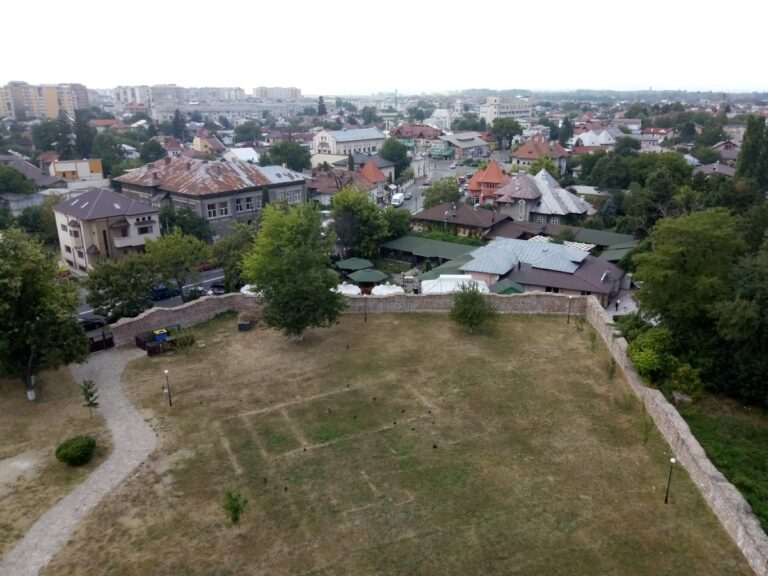
The former monastic enclosure contained buildings along its sides and a bell tower. The bell tower was rebuilt during Gheorghe Bibescu’s restoration and became known as Bibescu’s Tower. Military-school buildings later occupied the place of older monastic structures, but those buildings collapsed in the earthquake of 1940. The current monastery buildings belong to the reconstruction and renewal campaigns of the 1950s.
Heroes’ Monument
The Heroes’ Monument, unveiled in 1925, stands at Dealu and commemorates officers, teachers, and pupils of the Dealu high school who died in war. Designed by Romano de Simon, it bears the inscription, “Officers, teachers, and pupils of the Dealu high school who fell on the field of honor.”
Monastery museum
The monastery museum contains religious-art collections with cult objects, old icons, and ecclesiastical manuscripts. Its holdings also include medieval-art objects and material relating to the printing history of Dealu and the princely necropolis. The exhibitions connect the surviving church and monastic institution with the site’s roles in worship, learning, book production, and dynastic remembrance.
Nearby sites