D32: A Funnel Beaker Passage Grave in the Netherlands
Site at a Glance
- Popularity
- Very Low
- Country
- Netherlands
- Primary era
- Stone Age
- Eras represented
- Stone Age
- Civilizations
- Unclassified
- Site type
- Burial
- Remains
- Tomb
On this page7 sections
History
D32 is a Neolithic passage grave, a burial chamber reached through a passage, northwest of Odoorn in the Netherlands. It is attributed to the Western Group, a regional division of the Funnel Beaker culture, a northern European Neolithic culture named for its funnel-shaped pottery, and dates to 3470–2760 BC.
Nineteenth-century records
Nicolaas Westendorp mentioned the tomb in 1815, followed by R. Boelken in 1818. In 1847, Leonhardt Johannes Friedrich Janssen, curator of the Dutch antiquities collection at Leiden’s Rijksmuseum van Oudheden, visited D32. He included it in the first overview of Dutch megalithic tombs, published in 1848.
In 1874, Willem Pleyte, Janssen’s successor, and photographer Jan Goedeljee made a systematic photographic record of Drenthe’s megalithic tombs. Pleyte also created lithographs from the photographs. Three years later, museum director Conrad Leemans visited Drenthe, and Jan Ernst Henric Hooft van Iddekinge drew plans of the tombs for him. Leemans’s report was not published.
Archaeological recording and conservation
Between 1904 and 1906, physician and amateur archaeologist Willem Johannes de Wilde recorded Dutch megalithic tombs through plans, photographs, and detailed descriptions. Albert Egges van Giffen documented D32 for his atlas in 1918 and mapped it in detail in 1925, when he described the tomb as incomplete and deteriorated.
Restoration work was carried out during the mid-20th century and again in 1995. An investigation in 1958 found a pit in front of the entrance containing two complete Funnel Beaker vessels. Van Giffen interpreted the pit as a flat grave, a burial without a raised mound, associated with the Funnel Beaker culture.
In 2017, the Drenthe provincial government and the University of Groningen worked with the Gratama Foundation to record surviving Dutch megalithic tombs for a 3D atlas. The project used photogrammetry, a method for creating measurements or 3D models from photographs. Cup marks on D32 were discovered in 2018. A local tradition holds that stones from megalithic tombs were used to build the church at Odoorn.
Remains
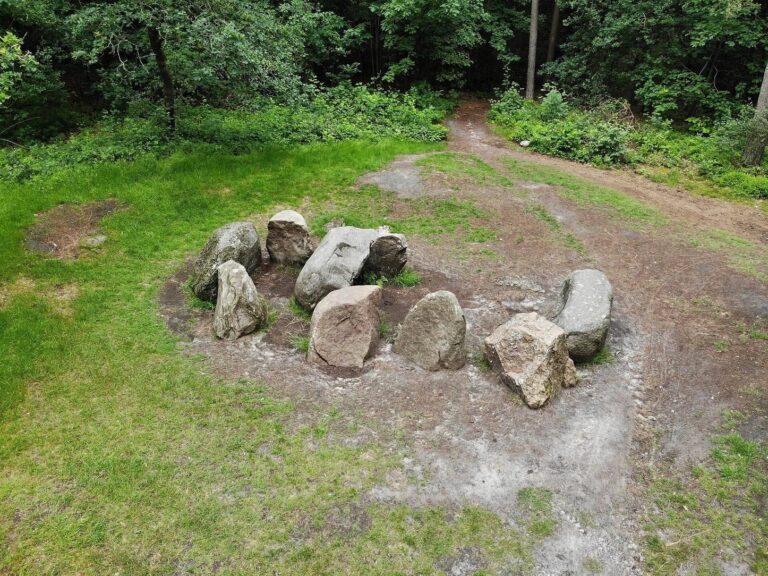
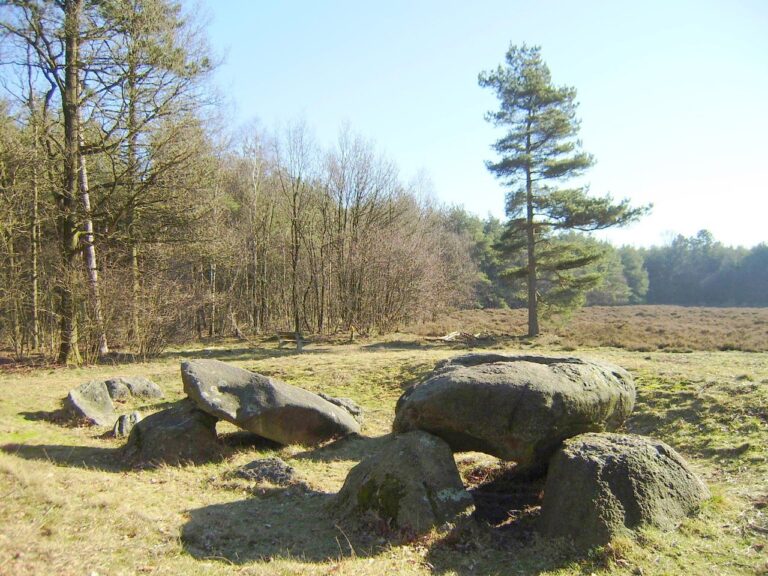
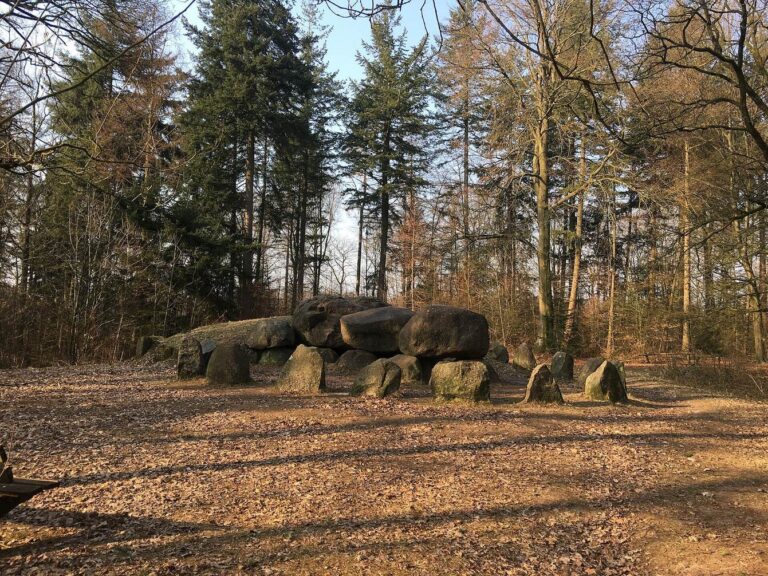
D32 stands on slightly elevated ground in a small wood, northwest of Odoorn and west of the Borgerderweg. Its passage grave is aligned east-northeast to west-southwest. The chamber’s original construction used large stones, and the surviving remains sit within a landscape that also includes the tombs of Exloo-Zuid, about 2.4 km to the east-northeast, and Valthe-West, about 2.4 km to the southeast.
Burial chamber
Stone construction
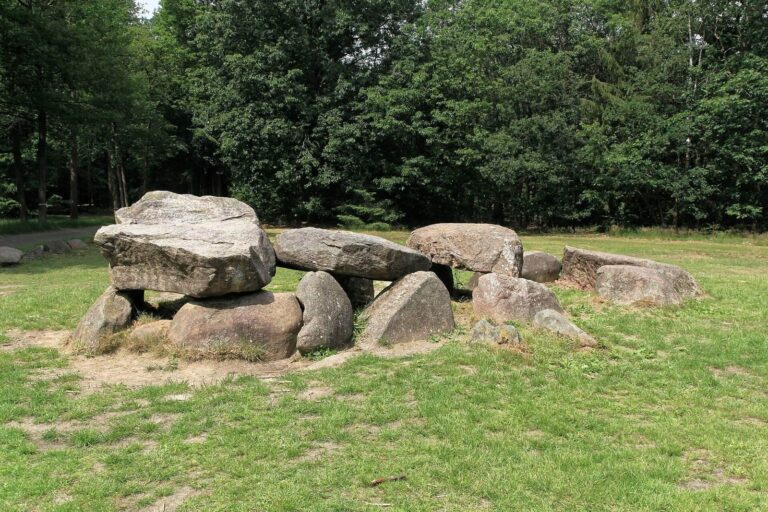
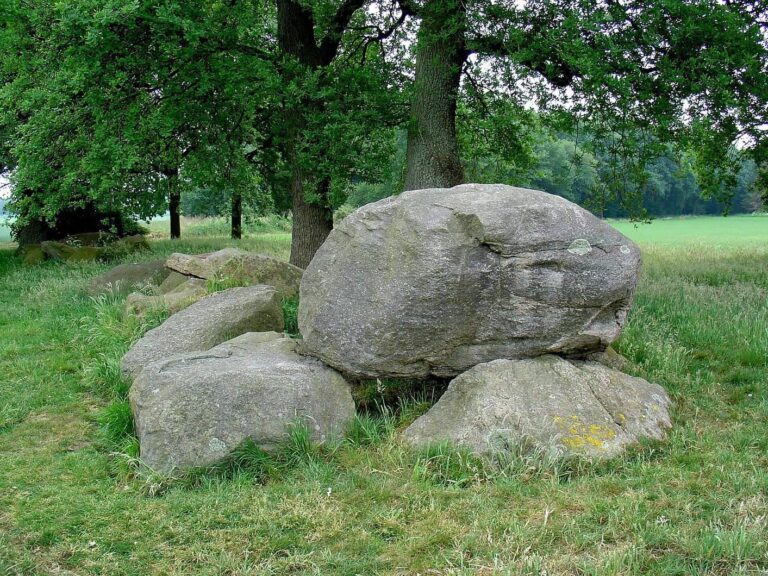
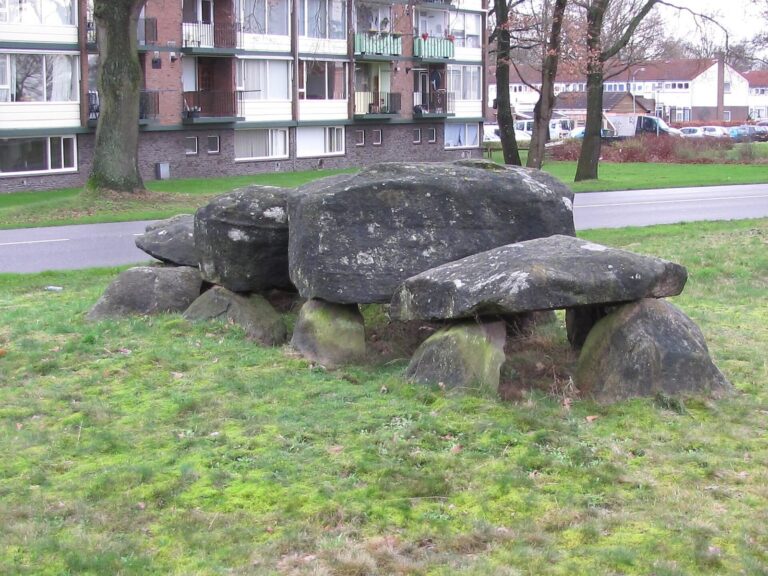
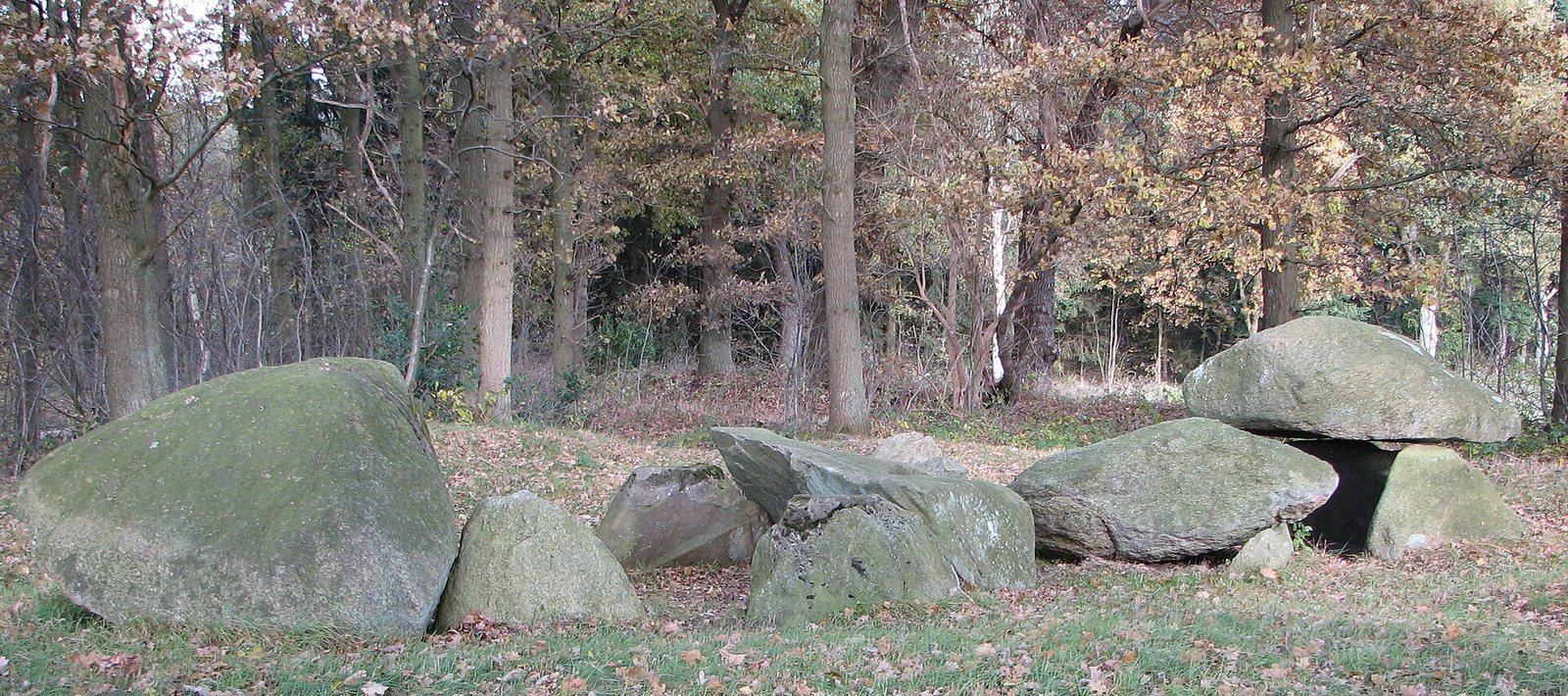
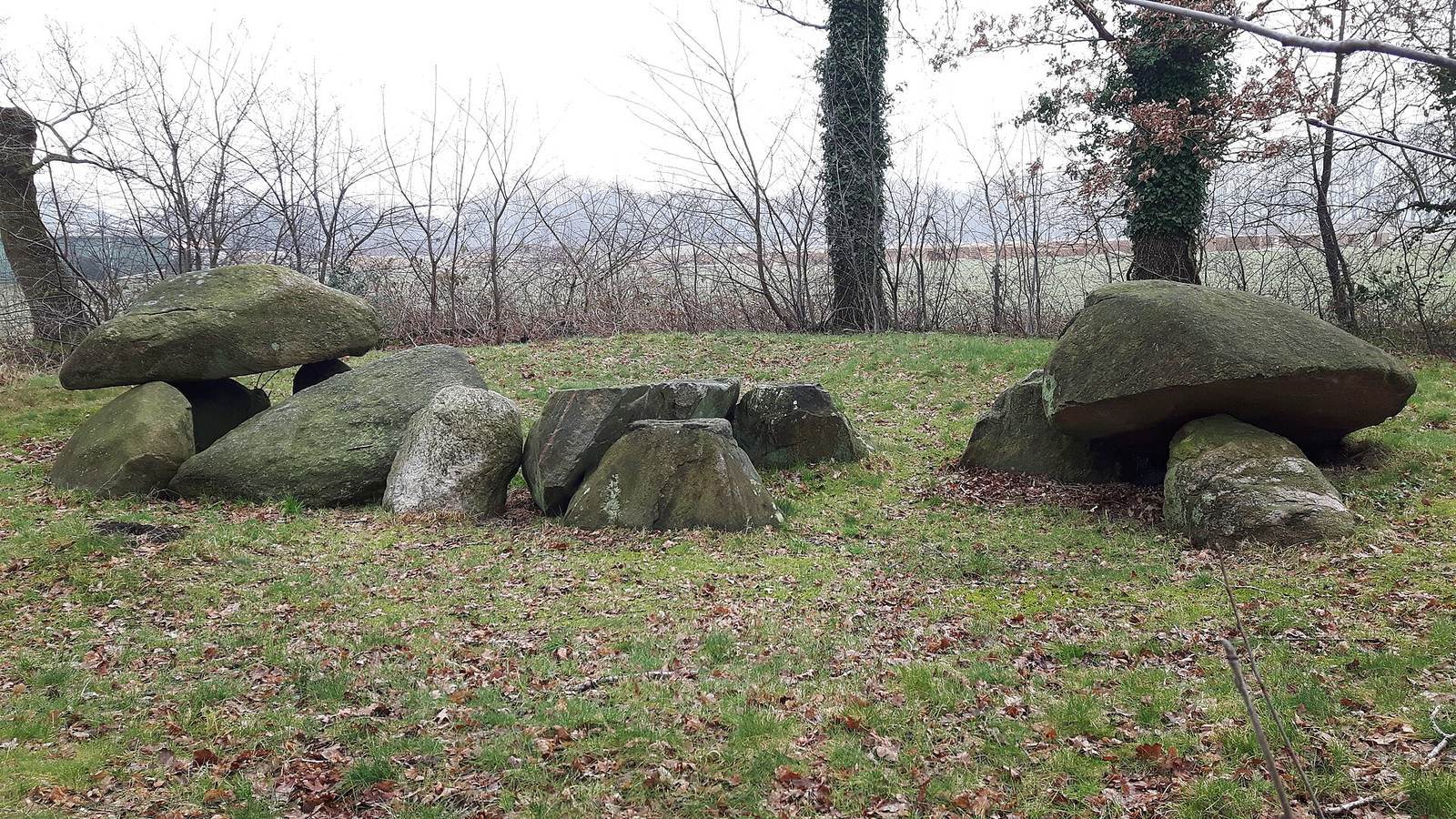
The chamber measures 7.6 m long by 3 m wide. It was originally formed by five pairs of side stones along its long sides, an end stone at each short side, and five capstones. Both end stones remain in their original positions. Four capstones survive, with only the two outer stones still resting on the side stones.
Carved marks and mound
The third capstone bears three cup marks, small cup-shaped hollows, on one of its long faces. Remains of the covering mound were still clearly distinguishable in 1925. A boulder bearing a bronze plaque stands at the beginning of the sandy path leading to the tomb.