Dolmen D49: A Reconstructed Funnel Beaker Passage Grave in the Netherlands
Site at a Glance
- Popularity
- Medium
- Country
- Netherlands
- Primary era
- Stone Age
- Eras represented
- Stone Age, Modern
- Civilizations
- Dutch
- Site type
- Burial
- Remains
- Tomb
On this page9 sections
History
Dolmen D49 is a Neolithic passage grave, a chambered tomb entered through a passage, in the Sleenerzand woodland south of Schoonoord in the Netherlands. People of the western group of the Funnel Beaker culture, a Neolithic culture named for its pottery, built it around 3300–3250 BC, during stage 3 of a pottery-based chronological sequence.
The name and local traditions
The name Papeloze Kerk, usually understood as “priestless church,” appears in print by 1848. A local tradition connects it with open-air Protestant sermons during the second half of the 16th century. At that time, during the Reformation, the religious movement that led to the establishment of Protestant churches, open Protestant worship was prohibited. The tradition names the Dutch Reformed preacher Menso Alting and says the open surroundings helped worshippers watch for intruders. Contemporary records do not support this association.
Other tales linked the tomb to a ghost or devil. One story claimed that will-o’-the-wisps revealed hidden treasure and that Spanish soldiers drowned in a nearby marsh while following the lights to disrupt a sermon.
Early descriptions and study
The Dutch minister and antiquarian Nicolaas Westendorp visited the tomb in 1812 and reported on it in 1815. In 1847, Leonhardt Johannes Friedrich Janssen, curator at Leiden’s National Museum of Antiquities, also visited. His 1848 overview of Dutch megalithic tombs included descriptions and schematic plans. In 1874, archaeologist and museum director Willem Pleyte arranged for the first systematic photographs of all surviving Dutch tombs, including D49. He made lithographs from the photographs. Conrad Leemans, director of the museum, visited in 1877, and Jan Ernst Henric Hooft van Iddekinge prepared plans. Leemans’s report was not published.
Damage, excavation, and reconstruction
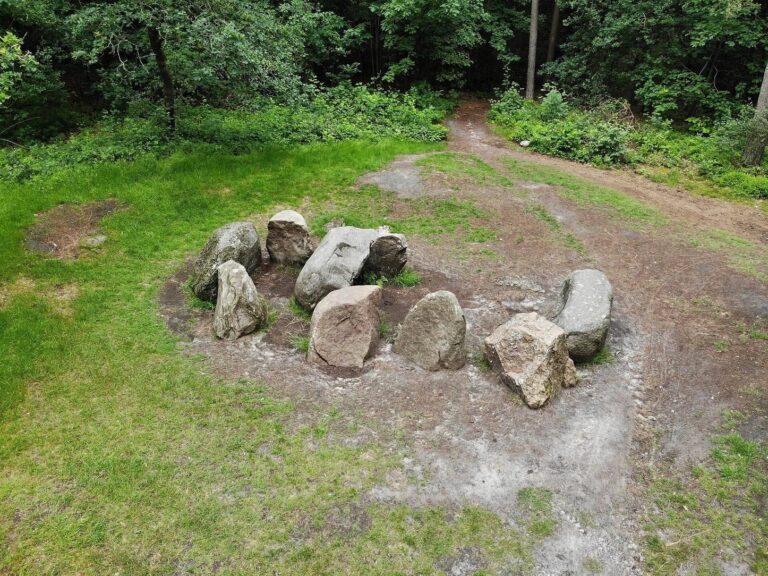
Stone seekers severely damaged D49 in 1861 and 1867. From 1904 to 1906, physician and amateur archaeologist Willem Johannes de Wilde recorded Dutch megalithic tombs with plans, photographs, and detailed descriptions, but his records for D49 are lost. Albert Egges van Giffen included the monument in his atlas in 1918 and excavated it in 1938 and 1958. Before reconstruction, only two capstones remained, both fallen into the chamber. Some supporting stones, the entrance stones, and many perimeter stones were also gone. Much of the covering mound survived, while the tomb lay in a hollow.
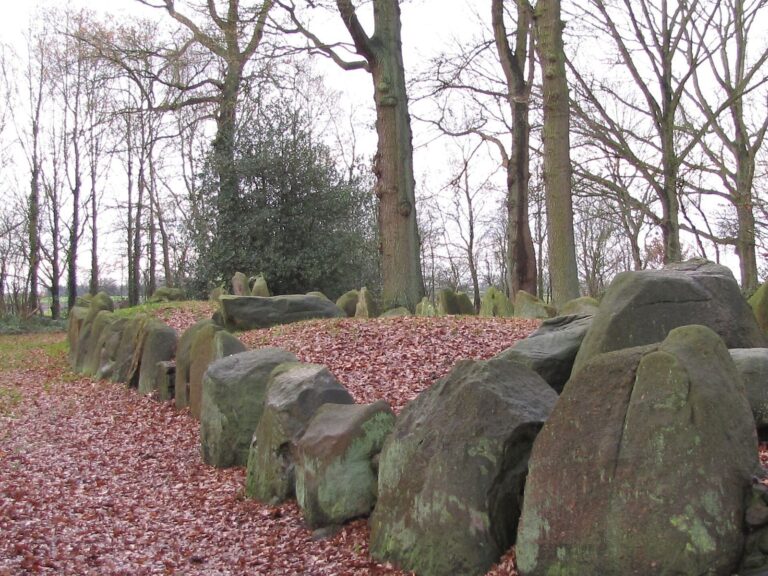
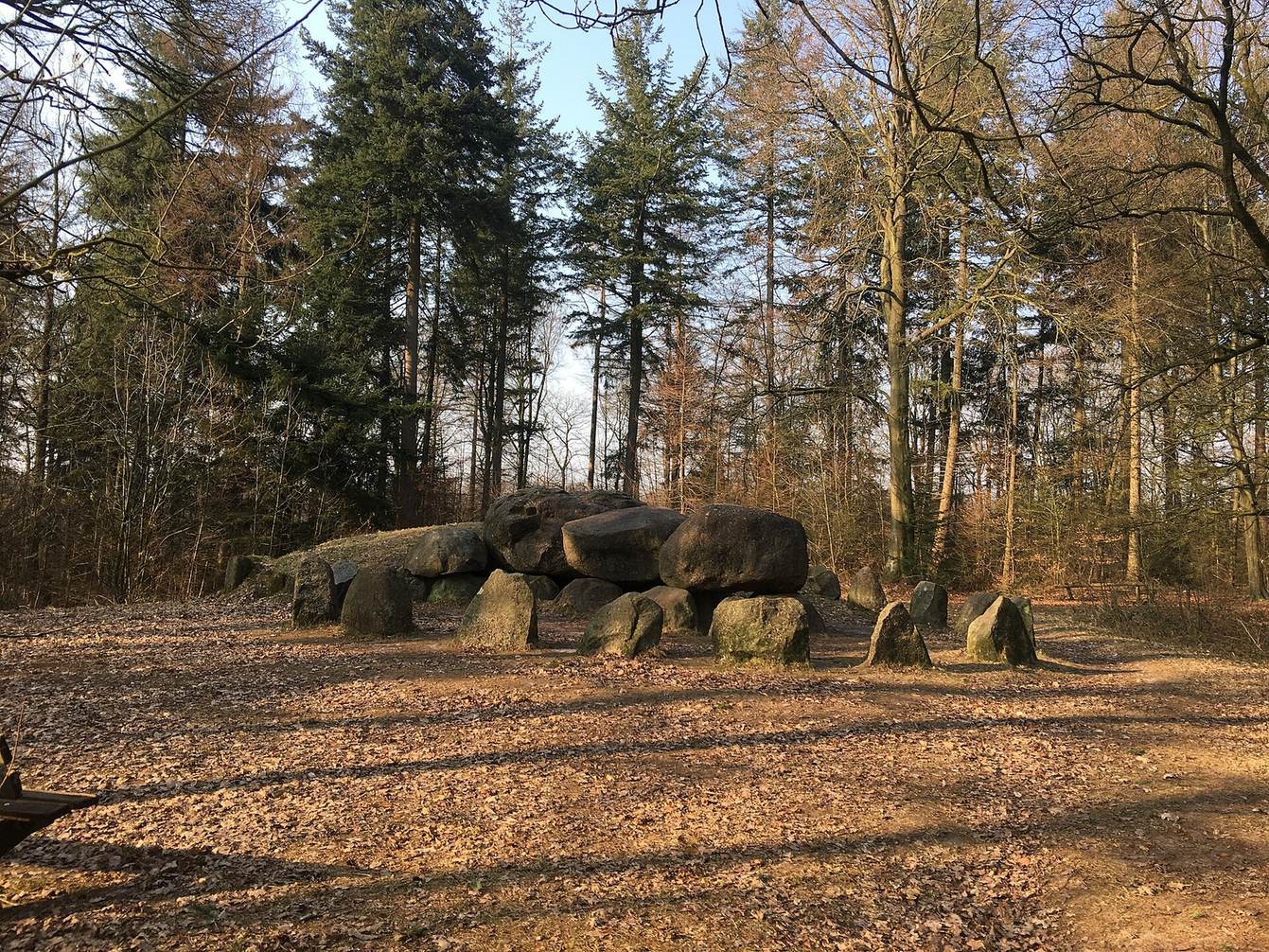
After the 1958 excavation, Van Giffen led a reconstruction that was completed in 1959. Chosen because of its poor condition, D49 was rebuilt to demonstrate the form of a Dutch megalithic tomb. The work used stones brought from elsewhere, including eleven from the badly damaged D33 tomb at Valthe-Valtherveld. A Dutch Army pioneer battalion transported D33’s remaining stones to Schoonoord in 1956. A further restoration followed in 1996. D49 is the only Dutch megalithic tomb restored to a nearly original external appearance.
The monument became a National Monument in 1973. In 2017, the Gratama Foundation used photographs to create a three-dimensional record for an atlas project involving the Province of Drenthe and the University of Groningen.
Remains
The tomb is aligned east-southeast to west-northwest. Its chamber measures 12.1 m long by 4.7 m wide, with an entrance midway along its southern side. The reconstructed layout includes the chamber, its passage, and a perimeter of stones; the covering mound is represented over only part of the structure.
Chamber and entrance
Six pairs of wall stones line the chamber’s long sides, with an end stone at each short end and six capstones above. The passage is formed by two pairs of wall stones and one capstone. Gaps between the chamber stones were filled with dry-stone masonry, stonework laid without mortar, reconstructed in 1959. Fieldstones covered with granite grit form the floor. A railing was installed inside the chamber during reconstruction, with pottery replicas displayed behind it.
Mound and perimeter
The tomb was originally covered completely by an earthen mound. In its reconstructed form, the mound covers the western half, while the other half remains exposed to show the stone framework. The reconstructed perimeter consists of 28 stones. Two small, deliberately formed depressions appear on the outer face of one perimeter stone. D49 stands in woodland planted during the 20th century; before that, the tomb was in open country. Dolmens D50 and D51 lie about 2.8 km to the southeast.
Human and animal remains
Excavation recovered 3.6 g of cremated human bone from one individual. The person’s age at death and sex could not be determined. A further 0.9 g of cremated animal-bone fragments was found; whether these were associated with tools or food offerings is unknown.
Pottery
The chamber contained 530 Funnel Beaker pottery sherds, including 310 undecorated pieces. They could be reconstructed as 150 vessels; about 100 could be identified by type, and 87 dated more precisely. Forms included steep-sided beakers, bowls, deep bowls, shoulder cups, amphorae, shouldered vessels, funnel beakers, and a baking plate. The dated vessels comprise 19 from stage 3 (3300–3250 BC), 16 from stage 4 (3250–3190 BC), and 37 from stage 5 (3190–3075 BC). The smaller numbers from stage 6 (six vessels, 3075–2860 BC) and stage 7 (nine vessels, 2860–2760 BC) indicate markedly reduced use in these later stages.