Czocha Castle: A Medieval Border Fortress in Poland



Site at a Glance
- Rating
- 4.5
- Popularity
- Very High
- Country
- Poland
- Primary era
- Medieval
- External website
- Open
- Eras represented
- Medieval
- Civilizations
- Holy Roman Empire, Kingdom of Bohemia
- Site type
- Military
- Remains
- Castle
On this page9 sections
History
Czocha Castle is a medieval defensive fortress in Poland, located in Sucha above the Leśnia Reservoir on the Kwisa River. Established between 1241 and 1247 on the Silesian-Lusatian frontier, it is attributed either to the Silesian Piasts, a branch of the medieval Piast dynasty that ruled parts of Silesia, or more specifically to Wenceslas I, the thirteenth-century king of Bohemia. The castle later developed architectural characteristics associated with the Renaissance and became part of the political and military history of the borderlands.
Frontier Fortress and Medieval Dynasties
The castle was captured by the Margraviate of Brandenburg in 1253 and granted as a fief to the Bishop of Meissen, von Weisenow. It was formerly associated with the name Czajków and appeared in a record from 1329 as castrum Caychow. In 1319, Czocha and its surrounding lands became part of the Duchy of Jawor as a dowry under Henry I of Jawor, a medieval Silesian duke.
After Henry’s death in 1346, his territories passed to his nephew Bolko II the Small, duke of Świdnica-Jawor. Following the death of Bolko II’s widow, Agnes of Habsburg, the castle entered the lands of the Bohemian Crown through an agreement with Charles IV, the fourteenth-century Holy Roman Emperor and king of Bohemia. This transition placed Czocha within the political sphere of the Bohemian monarchy.
Sieges and Noble Ownership
Hussite forces, followers of the religious reform movement associated with Jan Hus, unsuccessfully besieged Czocha during the Hussite Wars of the early fifteenth century. In 1427, while the owners were away, a detachment led by Czirnin captured the castle. It was retaken soon afterward.
From 1389 to 1453, Czocha belonged to the knightly families von Dohn and von Klüks. The Lusatian von Nostitz family owned it from 1451 to 1700. Several coats of arms associated with these families remained connected with the castle’s entrances and interior spaces, reflecting the succession of noble owners.
Neglect and Reconstruction
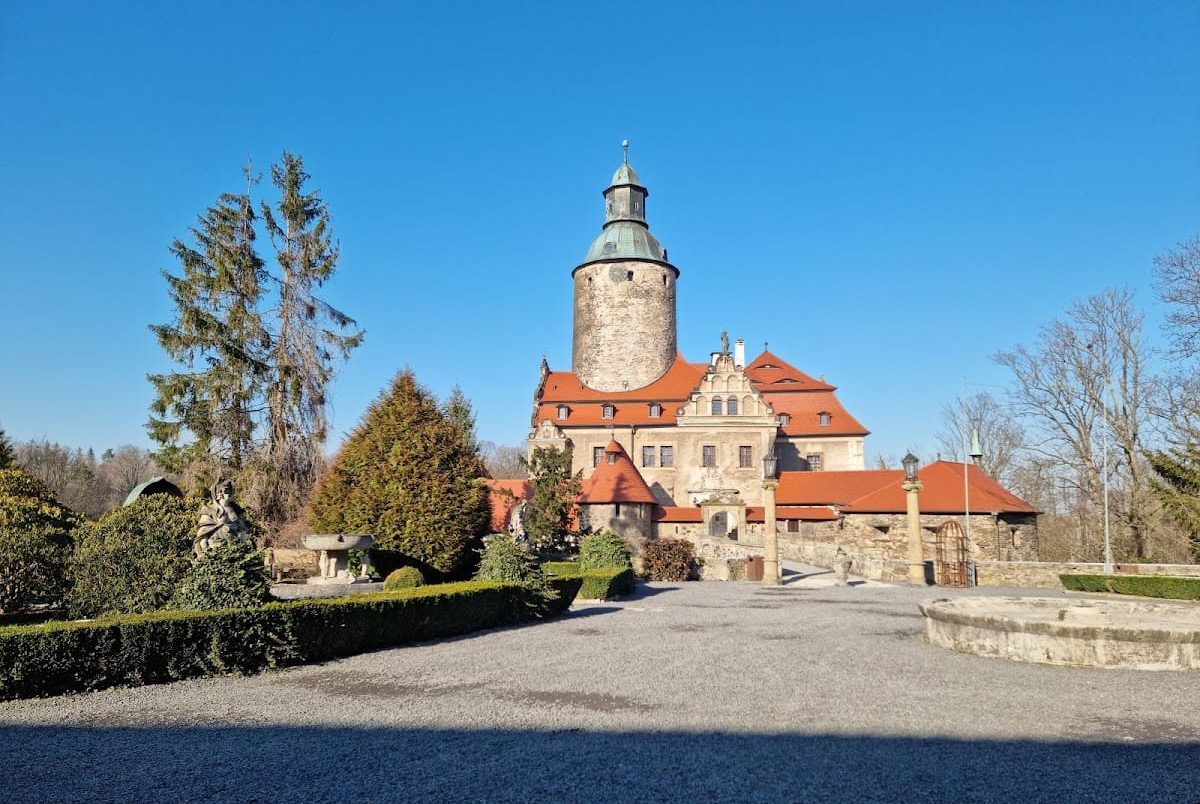
By 1847, the Upper Silesian teacher and writer Józef Lompa described Czocha as ruined or neglected. Dresden tobacco manufacturer Ernst Gütschow purchased the castle in 1909 for 1.5 million marks. Between 1912 and 1920, the Berlin architect Bodo Ebhardt reconstructed it to match its appearance in a 1703 engraving. The work gave the castle much of its later appearance but also destroyed many of the complex’s oldest sections.
Gütschow maintained relations with the Russian imperial court and later with Russian émigrés, from whom he acquired objects of high artistic value. He lived at Czocha until March 1945 and left the most valuable part of its furnishings behind when he departed. The claim that an Abwehr cipher school, belonging to Nazi Germany’s military intelligence service, operated at the castle during the Second World War remains unproven.
Postwar Use and Protection
After the Second World War, repeated looting stripped the castle of furniture and other furnishings. Some book collections were transferred to Wrocław during restitution operations, meaning the recovery or transfer of cultural property to a destination regarded as its rightful institution or territory. A later sensational claim that Leśna mayor Kazimierz Lech and castle librarian Krystyna von Saurma removed a truckload of valuables on 1 February 1946 was disproved. The icons involved had been taken to a restitution depot in Jelenia Góra and were later transferred to Warsaw.
Greek refugees occupied the castle briefly after the war and kept farm animals in the Knights’ Hall, contributing to the building’s deterioration. From 1952, it housed a military holiday facility and was classified as secret, which kept it off maps. Since September 1996, Czocha has operated publicly as a hotel and conference centre. Its current owner is AMW Rewita Sp. z o.o., a company belonging to Poland’s Military Property Agency, a state institution managing property associated with the armed forces. The castle has been registered as a protected historic monument in Poland under registration number 100/790 since 26 October 1960.
Remains
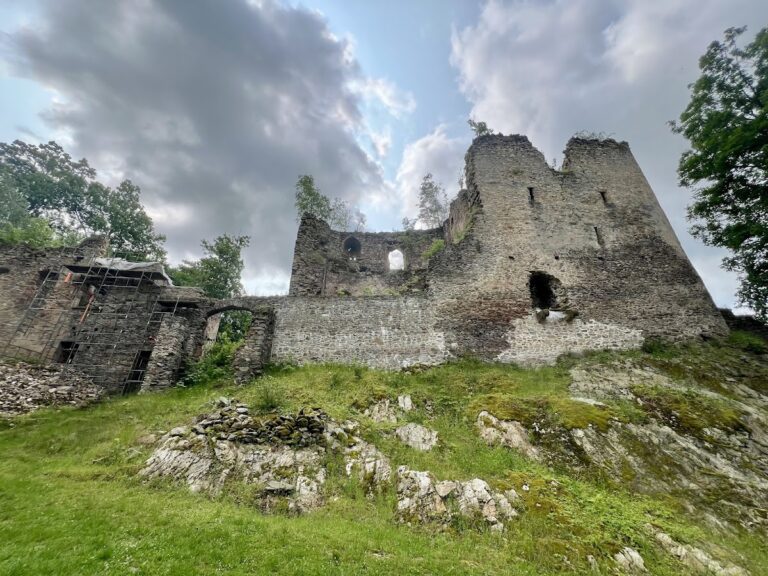
Czocha Castle stands on gneiss rocks belonging to the Izera metamorphic rock formation. Its defensive buildings occupy the rocky site above the Leśnia Reservoir. The surviving complex combines an old entrance-area tower, residential buildings, a two-gate entrance arrangement, and later Renaissance-influenced details shaped by Gütschow’s reconstruction.
Fortifications and Residential Buildings
The oldest surviving part is a tower beside the main entrance area. Residential buildings were later built around it, with the northern fragment forming the oldest section of that residential range. The former moat was converted into a game enclosure during the reconstruction carried out between 1912 and 1920, altering the relationship between the defensive perimeter and the surrounding grounds.
Entrance Complex
The entrance complex contains two principal gates. The older lower gate leads to the lower courtyard, while the newer upper gate forms part of the later entrance arrangement. Their surviving heraldic decoration preserves the memory of several owners and builders associated with the castle’s successive phases.
Heraldic and Decorative Features
A von Nostitz cartouche, an ornamental framed panel, stands above the portal of the first gate to the lower courtyard. Above the main entrance are the arms of von Nostitz and Debschitz, while von Üchtritz appears on the keystone, the central wedge-shaped stone in the arch. Other surviving or recorded heraldic features include a crowned lion on a wall, the arms of von Nostitz and Seydlitz, and von Gütschow heraldry associated with the main gate and a stained-glass window by Eduard Stritt.