Gryf Castle: A Gothic Border Fortress in Poland


Site at a Glance
- Rating
- 4
- Popularity
- Very Low
- Country
- Poland
- Primary era
- Medieval
- Eras represented
- Medieval, Early Modern
- Civilizations
- Holy Roman Empire
- Site type
- Military
- Remains
- Castle
On this page12 sections
History
Gryf Castle, also known as Greiffenstein, is a Gothic defensive fortress in Poland above Proszówka. Its origins are placed either in the twelfth century, when it may have served as the seat of a nobleman from the Greiff family, or in the thirteenth century, when Duke Konrad II of Głogów is said to have built it on an earlier fortified settlement associated with the Bobrzans, a Silesian tribal group. Its position near the Queis River, which marked the boundary between the Duchy of Silesia and the Bohemian-controlled Queis District of Upper Lusatia, gave the site a likely border-defence role.
Early Silesian and Bohemian Rule
At the beginning of the thirteenth century, Gryf Castle served as the seat of the landvogts of the Greiffenberg–Greiffenstein district. A landvogt was a territorial governor or royal representative. A document claiming that a castellan occupied the castle in 1242 was later exposed as a forgery, so it cannot establish that date or office.
By 1274 or 1277, the castle belonged to the Duchy of Schweidnitz-Jauer, a medieval Silesian principality that came under the Bohemian Crown. At that time, the complex consisted only of the upper castle. Seyfried von Raußendorf received it as a pledge in 1354. After Duke Bolko II died in 1368, the castle and duchy passed by inheritance to the Bohemian king Wenceslaus IV. Bolko’s widow, Duchess Agnes of Habsburg, retained a lifetime usufruct, meaning the right to use property and receive its benefits without full ownership, until her death in 1392.
In 1392, Wenceslaus IV first pledged Gryf Castle to the provincial governor Benesch von Chusnik and sold it to him two years later. Benesch appointed Wolf von Romke as castellan, and under Romke the castle became a base for robber-knight activity. In 1399, people from nearby Greiffenberg captured and beheaded Romke at the castle. Benesch pledged the property to Gotsche II Schof in 1400. In 1419, Gotsche acquired the lordship of Greiffenstein together with the towns of Greiffenberg and Friedeberg, creating an important territorial foundation for his descendants in the Jizera and Giant Mountains. From 1425 to 1426, Gotsche III used the castle as a base for several feuds against Görlitz.
Expansion under the Schaffgotsch Family
Gryf entered a major period of enlargement after Gotsche III’s nephew, Ulrich I von Schaffgotsch, united the Greiffenstein and Kynast lordships in 1511. Ulrich is also associated with a reconstruction begun in 1526. After his death in 1543, the work continued under Johann, or Hans, von Schaffgotsch, who erected defensive walls in 1546. Hans’s marriage to Magdalena von Zedlitz in 1551 brought the lordship of Giersdorf into the family through her dowry.
Hans Ulrich von Schaffgotsch was born at Gryf Castle in 1595. A Silesian nobleman of the Schaffgotsch house, he expanded the family’s holdings with the lordships of Trachenberg, Alt Kemnitz, Hertwigswalde, Prausnitz, and Schmiedeberg. In 1627, he received the status of Semperfrei, a high-noble rank within the Holy Roman Empire. During the Thirty Years’ War, the prolonged European conflict fought from 1618 to 1648, he was executed at Regensburg in 1635 as an alleged co-conspirator of Wallenstein, a Bohemian nobleman and imperial military commander. His estates were confiscated and later returned to his heirs, except for the lordship of Trachenberg.
Sieges, Decline, and Dismantling
Swedish forces besieged Gryf Castle twice during the Thirty Years’ War. The fortress resisted the siege of 1639, but the Swedes captured it in 1645 and forced its defender, Christoph Leopold von Schaffgotsch, to surrender. Prussian troops occupied the castle in 1745, and in 1778 it was still described as a strong fortress.
By this period, aristocratic residences were increasingly shifting from defensible castles to representative palace buildings. The Schaffgotsch family’s principal residence became Kynast, while damage at Gryf was not repaired. After Kynast burned in 1675, the family seat moved to Warmbrunn, where a palace had stood since the late sixteenth century.
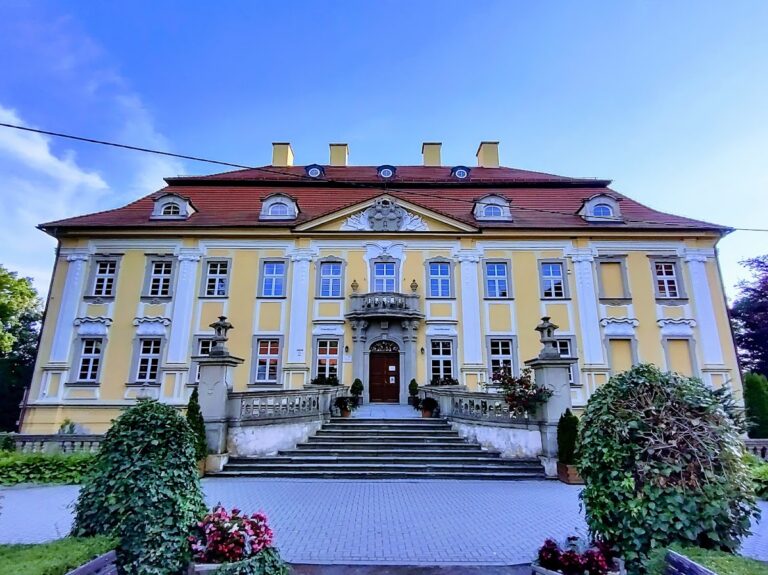
Johann Nepomuk von Schaffgotsch began rebuilding the Warmbrunn palace after a fire in 1777 and commissioned a simple summer palace below Gryf Castle in 1798. Completed in 1800, it served as an administrative residence. At the same time, most of Gryf Castle was dismantled. Some of its masonry was reused as building material for the estate below, and the partial dismantling is dated to 1799 in the castle’s heritage information.
Modern History and Cultural Memory
The Schaffgotsch family retained Gryf Castle until its expropriation in 1945. The ruins are privately owned and were entered in Poland’s register of immovable cultural monuments under registration number A/853/497 in 1958.
Several legends surround the castle, including stories of a griffin, a haunting female ancestor, and the knight Gotsche. The poet Theodor Körner visited Gryf and dedicated the poem Auf dem Greiffenstein to it.
Remains
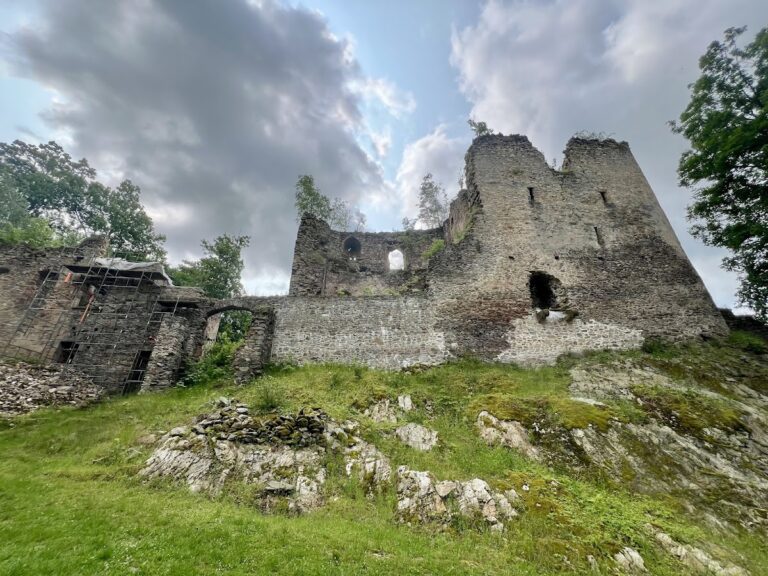
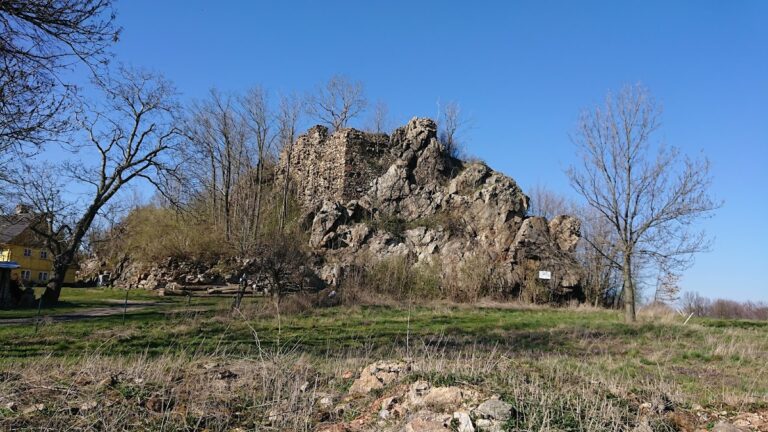
The ruins stand on a basalt summit known as Castle Hill, approximately 448 metres above sea level, above Proszówka. The site lies about six kilometres south of Gryfów Śląski and two kilometres north-east of Mirsk, above the route between those towns. Gryf was built mainly of stone as a large Gothic fortified complex divided into three separately walled sections. The upper castle occupies the highest ground, the middle castle lies to its north, and the lower castle extends across the eastern part of the site.
Upper and Middle Castles
Upper Castle
The upper castle is the oldest and highest section of Gryf. It had an irregular pentagonal plan and preserves its original masonry. Sixteenth- and seventeenth-century alterations enlarged and strengthened this part of the fortress, including the addition of parapets, which are low protective walls along the edges of fortifications. Its surviving walls form the most substantial part of the castle’s earliest fabric.
Middle Castle
The middle castle stood north of the upper castle as a separately walled section in front of the principal stronghold. It formed part of the enlarged fortified complex that developed around the original upper castle.
Lower Castle and Surviving Buildings
Lower Castle
The lower castle occupied the largest area, on the eastern side of the complex, and was the latest of the three sections. Sixteenth- and seventeenth-century building works expanded the lower castle and its entrance gate. The section also contained a gate tower. Its surviving remains include fragments of defensive walls and gates, part of the entrance gate, and the gate tower in the lower bailey, an enclosed area outside or below the principal stronghold. The lower castle is the least preserved section, although the ruins remain extensive despite the late eighteenth-century dismantling.
Chapel and Domestic Buildings
Remains of the castle chapel, residential buildings, and service buildings survive within the ruined complex. A large griffin was once painted on a wall of the chapel, and this image gave rise to the name Gryf, meaning griffin. Together with the surviving walls and gates, these fragments preserve evidence of the castle’s religious, residential, and administrative functions.