Czettritz Castle in Wałbrzych: A Renaissance Castle and Princely Estate


Site at a Glance
- Rating
- 4.5
- Popularity
- Low
- Country
- Poland
- Primary era
- Early Modern
- External website
- Open
- Eras represented
- Early Modern, Modern
- Civilizations
- German, Holy Roman Empire
- Site type
- Domestic
- Remains
- Castle
On this page8 sections
History
Czettritz Castle in Wałbrzych, Poland, is a Renaissance residence built for Diprand von Czettritz in the early seventeenth century. Construction began in 1606 and was completed in 1628. The castle was erected in Oberwaldenburg, then at the boundary of Waldenburg, after a fire at Neuhaus Castle, whose ruins remain in the Dittersbach district.
The Czettritz and Hochberg Families
The castle initially belonged to the Czettritz family. In 1738 it passed to the Counts von Hochberg of Fürstenstein, a prominent Silesian aristocratic family later associated with the princely title of Pless. The estate remained connected with the Hochbergs through subsequent changes to the building and its administration.
Rebuilding and Administrative Use
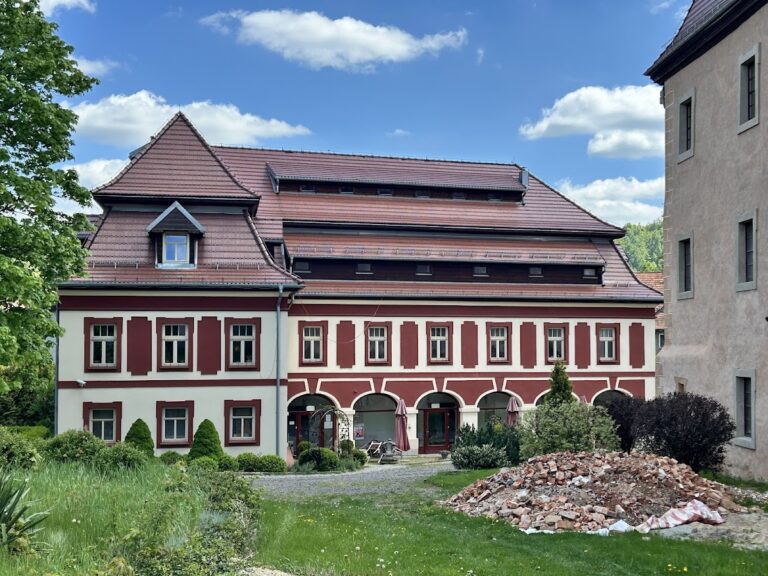
In 1857 the old castle was rebuilt and converted into the administrative headquarters for the estates of the Princes of Pless. A further major rebuilding and extension followed in 1882 and 1883, when the building acquired Neo-Renaissance features, a nineteenth-century revival of Renaissance architectural forms. It later housed the provincial administrative office in Wałbrzych.
Czettritz Park was laid out in 1886, and the wider complex developed into an estate with an administrator’s residence, farm buildings, and two Hochberg family villas dating from 1905 and 1923. Mary Theresa von Pless, known as Princess Daisy, died in the older villa in 1943. A British-born aristocrat associated with the Pless family and its Silesian estates, she was the last owner of Czettritz Castle.
Recent Institutional History
Since 2004, the castle has housed the State Higher Vocational School named for Angelus Silesius, the seventeenth-century name of Johannes Scheffler, a German religious poet and mystic. A monument to Mary Theresa von Pless was placed in the castle courtyard in 2007. The castle, park, and associated farmstead are separately entered in Poland’s historic-monument register.
Remains
The castle stands near Wałbrzych’s market square in the central Śródmieście district. It is a two-storey Renaissance building with a third mansard storey, and numerous rooms contain vaulted ceilings. The complex extends into the approximately five-hectare Czettritz Park and includes estate buildings and two Hochberg villas.
The Castle Building
The main entrance is on the east side. Its Renaissance portal has a heraldic cartouche bearing the coats of arms of the von Czettritz and von Zedlitz families. Inside, the vestibule contains the castle’s most notable Renaissance stucco ornamentation, while vaulted ceilings survive in numerous rooms. These details belong to the building’s Renaissance character, later complemented by the nineteenth-century Neo-Renaissance rebuilding and extension.
Park and Estate Buildings
The Czettritz Park was established in 1886 as part of the castle complex. The associated estate buildings include a residence for the castle administrator from the late eighteenth century and nineteenth-century service buildings, including stables and a carriage house.
Hochberg Villas
Two villas belonging to the Hochberg family form part of the complex. They date from 1905 and 1923. Mary Theresa von Pless died in the older villa in 1943, linking that surviving building to the final period of the castle’s ownership by the Pless family.
Nearby sites