Cranshaws Castle: A Medieval Scottish Tower House
Site at a Glance
- Popularity
- Medium
- Country
- United Kingdom
- Primary era
- Medieval
- Eras represented
- Medieval, Early Modern, Modern
- Civilizations
- British, Kingdom of Scotland
- Site type
- Military
- Remains
- Castle
On this page7 sections
History
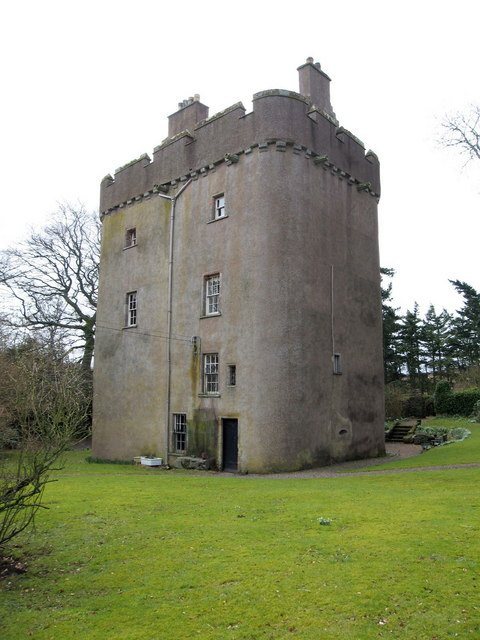
Cranshaws Castle is a medieval Scottish tower house, a compact fortified residence, near the village of Cranshaws in Berwickshire, Scotland, United Kingdom. Its construction date is uncertain, but the younger Sir John Swinton is thought to have built it. The castle was counted among the fortresses of the Douglas family, while its estate became the subject of prolonged disputes over ownership and overlordship.
Medieval landholding
The lands of Cranshaws belonged to the Barony of Bothwell, established for David Olifard by King Malcolm IV in the mid-12th century. The holding passed through a younger Olifard son and his descendants. It was generally held as a feu, a form of landholding in which the barony retained superior rights over the estate. The barony passed by marriage to the Morays in 1252, when the senior Oliphant line ended.
William Oliphant, Lord of Aberdalgie, inherited Cranshaws from his Olifard forebears and died in 1329. In 1336–37, King Edward III of England held Cranshaws and Hedderwick following William’s forfeiture.
Swinton control and contested claims
In 1362, Joanna de Moravia, heiress of Bothwell, married Archibald Douglas, 3rd Earl of Douglas. Their son, Archibald Douglas, 4th Earl, granted Cranshaws to Sir John Swinton in 1401, dispossessing the Oliphants. Sir John, the 14th of that name, died at the Battle of Homildon Hill in 1402. His son inherited the lands and is thought to have built the castle; the form of any earlier Oliphant building on the estate is unknown.
The wider contest over land rights also involved the Earldom of Dunbar and March. In 1403–04, its earl lost his Scottish lands, much of which went to Archibald Douglas. After the earl was restored to the Earldom of March in 1409, Douglas probably sought to transfer Cranshaws’s overlordship to that earldom. Cranshaws was forfeited by the Earl of March in 1435–36, although its earlier connection to the earldom is uncertain. Around 1460, a prolonged dispute focused on the earldom’s claim to superior rights over the estate.
The transfer from the Oliphants to the Swintons, made without Oliphant consent or compensation, prompted a separate, lengthy ownership dispute. A charter of 1412 called Walter Oliphant Lord of Aberdalgie. In 1442, Sir John Oliphant was recognized as heir to his grandfather’s Cranshaws lands, and his sasine, or formal recognition of possession, was taken on 28 February 1442–43. Sir John Swinton formally broke that possession the next day, asserting his own claim.
Lord Oliphant petitioned the courts in 1474. In 1476, he agreed with Alexander, Duke of Albany and Earl of March, to pay 30 years of non-entry dues, payments owed because formal possession had not been taken, dating from his father Sir John Oliphant’s death. The agreement restricted arrangements with the Swintons without the duke’s special permission and preserved Lord Oliphant’s right to pursue Swinton, his heirs, and others who had collected Cranshaws rents since his father’s death. That year, Lord Oliphant also raided Cranshaws and took oxen and horses.
Border conflict and later ownership
During the Rough Wooing, the Anglo-Scottish conflict of the 1540s, English soldier Thomas Carlyle arrived at Cranshaws in February 1545 with 30 horsemen. They fought men gathered there to meet the Laird of Swinton, warden of Scotland’s East March.
The Earls of Morton, a branch of the Douglas family, reacquired the castle in the 18th century. George Douglas, 13th Earl of Morton, undertook extensive renovations, followed by further alterations and extensions in the late 18th and early 19th centuries. Andrew Smith of Whitchester restored the building in 1896–97, and alterations also took place around 1900. The property passed to Smith’s nephew, Stenhard Landale, in 1931. Changes continued during the second half of the 20th century, and the interior was modernized in 1978. Cranshaws remains a privately owned residence and was designated a Category A listed building in 1971, Scotland’s highest listing category.
The castle is thought to have inspired Ravenswood Castle, Edgar’s home in Walter Scott’s tragedy The Bride of Lammermoor. Local tradition also places a brownie, a household spirit associated with domestic work, in the castle.
Remains
The tower house
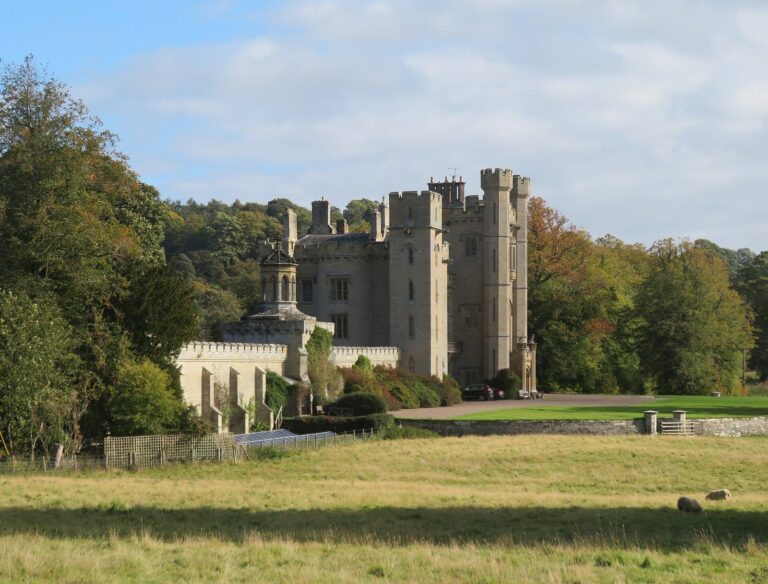
The castle is a multi-storey, rectangular tower with rounded corners and an asymmetrical plan. Its façades have a rough plaster finish, with cream-coloured sandstone details. The main entrance is on the southwest face, and a second entrance is at the rear; the wooden main door has decorative wrought-iron fittings. Most windows have twelve panes, while smaller ones have four or six. A projecting wall-walk, a walkway along a defensive wall, has a crenellated parapet, a low protective edge with alternating raised sections and openings. The parapet is thought to have been added in the late 19th century, after the castle left Morton ownership. The upper house has a slate-covered gabled roof with dormers.
Associated features
Features associated with the castle include a sundial, a covered well, and garden walls.