Brennberg Castle (Burg Brennberg): A Medieval Hilltop Ruin in Bavaria


Site at a Glance
- Rating
- 4.7
- Popularity
- Low
- Country
- Germany
- Primary era
- Medieval
- External website
- Open
- Eras represented
- Medieval, Early Modern
- Civilizations
- Duchy of Bavaria, Holy Roman Empire
- Site type
- Military
- Remains
- Castle
On this page14 sections
History
Brennberg Castle, known locally as Burg Brennberg, is a hilltop castle ruin in Germany above the village of Brennberg in Bavaria. The larger complex developed from an early eleventh-century stronghold associated with the noble de Prenberg family, whose first structure was probably built by Wernher I de Prenberg on the western castle hill. The family held fiefs from the bishopric of Regensburg and served it as stewards and ministeriales, members of the medieval service nobility who held offices and estates for a prince or church institution.
The de Prenberg lords
Perinhart de Briemberch, regarded as the ancestor of the de Prenberg line, was a vassal of the monastery of Sankt Emmeram in Regensburg. The family later included Reimar II of Brennberg, a minnesinger whose courtly songs were preserved in the medieval German Manesse Codex, and Reimar IV, who founded the monastery at Frauenzell.
In 1173, Regensburg citizens murdered Reimar III, placing the continuation of the male family line in question. His brother Bruno, then a cathedral canon, returned to secular life, married Berta of Haidau around 1280, and became lord of Brennberg. Bruno’s son Reimar IV followed him. After Reimar IV died, his daughter Agnes married Friedrich I Auer of Auburg, and the lordship passed to the Auer family.
The Auer succession and divided lordship
The male de Prenberg line ended in 1326, when the fief and lordship initially reverted to the bishopric of Regensburg. Through his marriage to Agnes de Prenberg, Friedrich I Auer became lord of Brennberg and adopted the de Prenberg name and coat of arms. From 1327, the family was known as Auer de Prenberg or Auer zu Brennberg.
Friedrich I was also commander of Wörth Castle on the Danube and mayor of Regensburg. After his expulsion from Regensburg in 1334, he enlarged Brennberg as his new ancestral seat. With help from his brother Heinrich of Auburg, he added a tower to the western castle hill. In 1368, the Auer family received the pledge of Donaustauf Castle from Emperor Charles.
In 1379, Friedrich I’s sons divided the Brennberg possession. Friedrich II received the western tower and the Münchstein well, while Hans received the eastern tower. The lordship thereafter comprised Oberbrennberg and Unterbrennberg. Although separately held, the two parts remained joined by a central courtyard, creating a divided family castle of the kind sometimes called a jointly held or branch-divided castle.
The Nußberg and Lerchenfeld periods
Oberbrennberg passed to Achatz I of Nußberg in 1466 after he settled the debts of his deceased brother-in-law Wilhelm of Auer. Achatz died in 1480, and his son Wilhelm II succeeded him. When Wilhelm II died in 1536, his son Haimeram became lord of Oberbrennberg.
Haimeram of Nußberg killed an innkeeper during a dispute, fled Bavaria, and joined the robber knight Hans Thomas of Absberg. Haimeram and other members of the group were arrested at an inn near Heideck in 1528. He died in 1551, after which his son Wilhelm III of Nußberg, later a government councillor in Straubing, inherited Oberbrennberg.
Unterbrennberg briefly belonged to Joachim Stauff before passing in 1540 to Christoph of Rain. Christoph sold it to Wilhelm III of Nußberg, reuniting both Brennberg complexes under one lord. Because the Nußbergs and Joachim Stauff were usually away from the castle, stewards administered Brennberg and Frauenzell on their behalf.
Wilhelm III died unmarried in 1568. His will divided the inheritance between his paternal Nußberg relatives and his maternal relatives, while Caspar of Lerchenfeld acquired Burg Brennberg. In 1572, Caspar divided the lordship between his two eldest sons. Andreas of Lerchenfeld received Oberbrennberg, and Georg David of Lerchenfeld received Unterbrennberg.
War, fire, and rebuilding
Johann Jakob of Lerchenfeld inherited Unterbrennberg in 1620. The Thirty Years’ War, the major European conflict of 1618 to 1648, brought raids and plundering that caused severe losses. On 28 June 1644, Johann Jakob sold the castle to Wilhelm Keck. Georg Konrad of Lerchenfeld bought it back in 1654.
Oberbrennberg burned for unexplained reasons on 10 April 1642 and was rebuilt by the Lerchenfeld family. A larger fire destroyed both castle complexes in 1686, after which the Lerchenfelds rebuilt them. Franz Ludwig of Lerchenfeld subsequently held both castles. He was followed by Franz Xaver of Lerchenfeld, a government councillor in Straubing who died in 1776.
Decline and preservation
Oberbrennberg passed through Franz Xaver von Lerchenfeld’s daughter to her husband, Joseph von Gumppenberg. In 1832, the possession and its patrimonial jurisdiction, a lord’s judicial authority over the inhabitants of an estate, passed to Prince Maximilian Karl of Thurn and Taxis.
Unterbrennberg was sold in 1821 by Baron Höffels of Munich to Baron Closen. Closen expelled the resident huntsman and the financial administrator Georg Rabl and ordered the contents of the castle to be sold. The expelled residents then plundered the complex as compensation, after which the buildings were left to decay. Prince Maximilian Karl of Thurn and Taxis acquired Unterbrennberg in 1840. Its remaining buildings were dismantled, and the site continued to deteriorate.
The Thurn und Taxis princely house donated the ruins to the municipality of Brennberg on 4 June 1935. In 1980, the surviving fabric was secured and a wooden observation tower was erected. Archaeological excavations and restoration during the 1980s made the entire castle complex accessible as a preserved ruin. Brennberg is listed as a protected architectural monument of Brennberg and as an archaeological monument encompassing features and finds from the medieval castle.
Remains
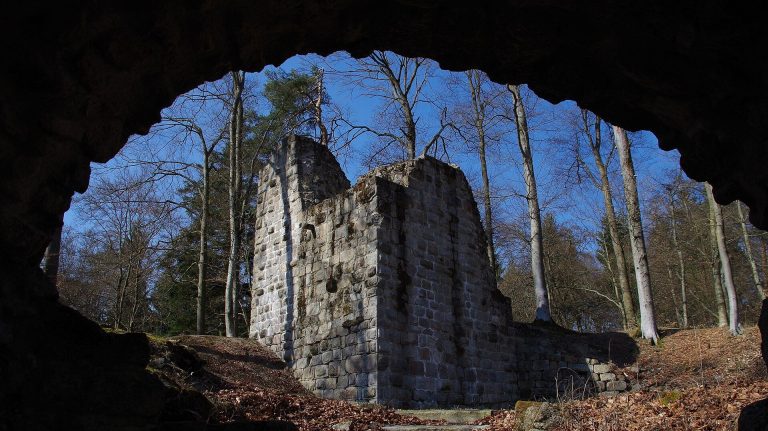
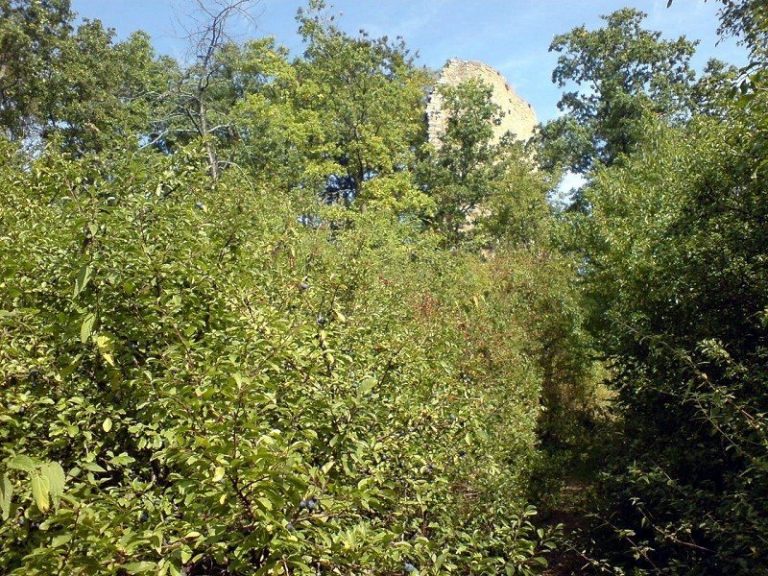
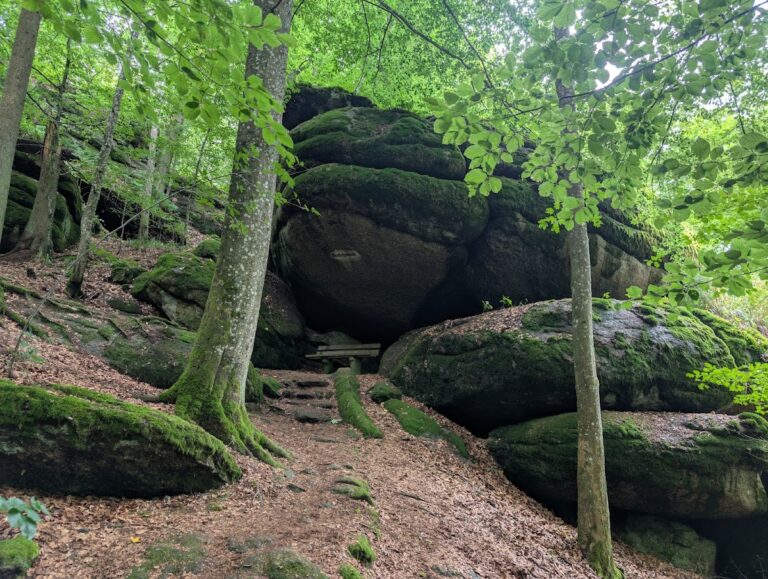
Brennberg Castle occupies a 653-metre-high granite rock rising about 50 metres above the village of Brennberg, approximately 23 kilometres east of Regensburg. The ground falls gently on the north side, where a defensive ditch and rampart protected the approach. The complex is arranged in western Oberbrennberg and eastern Unterbrennberg, with the two parts linked by a central courtyard.
Early castle and western complex
Romanesque keep and residence
The oldest surviving architectural phase consists of an eleventh-century Romanesque keep and residential building. These structures formed the core of the early castle on the western hill and provide the physical basis for understanding the site’s initial development.
Auer Tower and Münchstein well
The western complex was enlarged in the fourteenth century with the Auer Tower and the deep draw well known as the Münchstein. The tower belongs to the expansion that transformed the earlier stronghold into the Auer family’s ancestral seat, while the well served the castle’s need for water.
Later buildings and surviving fabric
Rebuilt residential range
After a major fire, a three-storey castle was erected on the foundations of the earlier Gothic residential building. Its surviving remains form part of the restored ruin and reflect the rebuilding that followed the castle’s destructive fires.
Eastern grain store
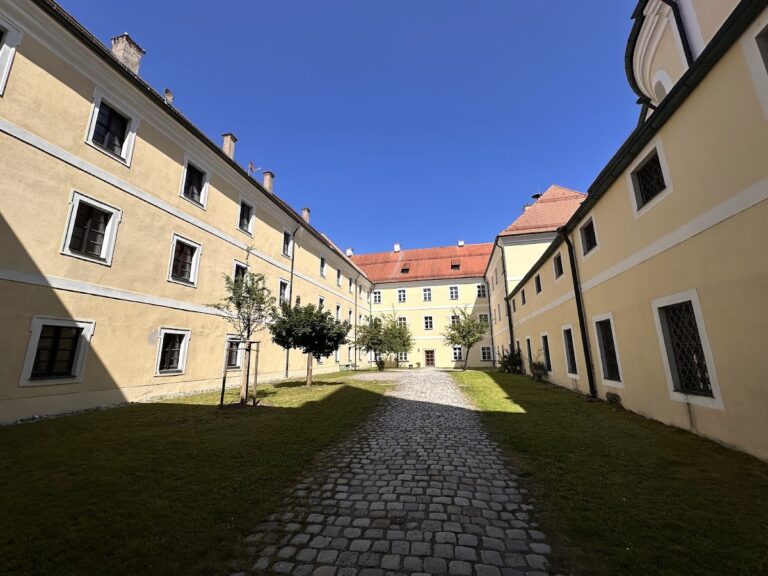
An eastern grain store with a hipped roof was built after the fire of 1686. This building survives and is now used as a dwelling, providing a standing example of the later phase of construction within the castle complex.
Observation tower and survey point
The remaining castle fabric has been secured as a restored ruin. A wooden observation tower rises within the site, and the Alps can be seen from it in clear conditions. A surveying point was also installed at the castle for preparing topographic maps.