Saint John the Baptist Monastery, Serres: An Orthodox Monastic Complex
Site at a Glance
- Popularity
- High
- Country
- Greece
- Primary era
- Medieval
- Eras represented
- Medieval, Early Modern, Modern
- Civilizations
- Byzantine, Ottoman
- Site type
- Religious
- Remains
- Monastery
On this page13 sections
History
Foundation and Byzantine period
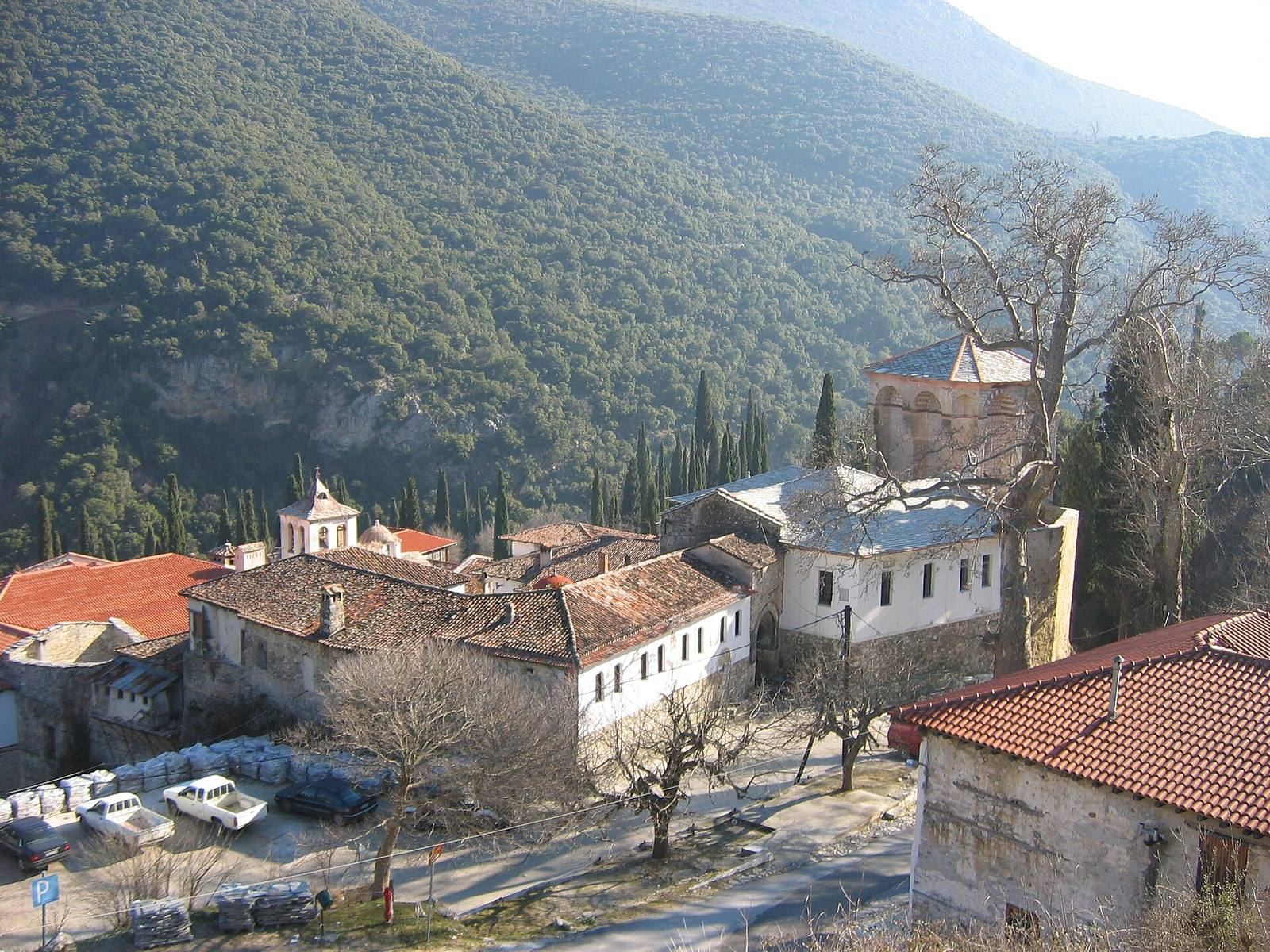
Saint John the Baptist Monastery is an Orthodox monastery about 10 km northeast of Serres, Greece, at the foot of Mount Menikio. Joachim, later bishop of Zichna, founded it between 1270 and 1275. It became an important spiritual center in eastern Macedonia.
Around 1300, Joachim enlarged the monastery, adding a small katholikon, the principal church of an Orthodox monastery, in the courtyard, along with a communal dining hall and a high enclosing wall. In 1332, the monastery and the surrounding region of Zichna came under Byzantine emperor John VI Kantakouzenos. An imperial decree soon afterward made the monastery stavropegial, placing it directly under a senior church authority rather than its local bishop.
A Serbian attack badly damaged the monastery in 1345. Helena, the wife of Serbian ruler Stefan Dušan, protected it from complete destruction. In 1353, small monastic settlements from two other monasteries joined the community.
Ottoman rule and monastic property
In 1371, before the Ottoman Empire completed its conquest of Serres, the monks persuaded Sultan Murad I to reduce the property tax charged to the monastery. Gennadius II Scholarius, a leading Byzantine theologian who became the first patriarch of Constantinople after the Ottoman conquest of the city in 1453, had lived at the monastery as a monk from 1457 to 1462. He later retired there and died in 1473.
An Ottoman register for 1568–1569 lists the monastery’s holdings, including six fruit orchards, two small olive groves, seven mills, three agricultural estates, houses, and 18 shops in Serres. Its property also included houses, orchards, olive groves, and winter pastures around Zichna, Thessaloniki, and Siderokapsa. Painters from the Linotopi school decorated the monastery in 1630.
Nineteenth-century cultural life and conflict
When Slavist Victor Grigorovich visited in 1845, he wrote that the monks concealed their Slavic origins by using Greek. He described the library as well organized and reported that its Slavic books had been burned. At the time, the monastery remained directly under senior church authority, and services were held in Greek.
During the nineteenth century, the monastery was an important spiritual center for eastern Macedonia. Monks from Slavic-speaking communities were associated with it, and its school taught children from nearby villages. Metropolitan Neophytos of Serres called the monastery a “hearth of pan-Slavism,” meaning solidarity among Slavic peoples, and described three quarters of its fathers as Slavic-speaking and one quarter as Greek.
Around 1870, the director of Serres’s Greek school entered monastic life under the name Christopher, intending to strengthen Greek influence among supporters of Slavic causes at the monastery. He organized Greek-language, Greek-oriented education for local children and opposed the abbot Dionysius of Gorno Brodi. In a letter dated 26 January 1873, the monks affirmed their commitment to Hellenism, or Greek national and cultural identity, and cited the monastery school, which taught more than 40 children from nearby Slavic-speaking villages. In 1878, Metropolitan Nathanael of Serres exiled Dionysius, a former abbot, and threatened abbot Theodosius Gologanov.
The monastery had about 60 monks and 60 servants in 1889, and 25 monks in 1891. Christians from nearby villages contributed to the construction of its large church. After the monastery came under Greek administration in 1913, authorities began erasing its Slavic inscriptions.
Library, preservation, and recent changes
A 1916 inventory described a collection of about 1,500 items. It included four Greek-language parchment imperial charters issued by Byzantine emperors Andronikos II and Andronikos III, 100 parchment religious manuscripts, 200 paper manuscripts, registers, old printed books, copies of Ottoman decrees, a copy of a charter issued by Stefan Dušan, and chronographs from 1611 and 1626. A chronograph is a historical work arranged by date.
In 1917, library treasures were transferred from the monastery to Bulgaria. They included 24 Gospels, 200 rare manuscripts, about 1,500 old books, four Byzantine imperial charters, and other sacred objects. Some items were later returned and transferred to the National Library in Athens; most remained in Sofia.
The monastery was designated a protected cultural monument in 1962. Protection was extended in 1991 to include its aqueduct, bridges, two western buildings, and chapels; the school, library, tower, and courtyard were added to the protected complex in 1993. In 1986, the monastery passed to a women’s monastic community, which restored it.
A fire on 13 December 2010 damaged the complex. An expert commission attributed the blaze to a wood-burning stove in the pilgrims’ guesthouse. The guesthouse, a Byzantine-era gallery, and workshops burned, while the newer wing and the monks’ cells were unharmed.
Remains
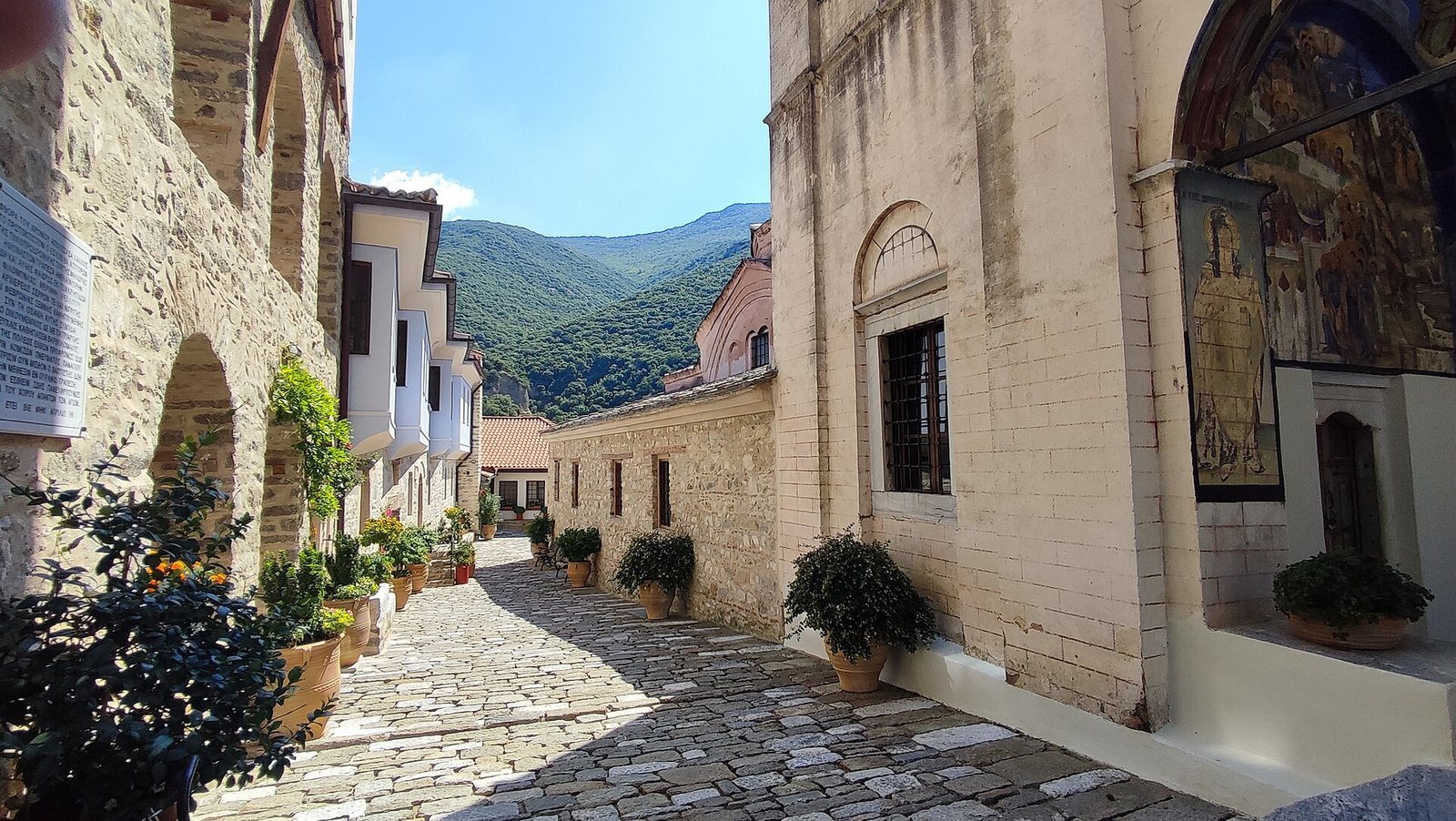
The complex brings together buildings from several periods. Its oldest structures date to the pre-Ottoman thirteenth and fourteenth centuries; other parts were built from the sixteenth through eighteenth centuries, and many buildings date to the nineteenth and early twentieth centuries. Much of the later work is associated with the Gorno Brodi craft center, whose builders, stoneworkers, carvers, and painters worked across the region.
Monastic core
Katholikon
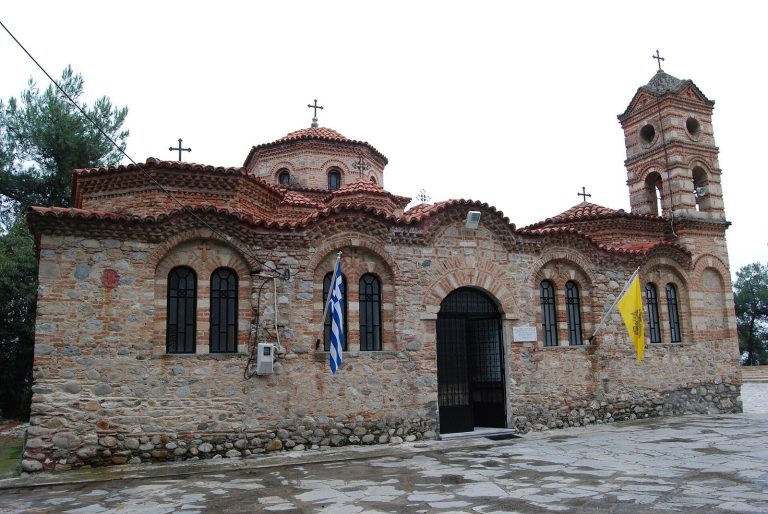
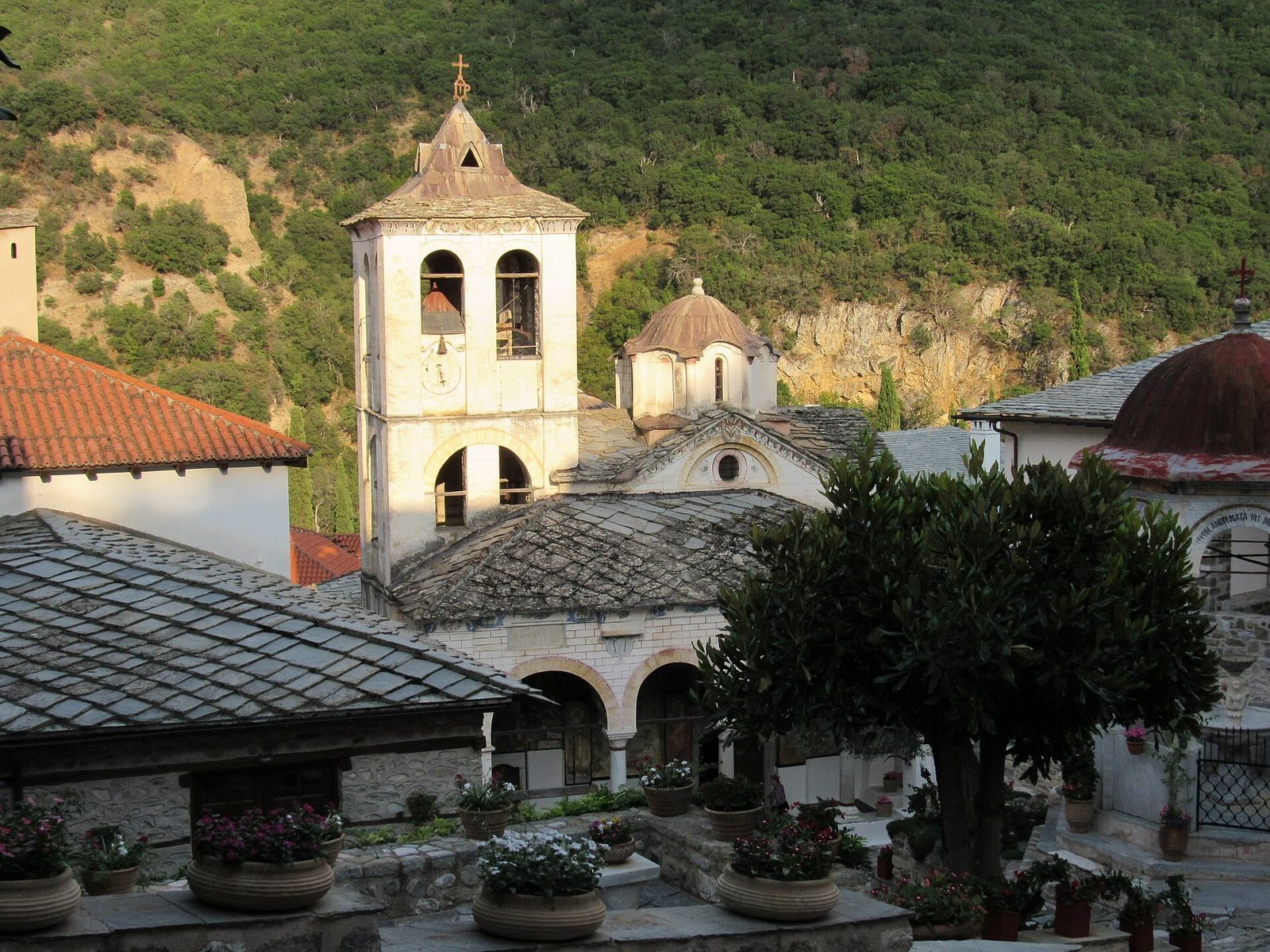
The principal church is built of stone and has Byzantine-style icons and wall paintings. Its bell tower, entrance vestibule, and gazebo-shaped baptistery, a place used for baptism, are attributed to craftsmen from Gorno Brodi. The church also contains Gennadius II Scholarius’s grave.
Wall paintings and iconostasis
The paintings include a fresco of the Forty Martyrs, a group of Orthodox saints, dated to 1300–1333, and an image of Christ Anapeson, the reclining Christ, from 1358–1364. A depiction of the Second Coming dates to the nineteenth century. Nineteenth-century donor portraits show Gennadius II and Byzantine emperor Andronikos II Palaiologos. Images of Christ Pantokrator, Christ as ruler of all, and the Virgin Hodegetria, who points toward Christ, are examples of painting associated with the Palaiologan dynasty, the ruling house of the later Byzantine Empire. The earliest paintings are noted for their expressiveness and realism; some are attributed to Panselinos, the conventional name of a celebrated medieval Byzantine painter associated with Macedonia.
The church’s iconostasis, a screen bearing icons that separates the sanctuary from the main body of the church, has carved work dated to about 1793–1803. Its makers are uncertain: attributions connect it with Petar Filipov of Debar, Petre Filipovski-Garkata, a Mijak master, or carvers from Gorno Brodi. The monastery’s original royal doors, the central doors of an iconostasis, are held in the church-art collection at the Cathedral of Saint Alexander Nevsky in Sofia. The pair now in the monastery dates to 1555.
Courtyard and communal buildings
The monastery’s early courtyard complex includes the small church, refectory, or communal dining hall, and high enclosing wall associated with Joachim’s enlargement around 1300. A Baroque marble fountain with a lion sculpture is among the complex’s carved stonework. Gorno Brodi craftsmen are also credited with many other carved stone elements and small features.
Waterworks, bridges, and associated buildings
Bridge and aqueduct
Joanikios Bridge lies southwest of the monastery and leads to its main gate. Built in 1835, it is attributed to the Gorno Brodi craft center. An inscription names the abbot from Gorno Brodi who funded the bridge and records his direct labor on the work. Other bridges around the monastery are also attributed to that center. An aqueduct forms part of the wider complex.
Chapels and other buildings
The monastery grounds include a tower, school, library, and two buildings west of the main complex. Chapels are dedicated to Saint Paraskeva, the Holy Archangels, the Nativity and Dormition of the Virgin, and Saints Cosmas and Damian. The Dormition is the Orthodox feast commemorating the Virgin Mary’s death.