Duomo di Pordenone: The Roman Catholic Co-Cathedral of San Marco


Site at a Glance
- Rating
- 4.6
- Popularity
- Low
- Country
- Italy
- Primary era
- Medieval
- External website
- Open
- Eras represented
- Medieval, Early Modern, Modern
- Civilizations
- Habsburg, Holy Roman Empire, Italian, Venetian
- Site type
- Religious
- Remains
- Cathedral
On this page22 sections
History
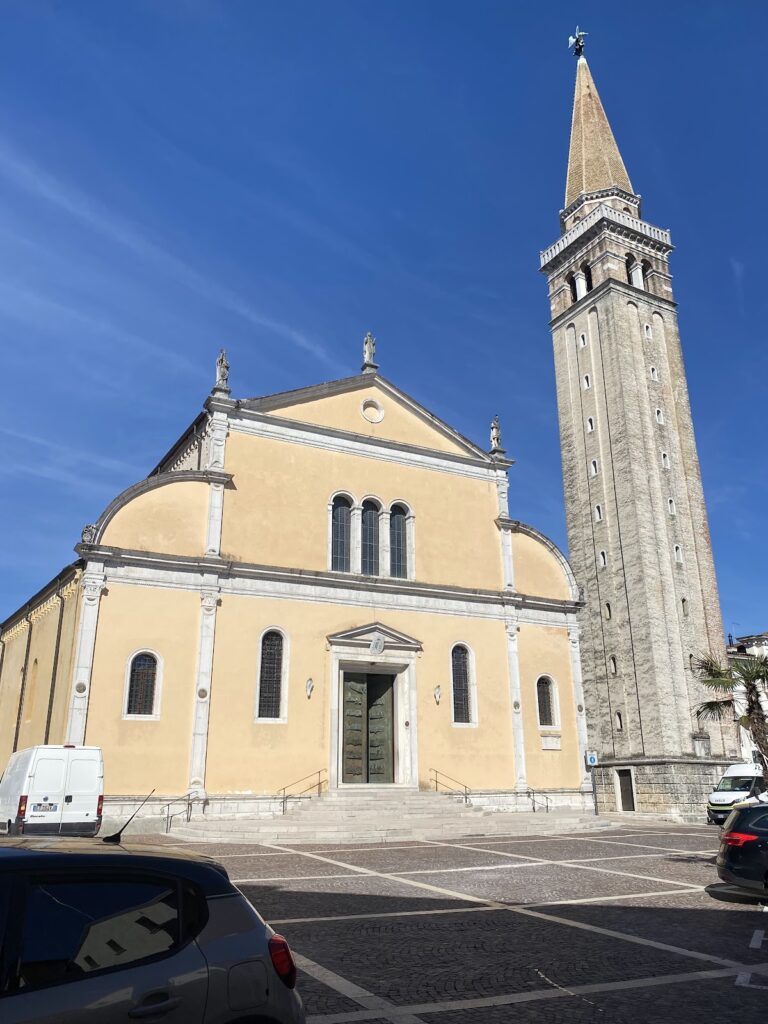
The Duomo di Pordenone, formally the Concattedrale di San Marco Evangelista, is the principal Catholic church of Pordenone, Italy, and a co-cathedral of the Diocese of Concordia-Pordenone. Dedicated to Saint Mark, it was built by the Christian community of Pordenone from the second half of the thirteenth century in a Romanesque-Gothic setting over an earlier structure. Its medieval fabric, later alterations, and extensive collection of paintings and sculpture reflect the city’s changing religious and political importance.
From Torre parish to an independent church
Pordenone’s Christian community originally depended on the parish church of Saints Hilary and Tazianus at present-day Torre, a foundation probably connected with Aquileia, an important ancient Roman and Christian center in northeastern Italy and a traditional center of early evangelization in the region. Political developments and the progressive silting of the Noncello increased Pordenone’s importance at Torre’s expense. In 1278, the church of Saint Mark became an independent parish, marking a new stage in the religious organization of the town.
The present church rose during the second half of the thirteenth century over the remains of an earlier building. Its campanile, a bell tower, was begun in 1291 and completed in 1347. The church itself was consecrated in 1468. The tower replaced an earlier bell tower, probably situated in the chapel on the church’s left side, and formed part of a deliberate rebuilding program after the fire of 1318. Its ground floor served as a prison until 1544.
Alterations from the sixteenth to the nineteenth century
The interior arrangement changed substantially during the sixteenth and eighteenth centuries. Three side chapels were created on each side of the single nave in the sixteenth century. During the eighteenth century, the nave was raised and its decoration was reshaped in keeping with contemporary taste under the direction of Domenico Rossi, an architect active in northern Italy whose work included major church interiors.
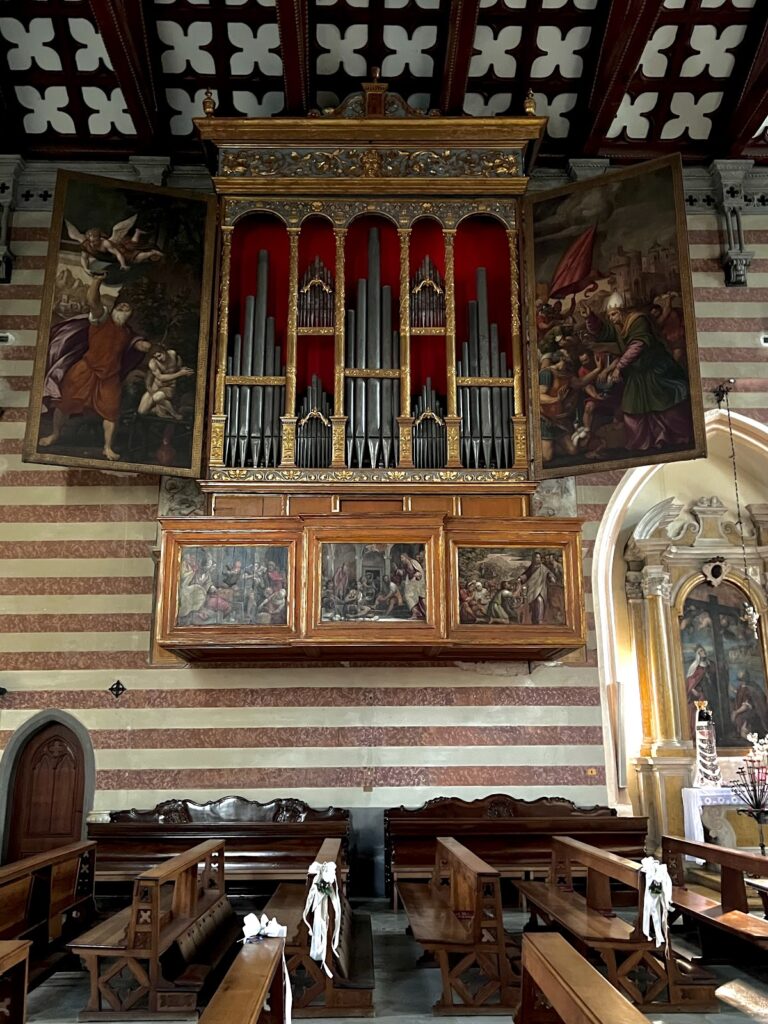
Several furnishings came from the former church of the Blessed Virgin of the Rosary, which was demolished in 1812. These included the high altar, the organ, and some marble side altars. The organ had been removed from that church in 1810 by Francesco Comelli, together with its case and gallery. The floor was raised and redesigned in 1859. Later work on the ceiling, carried out between 1878 and 1883, destroyed Venier’s 1722 fresco cycle illustrating episodes from the life of Saint Mark and introduced neoclassical cornices and pilasters. An exterior staircase was built in 1897 after the street level was lowered.
The campanile endured repeated threats and repairs. Earthquakes, especially those of 1348 and 1976, and lightning caused damage over the centuries. An order for its demolition on safety grounds was issued in 1820 but never carried out. An iron strengthening belt was added in 1862, followed by extensive renovation in 1888 and further consolidation after the 1976 earthquake.
Restoration and the co-cathedral
Localized restoration began in 1938 and continued until 1941. This work revealed two saints attributed to Pordenone on the right crossing pier, fifteenth-century frescoes in the Chapel of Saints Peter and Paul, and a Resurrection fresco in the sacristy. A broader restoration campaign began in 1956 and proceeded in stages. Some surrounding buildings were demolished to recover the appearance associated with the eighteenth-century enlargements, and decoration in the crossing dome was uncovered.
Between 1965 and 1975, the floor was restored and tomb slabs were found beneath it before being installed outside the church. The nave roof was repaired according to its original construction scheme, and frescoes were restored. Several fourteenth- and fifteenth-century paintings hidden beneath the nave plaster were detached and mounted on the interior walls, while the best-preserved scene remained in its original position. Restoration behind the high altar also uncovered part of a fresco bearing an inscription dated 1412, described as the oldest inscription so far found in the church.
The Friuli earthquake of 1976 caused considerable damage. The load-bearing walls were consolidated, and both the interior floor and nave roof were rebuilt. In 1997, steel tie rods strengthened the walls and the facade was repaired. The church became a co-cathedral on 26 October 1974 by decree of the Congregation for Bishops, following the transfer of the episcopal see from Portogruaro to Pordenone. A co-cathedral is a cathedral church that shares the seat or title of a diocese with another cathedral.
The church’s later history also includes religious and cultural changes within its furnishings. On 13 December 2015, during the Extraordinary Jubilee of Mercy, it hosted the solemn opening of the first Holy Door in the Diocese of Concordia-Pordenone. The wooden angels from the Chapel of Saints Peter and Paul, which had long been held in the Civic Museum of Art of Pordenone, were returned to the Parish of San Marco in 2015.
Remains
Exterior and medieval structure
The Duomo combines Romanesque, Gothic, and neoclassical elements. The most faithful surviving medieval components are the fourteenth-century apse, the lantern, a raised structure over the crossing, and the campanile. The tall bell tower is built almost entirely of exposed brick. Its Romanesque-Gothic design includes elegant three-light openings and hanging terracotta arches. A seventeenth-century spire brings its total height to 79.47 metres, and the belfry contains six bells. One small bell was cast by the Fadiis brothers in 1627; the other five were made by the De Poli foundry of Vittorio Veneto in 1991 and blessed during Pope John Paul II’s visit to the diocese the following year.
The present facade follows an unfinished nineteenth-century design by Francesco Lazzari. Its portal, made by Giovanni Antonio Pilacorte in 1511, has a lunette with Christ of Sorrows, zodiac signs on the jambs, and scenes of Creation on the architrave and plinths. Pilacorte was a Renaissance sculptor and stoneworker known for architectural sculpture and church furnishings. The facade formerly carried frescoes by Gasparo Narvesa, commissioned by the Council of Pordenone on 21 April 1593. Traces of these paintings were still visible in the nineteenth century.
The space before the church was formerly used as a burial ground. On the left, the outline of the Chapel of Saint Anthony Abbot, demolished in 1895, remains visible. Inside the entrance, a holy-water stoup rests on a carved block by Pilacorte dated 1508. The block bears Pordenone’s civic arms, showing an open urban gate above waves.
Nave and right-hand chapels
The interior is organized around a single nave with three side chapels on each side. The eighteenth-century raising of the nave and its new decoration altered the earlier spatial character, while the later restoration campaigns preserved and repositioned medieval and Renaissance frescoes. The vault now bears Antonio Boatto’s 2000 fresco of the Trinity as presented in the Gospel of Saint Mark. Windows designed by Albano Poli were inaugurated in 2014. Each differs from the others and was intended to emphasize changing natural light and the church’s works of art.
Chapel of Mercy
The first chapel on the right contains the 1515–1516 Madonna of Mercy altarpiece by Pordenone, the artistic name of Giovanni Antonio de’ Sacchis, a Renaissance painter active in northeastern Italy. The Virgin shelters several figures beneath her mantle, with Saints Christopher and Joseph beside her. Behind them is a pastoral landscape containing a large castle and a fortified city gate. The related altar of Saint Joseph, also called the altar of Mercy, was made by Giovanni Battista Bettini in 1771.
Second and third right-hand chapels
The second right-hand chapel contains a statue of the Virgin. Two frescoes immediately before it, attributed to Stefano Pievano of Sant’Agnese, depict bishop saints and Saint Christopher. The third chapel contains Marcello Fogolino’s 1523 painting of Saint Francis with Saints Daniel and John the Baptist. The lower part shows the arms of the Fontana family and two small Pordenone churches formerly dedicated to Daniel and John the Baptist.
Montereale-Mantica Chapel
Aloisa Mantica commissioned the Montereale-Mantica Chapel, which contains her sarcophagus, dated 1511. Giovanni Maria Zaffoni, known as Calderari and a pupil of Pordenone, frescoed the chapel in 1554–1555 with scenes from the life of the Virgin on the walls, lunettes, and vault. The decoration has been interpreted as anticipating Mannerism, a sixteenth-century style marked by sophisticated, often elongated forms and carefully composed settings, and possibly as relating to the dogma of the Immaculate Conception. Giancarlo Magri restored the chapel in 2013.
The chapel also contains Pomponio Amalteo’s 1565 altarpiece of the Flight into Egypt. Amalteo was a sixteenth-century Italian painter associated with the artistic milieu of Friuli. In the painting, a palm tree offers dates to Mary and water springs forth for her. The surrounding landscape includes statue fragments, obelisks, and imaginary architecture.
Frescoes on the right crossing pier
The right pier before the Montereale-Mantica Chapel carries fifteenth- and sixteenth-century frescoes of John the Baptist, Saint Francis receiving the stigmata, Saint Daniel, Saint Roch, Saint Erasmus, and the Madonna and Child. The image of Saint Roch, dated 1515–1518, and that of Saint Erasmus, dated 1512–1514, are attributed to Pordenone. Saint Roch has traditionally been regarded as a self-portrait. The Madonna and Child, dated before 1506, has also traditionally been attributed to the same painter, though the attribution does not have firm supporting evidence.
Crossing, baptistery, and Saint Nicholas chapel
Chapel of Saints Peter and Paul
The Chapel of Saints Peter and Paul, also called the Ricchieri Chapel, stands to the right of the crossing. Its vault contains symbols of the Evangelists, saints, and angels, while its walls show views of the city. Most art historians date the frescoes to 1414–1420 and attribute them to a close follower of Gentile da Fabriano. The chapel contains Filippo de Porri’s seventeenth-century wooden statue of the Risen Christ and two wooden angels dated 1690–1695. Their gilded garments are green on the reverses.
Detached frescoes on the side walls show the Apostles with Saint George, dated 1340–1350, and an enthroned nursing Madonna with Saint Mark, dated approximately 1360–1370. Both works were made by anonymous artists. The chapel’s wooden angels were returned to the Parish of San Marco in 2015 after a long period in the Civic Museum of Art of Pordenone.
Baptistery
The baptistery contains a 1505 fresco of the Resurrection of Christ, an icon-carpet depicting the Virgin and Child from central Persia, and a baptismal font by Giovanni Antonio Pilacorte. It also displays copies of four painted tempera panels from 1534. Their subjects are the birth of John the Baptist, John the Baptist preaching in the wilderness, the Baptism of Christ, and Herod’s banquet. The original panels are preserved in the Civic Museum of Art of Pordenone.
Chapel of Saint Nicholas
The Chapel of Saint Nicholas contains frescoes by an anonymous painter known as the Master of the Stories of Saint Nicholas. Dating from the second half of the fifteenth century, the paintings show seated Church Fathers in the vault and episodes from the life of Saint Nicholas on the walls. They were restored in 2015–2016. A detached fresco on the wall adjoining the presbytery depicts Saint Nicholas enthroned. It dates from 1414–1420 and is attributed to the anonymous Master of the Ricchieri Chapel.
The chapel’s other furnishings include a 1753 altar by Giovanni Battista Bettini, a 1773 altarpiece attributed with some uncertainty to Pietro Feltrin, and a late-fifteenth-century pastiglia crucifix. Pastiglia is raised decorative modeling made from a moldable plaster-like material.
Presbytery and left-hand chapels
Presbytery
The presbytery contains an altarpiece by Pordenone and Pomponio Amalteo showing Saint Mark consecrating Hermagoras as bishop of Aquileia. Hermagoras was an early Christian bishop traditionally regarded as Aquileia’s first bishop. He is surrounded by the archdeacon Fortunatus and Saints John the Baptist, Sebastian, Jerome, and George, who appears mounted and in armor. The high altar partly conceals the painting and is accompanied by two adoring angels made by Torretti in 1764. The presbytery also contains an ambo, a raised stand for proclaiming scripture, by Fiorenzo Bacci and wooden choir stalls made by Sebastiano Rizzani in 1742. In August 2015, the lower eighteenth-century stalls were moved to the Chapel of the Blessed Sacrament.
Chapel of Saint Augustine
The Chapel of Saint Augustine contains Pietro della Vecchia’s 1672 painting of the Virgin in Glory with Saints Augustine and Monica. The painting formerly stood in the church of San Giorgio and has been restored several times, most recently in 1972 and 2014. Two anonymous seventeenth-century paintings of Saints Peter and James are also kept in the chapel.
Chapel of the Blessed Sacrament
The Chapel of the Blessed Sacrament is an eighteenth-century space with stucco and other decoration dating from the 1770s.
Frescoes on the left pier
The left pier bears a sinopia by Gianfrancesco da Tolmezzo depicting a saint, a fresco of the Pentecost by the same artist, and an anonymous fresco of Saint Francis dated 1375–1400. A sinopia is an underdrawing, usually in red earth pigment, made on a wall before the final fresco is applied.
Third and second left-hand chapels
The third chapel on the left contains Marcello Fogolino’s 1523 painting of the Madonna with Saints Blaise and Apollonia. Beside it stands an eighteenth-century pulpit decorated with scenes of the Parable of the Sower, Christ and the Samaritan Woman, and the prophet Moses with the Tablets of the Ten Commandments.
The second left-hand chapel contains Domenico Tintoretto’s 1594–1595 altarpiece of Saint Jerome. The saint is shown half-naked, with his cardinal’s hat discarded to indicate his renunciation of worldly honors. A lion, crucifix, skull, penitential stone, and an angel holding a scroll praising penitence complete the composition.
First left-hand chapel and organ
The first chapel on the left contains an eighteenth-century altarpiece by Antonio Cavagioni depicting Saint Vincent Ferrer. The church’s organ was made by Pietro Nachini in 1749, later enlarged by Giovanni Battista De Lorenzi, and restored by Francesco Zanin in 2004. It retains the case and gallery transferred from the demolished church of the Blessed Virgin of the Rosary.
Nearby sites