Civitas Classis: Ravenna’s Roman Naval Base and Settlement
Site at a Glance
- Popularity
- Medium
- Country
- Italy
- Primary era
- Medieval
- Eras represented
- Classical, Medieval
- Civilizations
- Byzantine, Ostrogothic, Roman
- Site type
- City
On this page20 sections
History
Civitas Classis was a Roman naval settlement and harbor at Ravenna, Italy, where Octavian established a fleet base between 35 and 12 BC. The settlement itself grew from the second century AD. Its harbor served Rome’s navy and, when the fleet was not using it, commercial traffic connected with Ravenna.
Roman naval base and settlement
Before the naval base was established, Classe was a small fishing and trading port. Ravenna, to its north, had been founded in the late third or early second century BC. For about three centuries, the base at Classe housed Rome’s eastern Mediterranean fleet and ranked among the empire’s important naval installations.
The harbor could accommodate as many as 250 ships. The fleet and its support services involved around 10,000 people, including sailors, soldiers, rowers, officers, pilots, carpenters, doctors, repair workers, scribes, and weapons makers. Most personnel were housed at Classe, though some sailors and their families lived in Ravenna. Imperial rules formally barred sailors in service from marrying, but families established roots in the area.
The fleet operated chiefly in the Adriatic and Aegean, with voyages reaching as far as Spain. It helped suppress a slave revolt at Brundisium in AD 24 and protected merchant shipping from pirates during peacetime. It probably also contributed to reducing piracy across the Mediterranean. Its ships included triremes and quadriremes, warships classified by their rowing arrangements, as well as lighter liburnian vessels. A figure of 5,000 ships is associated with the fleet in AD 69, though that number is uncertain.
Classe also held Germanic leaders. These included Bato I, a Pannonian rebel defeated by Tiberius; a son of Arminius, who had resisted Roman rule in Germania; and Maroboduus, former king of the Marcomanni. Maroboduus had sought Tiberius’s protection and later died at Ravenna. Classe may have been the departure port for Trajan’s second campaign against Dacia, an interpretation linked to Trajan’s Column. Brundisium and Ancona have also been proposed.
The base was initially administered by the emperor’s fleet prefect. Grain storage and distribution served the imperial administration, while an agricultural estate supplied food for the soldiers. After Ravenna became an imperial residence in 402, Classe appears to have come under the city’s jurisdiction.
Christian life and burial
Burial grounds occupied the area before the settlement expanded. Christian burials appear by the late second century, and Christianity became an important part of life at Classe and a center for its spread around the Po estuary. From the fourth century, the community had its own baptistery and several churches. Burial near the tombs of saints encouraged the practice of placing the dead close to their remains.
Classe apparently did not have a bishop of its own, perhaps because it was much smaller than Ravenna. Its religious life developed alongside that of the nearby city, with several churches associated with the settlement in late antiquity.
Harbor decline and Ravenna’s rise
When harbor maintenance lapsed during the third-century imperial crisis, silt began to accumulate and the port started to dry out. Ravenna and Classe declined. From about 306, emperors stayed at Ravenna to watch for approaching enemies. Ravenna’s elevation to the western imperial capital in 402 brought renewed prosperity to Classe, including growth in its residential district and grain administration.
Ostrogothic and Byzantine rule
After western Roman rule ended in 476, the settlement and harbor continued. The Ostrogothic king Theodoric arranged repairs to the harbor, which now served northern Italy chiefly as a commercial port rather than as a major military base. In 540, the Byzantine general Belisarius recaptured Classe during the Gothic War. Emperor Justinian I then had the harbor restored. It became the empire’s second most important port after Constantinople, and the population grew as new churches were built.
Classe remained under eastern Roman rule until 751, within the Exarchate of Ravenna, the eastern Roman administration of territories in Italy. Lombard forces under Faroald I, duke of Spoleto, plundered the settlement in 579. Between 584 and 588, Droctulf, fighting for the eastern empire, recovered it. Faroald II captured Classe in 712 or 713 but returned it to Byzantine control after the exarch protested. In 717, forces of the Lombard king Liutprand took and plundered the city again.
Medieval decline
When King Aistulf captured Ravenna in 751, Byzantine rule and the Exarchate ended. Classe appears to have been destroyed during the Lombard wars. Its harbor silted up, and the settlement lost its military and commercial importance. In 756, the Frankish king Pepin the Short drove the Lombards from Ravenna and Classe. Ravenna’s archbishops briefly ruled the territory before Charlemagne’s conquest of the Lombard kingdom in 774 transferred it to the papacy. During the eighth and ninth centuries, Classe dwindled into ruins and scattered houses.
Muslim pirates raided the area in the mid-ninth century. In 870, they landed on the coast and sacked a basilica of Sant’Apollinare. The inhabitants left Classe and took refuge within Ravenna’s walls. At an undetermined point in the Middle Ages, the Po River destroyed the harbor.
Archaeological investigations
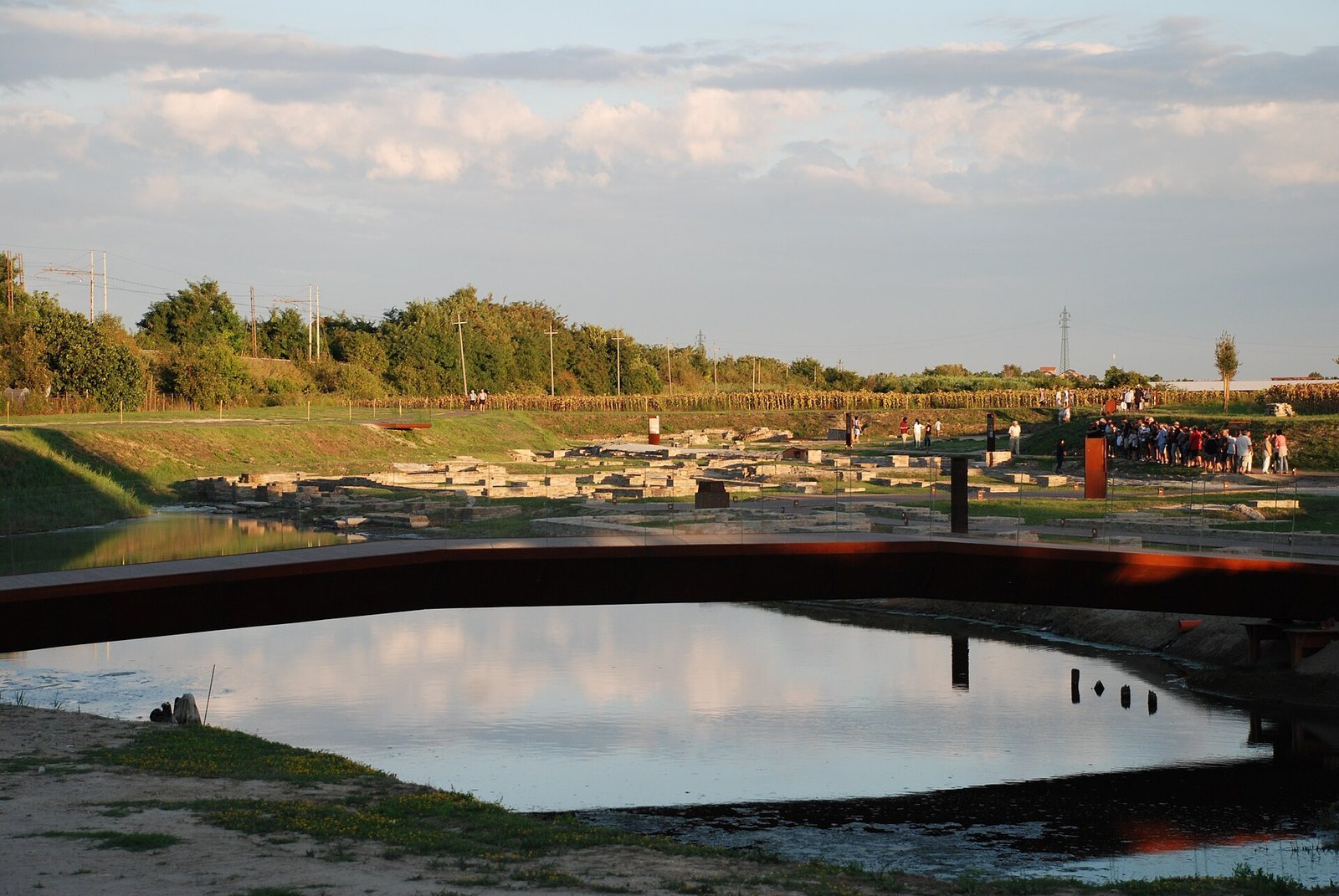
Investigations at Classe began in the twentieth century. In 1956, engineer Giuseppe Cortesi compared earlier studies with aerial photographs by Vitale Valvassori, helping to identify remains of the Basilica of San Severo and the first traces of the harbor. Further aerial work in 1960 located the harbor entrance south of the present Fiumi Uniti riverbed. In 1974, large masonry structures at the entrance were interpreted as protection from sea currents. Excavations have focused on Podere Chiavichetta, San Severo, Podere Marabina, and Saint Probus. The archaeological park was renovated in 2015.
Remains
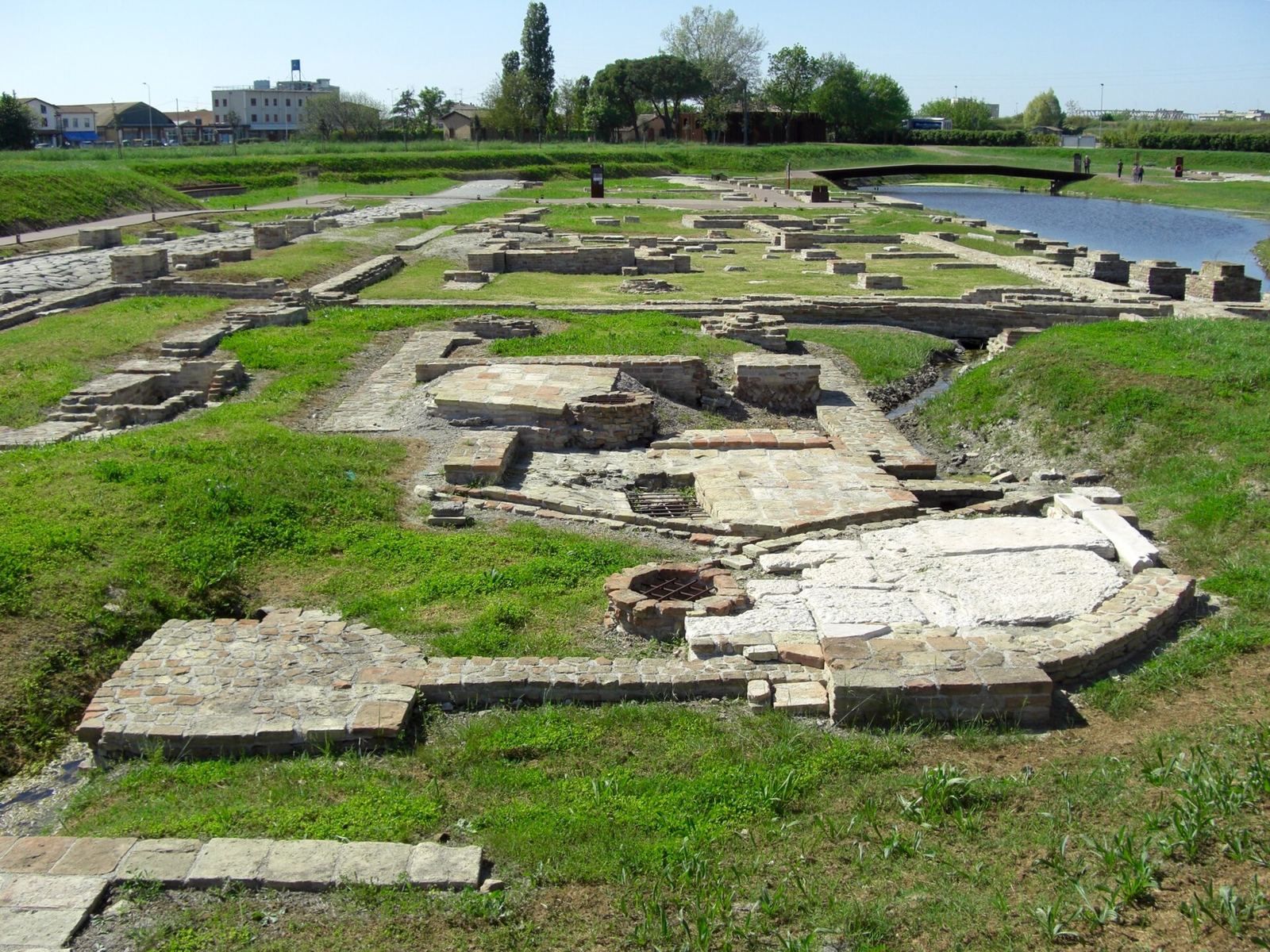
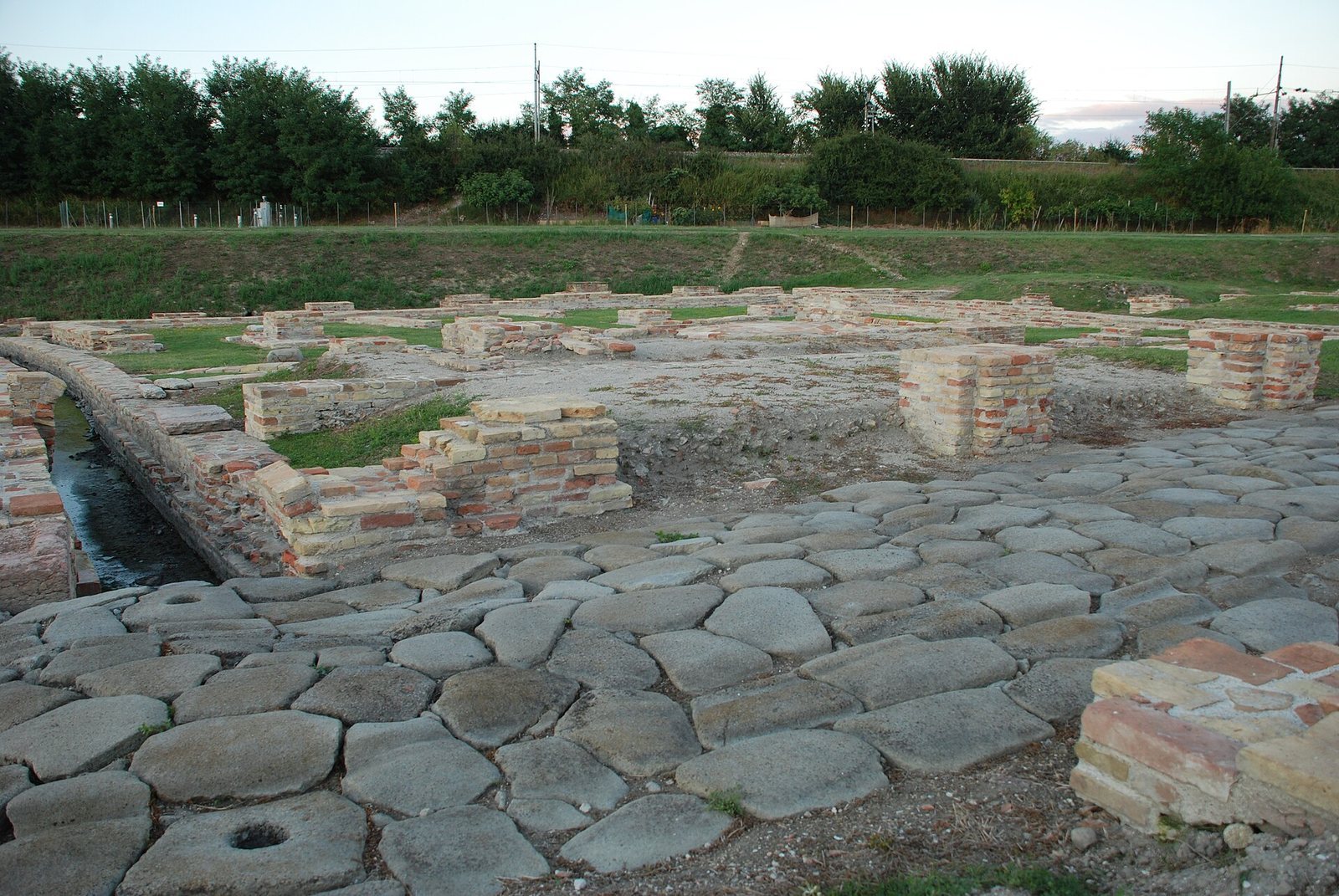
The remains belong to a settlement organized around a harbor, its connecting waterways, and the facilities of the fleet. Excavations have recovered harbor structures, quays, warehouse foundations, and sections of the road linking Classe with Ravenna.
Harbor and waterways
The harbor occupied a lagoon and connected to the Adriatic through a man-made canal. A second channel, the Fossa Augusta, linked Classe with Ravenna and was later extended north toward the Venetian lagoon and Aquileia, forming a calm-water route of about 250 km. The harbor foundations rested on timber supports, with large oak beams used above them. Ceramic fragments were incorporated into construction by the first century AD, and the harbor was rebuilt in brick in the second century. Its quays, waterfront loading platforms, extended for about 3 km. Arsenals, supply stores, barracks, and warehouses lined the canals and basins. At Podere Chiavichetta, excavations revealed quays and an island within the canal, joined to the mainland by a movable bridge. Masonry structures near the harbor entrance may have protected it from sea currents.
Settlement, roads, and water supply
Settlement walls
The settlement developed around the fleet soldiers’ camp, barracks, and warehouses. A semicircular wall enclosed the town in the third or fourth century. By the late fourth century, a wall also enclosed the residential area south of the harbor.
Roads and water supply
The Via Caesaris, built in the first century BC, connected Ravenna and Classe before joining the Via Popilia, another Roman road. Paved remains lie beneath Viale Galileo Galilei, under four successive road surfaces; the lowest is dated to the first century AD. Further traces were found north of the New Bridge. Trajan built a 35 km aqueduct to supply Ravenna, and it may also have carried water to Classe.
Buried landscape
The ground beneath Ravenna and Classe has gradually sunk for centuries, at an estimated rate of 16 to 23 cm per century. By the beginning of the fourth century, falling ground levels had made the harbor’s quays, shipyards, and access roads unusable. Siltation shifted the coastline about 9 km eastward. Remains lie at varying depths: Republican-period material is found 4 to 8 m below the surface, imperial material at 3 to 6 m, and Ostrogothic-period material at 2 to 4 m.
Churches and burial places
Seven ancient basilicas are associated with Classe and were probably located near burial grounds outside the walls. Four followed Catholic belief and three Arian teaching, a Christian doctrine that denied the full equality of the Son with God the Father.
Basilica Petriana
The Basilica Petriana, Classe’s first Christian church, was begun by Peter Chrysologus in the first half of the fifth century and completed under his successor Neon. It had three aisles, or long interior divisions, and a portico, a covered walkway on four sides. A baptistery for Christian baptism was added during Theodoric’s rule. An earthquake destroyed the church in 725.
Basilica of Sant’Apollinare in Classe
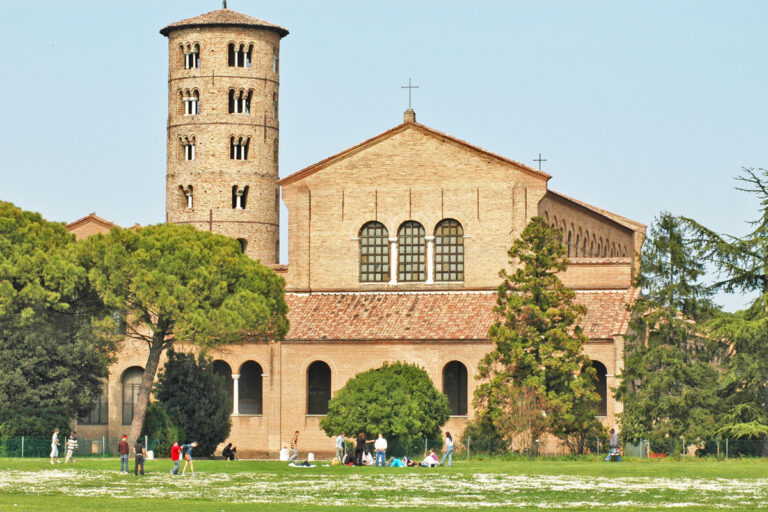
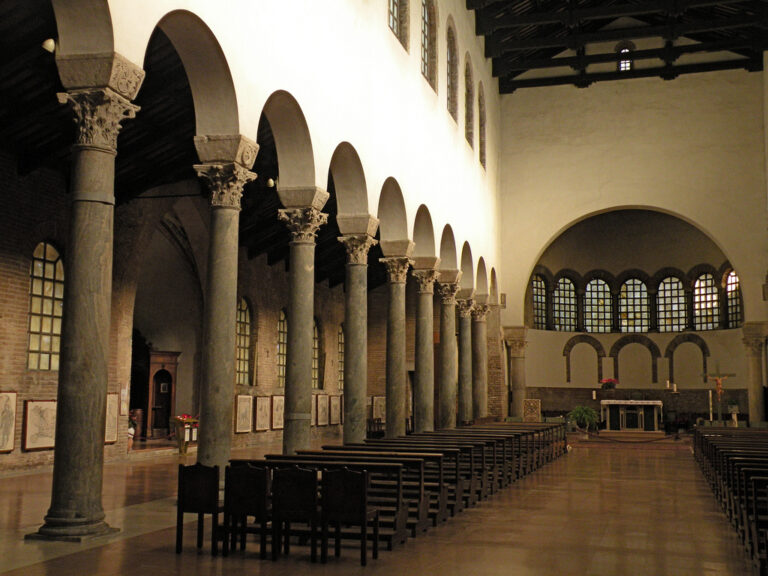
Bishop Ursicinus oversaw construction of the Basilica of Sant’Apollinare in the first half of the sixth century, at the place traditionally believed to be Apollinaris’s tomb. It is the only church from ancient Classe still standing.
Basilica of San Severo
The Basilica of San Severo was built near the Via Caesaris to house the tomb of Severus, a bishop of Ravenna. Work began around 570 and was completed under a later archbishop. The Byzantine church had three aisles and an adjoining monastic complex. It survived the earthquake of 725, but Severus’s remains were later taken to Germany. The basilica was demolished in 1468. A smaller replacement was subsequently restored and renewed in the eighteenth century, then abandoned and destroyed around 1820.
Sixth-century basilica outside the walls
An unidentified basilica stood just outside the walls in the sixth century. It had three aisles and an atrium, an open central courtyard.
Cemeteries and sailor tombstones
Tombstones belonging to sailors from the fleet have been unearthed at Classe. They provide physical evidence of the people who served at the naval base.
Images and objects
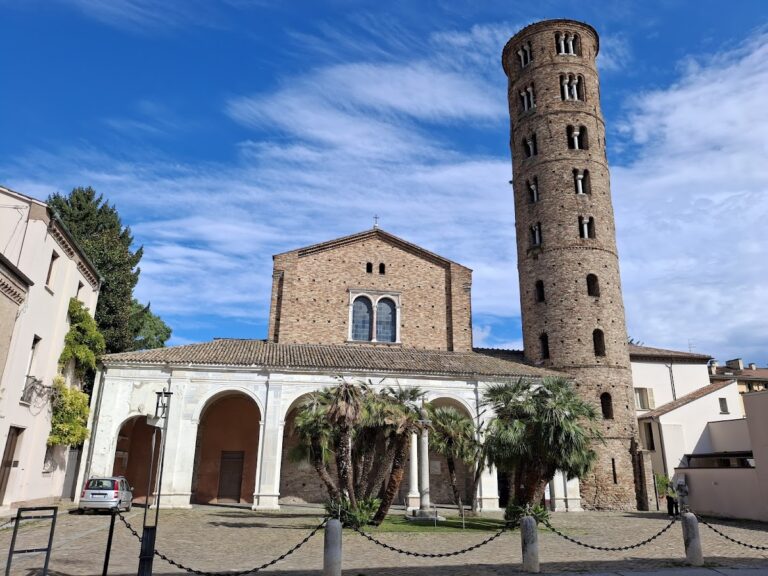
A mosaic in Sant’Apollinare Nuovo at Ravenna depicts Classe’s harbor in the 520s. It shows a walled settlement with an amphitheatre and basilica, and two lighthouses beside the harbor entrance. Excavations in the early 1970s also recovered a marble head with a turret-shaped crown, representing Tyche, the Greek goddess associated with a city’s fortune and prosperity. The head probably formed part of a relief on a public or religious building.