Ensemble de Quélarn: A Middle Neolithic Burial Complex in Brittany, France
Site at a Glance
- Popularity
- Low
- Country
- France
- Primary era
- Stone Age
- Eras represented
- Stone Age
- Civilizations
- Unclassified
- Site type
- Burial
- Remains
- Burial Mound
On this page15 sections
History
Early visits and construction
Charcoal found among stones packed around a pit for setting a support was dated to about 7000 BP, a dating convention that uses 1950 as its reference year. It suggests that people may have visited the site during the Mesolithic, or Middle Stone Age. Pollen in old soil beneath chambers C and D indicates that the surrounding land was pasture and that people frequented the area before the monument was built.
The cairn, a stone-built monument, was constructed during the Middle Neolithic, the middle part of the New Stone Age. Its final form developed through successive building work rather than a single planned project. Chamber C may have been built first, with chamber B added to its east; the shared arrangement of chambers A and B suggests that they were constructed together. A facing wall across the front was added later in two stages.
Quarrying and local tradition
During the Middle Ages, stone was taken from the cairn. An estimated 1,000 to 1,500 cubic metres was removed from its upper structure, contributing substantially to the ruinous condition seen today. Local tradition held that korrigans, small beings in Breton folklore, frequented the site, which was called the Korrigan Warren. The story may relate to passages so low that people had to crawl through them and to the small stature attributed to the korrigans.
Investigation and protection
Armand du Châtellier mentioned the site in 1850 and published an initial plan. His son Paul excavated it in 1887, counting one passage tomb and 27 open-air chambers; he interpreted the complex as a burial ground.
Orders dated 10 June 1920 and 26 August 1921 gave the site historic-monument protection. From 1979 to 1983, Pierre-Roland Giot led five excavation campaigns with A.M. Apsimon of the University of Southampton. The work clarified the complex’s construction sequence, recovered funerary objects, and established its Middle Neolithic date. Giot considered the excavation incomplete and estimated that a full investigation would have required at least twice as much time. The Finistère department acquired the site in 1987.
Remains
Cairn and setting
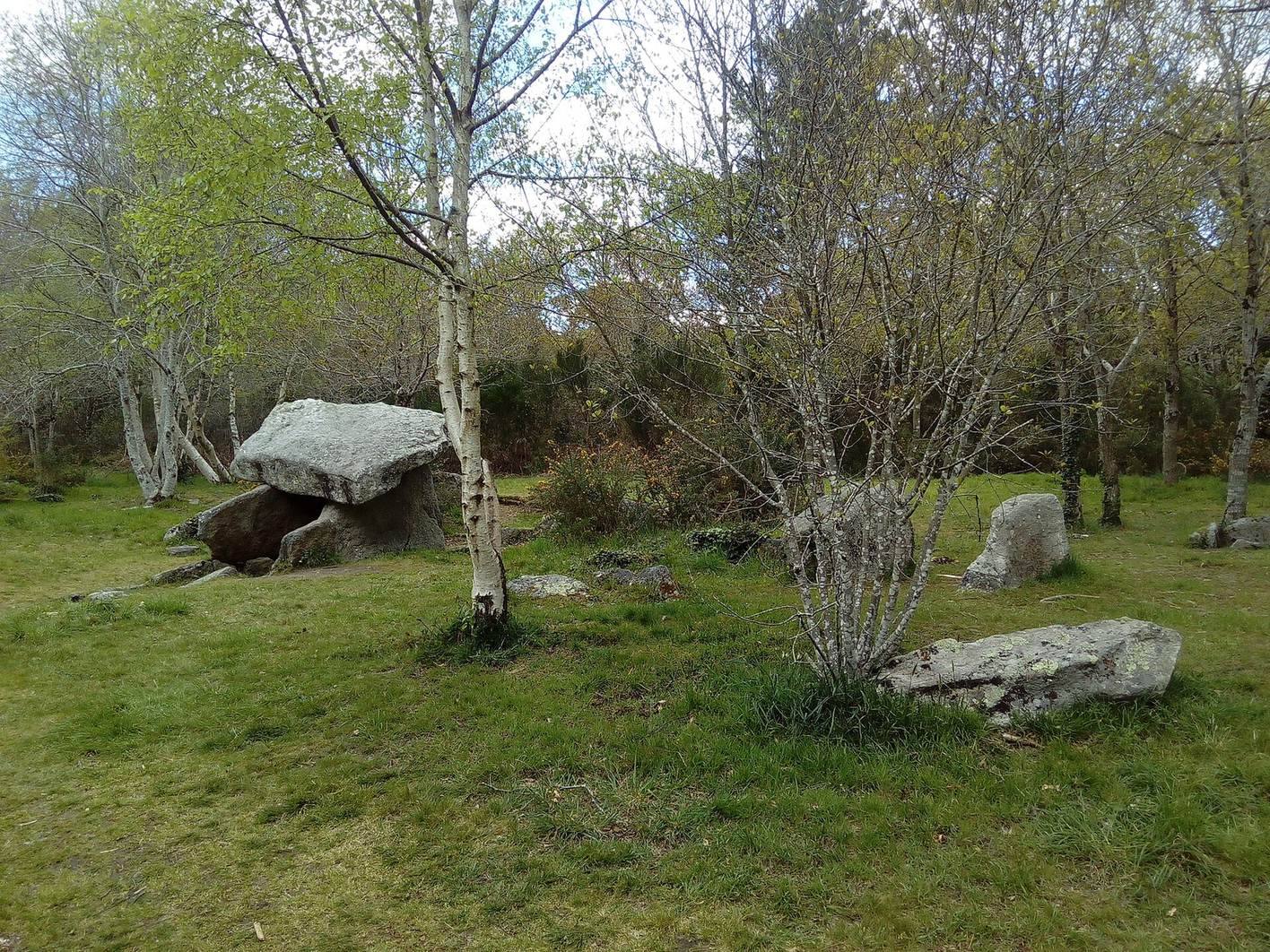
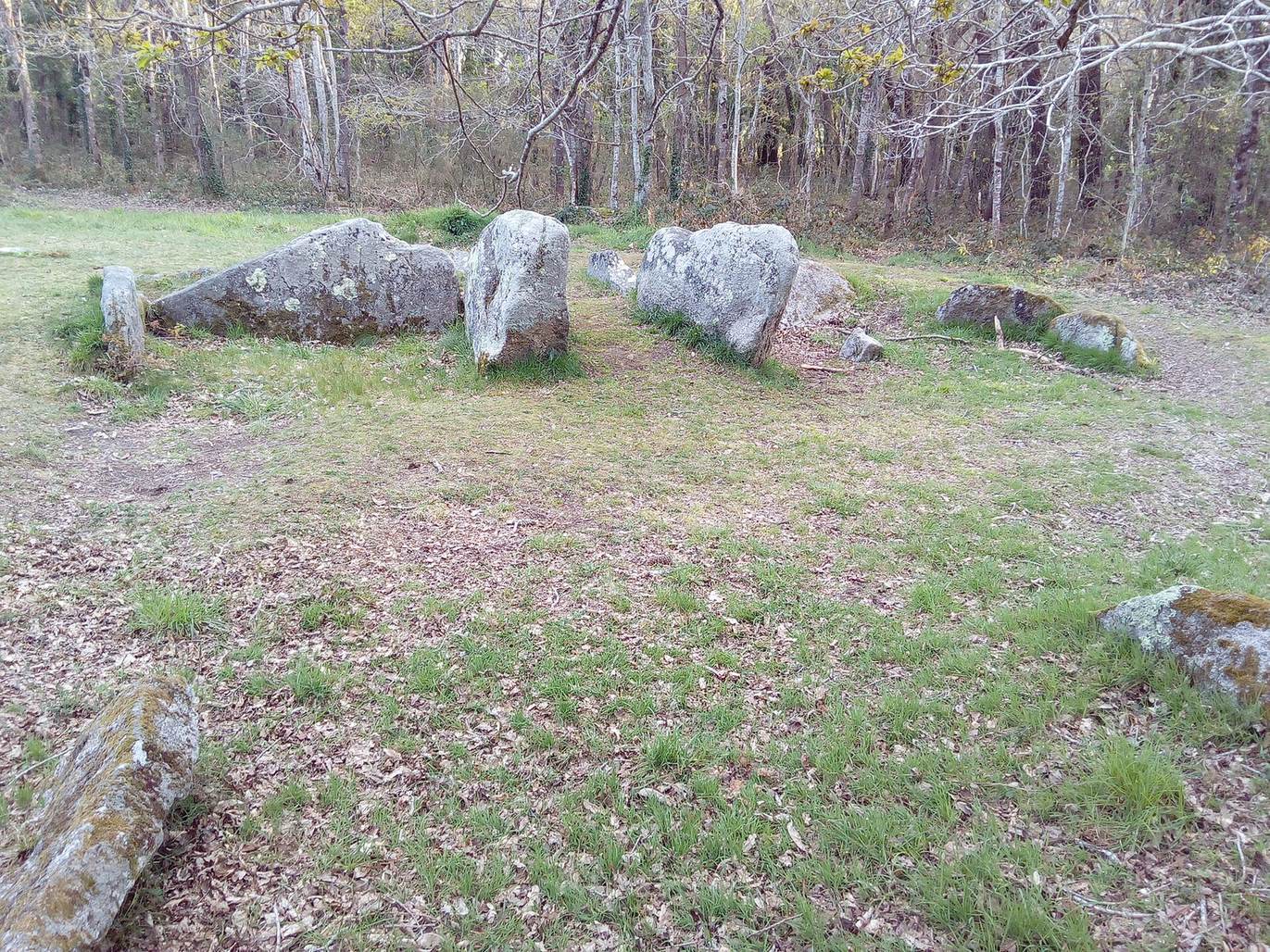
The ruinous cairn is about 55 metres long and 10 metres wide, runs east to west, and is built from coarse-grained local granite. Six covered corridors open to the south, each leading to a group of partitioned burial chambers connected by a central passage. The chambers are labelled A through F from east to west. A small menhir (standing stone) associated with the complex stands about 50 metres south of the cairn’s western end. A separate standing stone lies about 300 metres farther south, while the Tronval tomb is about 300 metres to the east. The Tronval tomb is sometimes grouped with Quélarn, although it is a distinct site.
Burial chambers
Chamber B
Four compartments, numbered I to IV, surround a central space at the end of chamber B’s corridor. A threshold stone lay where the corridor passes between compartments II and III, and the northeastern compartment, III, has a well-preserved paved floor. The entrance passage has an outer section built with dry-stone walls and an inner section lined with upright slabs. A covering slab survives over the access corridor. At its entrance, a pit measuring 1.12 by 0.70 metres and 0.40 metres deep contains small granite slabs set both upright and flat. Their purpose is uncertain; they may have formed part of an earlier way to close the corridor, before the front wall was added. The original covering of the burial chambers is also uncertain. Large slabs may have been used, perhaps removed during medieval quarrying, or the roofs may have been formed from layers of stone set progressively inward.
Chamber C
Chamber C has four compartments. Remnants of a slab pavement were found in its southwestern compartment.
Chamber D
Chamber D is square and divided internally. Its western compartments are badly degraded.
Chamber E
Chamber E measures 8 by 8 metres. It had six compartments, three on either side of a central paved space, and an outer facing wall.
Chamber F
Chamber F is a separate burial associated with the cairn. Three upright slabs outline adjoining small stone burial compartments, each with a paved floor.
Archaeological finds
Finds from chamber E
Small fragments of fine pottery from the Middle Neolithic and coarser pottery from the Late Neolithic were found in chamber E’s access corridor. Charcoal from the same area was radiocarbon dated to a period corresponding to the Middle Bronze Age, and may represent a later intrusion.
Finds in front of the cairn
Pottery from Roman-period Gaul and the Middle Ages found in front of the cairn indicates that the site was used in later periods as well.