Basilica of Sant’Apollinare in Classe: A Sixth-Century Byzantine Basilica in Ravenna


Site at a Glance
- Rating
- 4.7
- Popularity
- Medium
- Country
- Italy
- Primary era
- Medieval
- External website
- Open
- Eras represented
- Medieval, Early Modern
- Civilizations
- Byzantine
- Site type
- Religious
- Remains
- Basilica
On this page15 sections
History
The Basilica of Sant’Apollinare in Classe is a sixth-century Byzantine church in Italy, located in Classe, the ancient port district of Ravenna. Construction began in the second quarter of the sixth century over the burial place of Saint Apollinaris, traditionally regarded as Ravenna’s first bishop, during the Justinianic period, when Ravenna was under Byzantine rule and received major architectural and artistic commissions. The basilica was initiated by Bishop Ursicinus and financed by Julianus Argentarius, who also supported the construction of the Basilica of San Vitale.
Foundation and consecration
Bishop Maximian consecrated the church on 9 May 549 and dedicated it to Saint Apollinaris. A sixth-century inscription states that Julianus Argentarius raised the building from its foundations and that Maximian placed Apollinaris’s relics inside it. This inscription supplied the evidence for the precise consecration date. The relics were discovered while the basilica was being built and became its principal sacred focus.
The church stood beside a Christian cemetery and may also have occupied the site of an earlier pagan burial ground. Ancient tombstones were reused in the building, while a fourth-century funerary urn found beneath the floor gives further evidence for activity at the cemetery before the basilica was constructed. The port district itself had developed around the Roman fleet base reinforced by Augustus to defend the Adriatic. Later silting moved the coastline approximately 9 kilometres east, changing the relationship between the church and the harbor landscape.
Relics and changing decoration
In 856, the relics of Saint Apollinaris were moved inside Ravenna’s walls to Sant’Apollinare Nuovo because of the danger of enemy raids. They returned to the basilica in 1748, but were placed in the main altar instead of being restored to the crypt. The church’s mosaics were created in successive campaigns from the sixth through the ninth centuries. The sixth-century decoration belongs to the Justinianic period and forms the latest major group of Ravenna mosaics from that era. Further work was carried out in the second half of the seventh century and again in the ninth century.
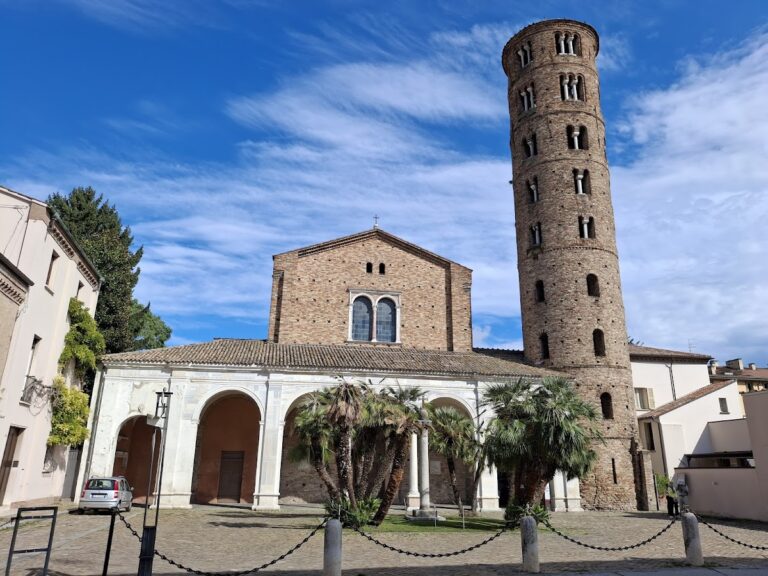
During the tenth century, the basilica received a narthex, or entrance hall, an additional chapel, and a cylindrical bell tower. Much of the original mosaic decoration in other parts of the church was lost after the Venetian sack of Ravenna in 1449. The main surviving concentration remained around the apse and its adjoining areas. In the fifteenth century, Sigismondo Malatesta ordered the removal of the marble revetment from the lower walls and reused it in the cathedral of Rimini, now called the Tempio Malatestiano.
The monastery and later status
In March 1001, Emperor Otto III spent Lent in the monastery attached to the basilica after his expulsion from Rome and the collapse of his attempt to revive the Roman Empire. The hermit Romuald of Ravenna urged him to abandon worldly life. Otto later returned to political action, prepared a campaign against Rome, and died in 1002. A memorial plaque in the basilica recalls this episode.
The Basilica of Sant’Apollinare in Classe remains affiliated with the Catholic Church and forms part of the Archdiocese of Ravenna-Cervia. It is included in the UNESCO World Heritage property Early Christian Monuments of Ravenna, inscribed in 1996 together with seven other Ravenna monuments under criteria recognizing their artistic, historical, architectural, and cultural importance.
Remains
The basilica is a three-aisled brick church measuring approximately 55.58 by 30.30 metres. Its thin red fired bricks, about 48 by 4 centimetres, are laid with mortar joints roughly 4 centimetres thick, creating the strong red-and-white contrast of the exterior. A simple facade uses vertical elements, flat pilasters, and Lombard arcading with small paired arches. A high semicircular window with three openings lights the front, while a narthex precedes the entrance. The narthex replaced the original quadriporticus, an entrance court surrounded by four porticoes.
Exterior and internal layout
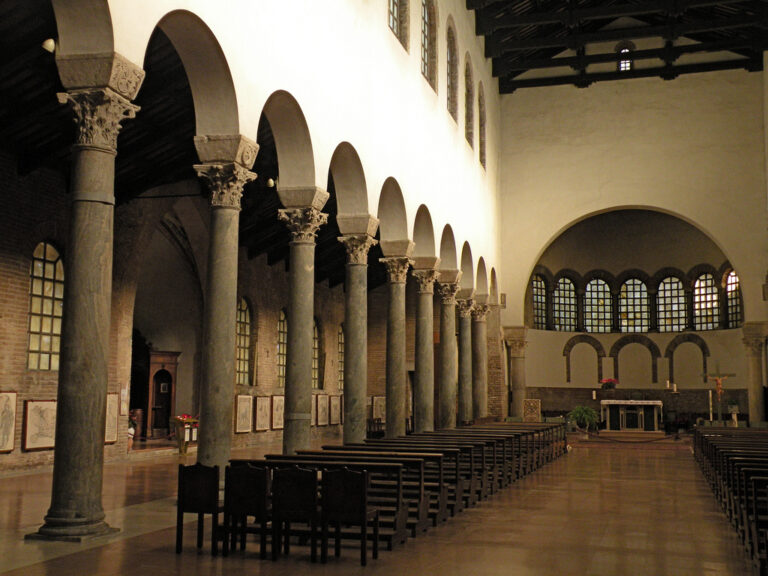
Light also enters through windows in the central and side aisles. Two rows of twelve columns divide the nave from the aisles. These twenty-four columns are made of grey Greek marble with white veining, probably from Mount Hymettus or Proconnesus, and stand on square bases. Their Byzantine composite capitals have openwork acanthus leaves twisted as though blown by wind. Above the arcades, eighteenth-century frescoes show the bishops of Ravenna in chronological order within medallions.
The central nave ends in a five-sided polygonal apse with five windows. Rectangular pastophoria, auxiliary liturgical rooms beside the apse, flank it externally. The apse is raised above the nave floor and is reached by a broad staircase built in 1723 and restored in 1909. The main altar stands on the raised area. Dedicated to the Virgin Mary, it was made in the eleventh century from material taken from a sixth-century altar.
The lower walls retain the history of later alteration through the removal of their original marble facing. Fragments of the earlier tessellated mosaic floor survive in the northeast and southwest corners. The southwest fragment preserves the names of two patrons, Gaudentius and Felix.
Bell tower
The cylindrical campanile, or bell tower, was added in the tenth century. It is approximately 37.5 metres high and 6.17 metres in diameter. Its openings follow the characteristic Ravenna sequence of one arch, then two, and finally three arches as the tower rises.
Apse mosaics
The Transfiguration composition
The apse contains the surviving Justinianic mosaic cycle. Its upper field presents the Transfiguration symbolically rather than as a continuous narrative. A jeweled cross appears within a dark-blue, star-filled mandorla, an oval aureole surrounding a sacred figure or symbol, while a small medallion of Christ occupies the crossing. Above it appears the word “Ichthys,” an early Christian acrostic meaning “Jesus Christ, Son of God, Savior.” The cross bears Alpha and Omega, signs of the beginning and the end, and its base carries the Latin words “Salus Mundi,” meaning “Salvation of the World.”
God’s hand emerges from the clouds, with Moses and Elijah beside the cross. Beneath them, the apostles Peter, James, and John appear as three lambs, an allusion to the Gospel account in which Christ reveals his divine glory before these three disciples. Saint Apollinaris stands below in an orant pose, a praying figure with raised arms, within a flowering paradise-like landscape. Twelve white lambs surround him, separated by white lilies. They have been understood either as the twelve apostles or as the faithful associated with Apollinaris.
Bishops and Eucharistic imagery
Mosaic portraits of the Ravenna bishops Ecclesius, Severus, Ursus, and Ursicinus occupy the spaces between the apse windows. They wear similar garments and hold Gospels inside small shell-headed niches. The arrangement presents Apollinaris within a continuing episcopal succession and has also been interpreted as an image of his eternal life. More broadly, his position among the apostles connects the local bishop and his successors with the wider apostolic church.
Two large panels on the side walls of the apse extend the theological program. One shows the sacrifices of Abraham, Abel, and Melchizedek gathered around a single altar, referring to Christ’s sacrifice and the Eucharistic offering. The other represents Emperor Constantine IV presenting a scroll inscribed “Privilegia” to a representative of the Ravenna church in the presence of Archbishop Maurus. Constantine is accompanied by his co-rulers Heraclius and Tiberius.
The mosaics use colored glass tesserae, gold, and semiprecious stones. Marble was used for faces and light garments, producing relatively flat forms. Their frontal arrangements and symbolic treatment of biblical subjects reflect artistic tendencies after the reign of Justinian and place theological meaning above a sequential retelling of sacred history. The apse imagery has also been interpreted as affirming Christ’s divine and human natures in opposition to Arian doctrine, a controversy concerning the Christian understanding of Christ’s divinity.
Triumphal arch mosaics
The triumphal arch separating the apse from the nave carries another major mosaic. Its central medallion shows Christ holding the Gospel, surrounded by the four Evangelists’ symbols against a cloudy sky: the eagle of John, the winged man of Matthew, the lion of Mark, and the ox or calf of Luke. Below, twelve lambs emerge from the gates of Jerusalem and Bethlehem, representing the apostles.
Palm trees fill the lower curved surfaces of the arch. Its piers show the archangels Michael and Gabriel dressed as Byzantine dignitaries and carrying banners with the liturgical words “Holy, Holy, Holy.” The palms and archangels belong to the mid-sixth-century decoration. Representations of Matthew and Luke beneath them were added in the twelfth century, while the principal decoration of the arch is generally dated to the seventh century, although some art historians assign it to the ninth.
Crypt and adjoining chapels
A crypt lies beneath the main altar, enclosed by the apse walls and two side partitions that contain stairways. It originally housed the relics of Saint Apollinaris. After the relics were moved in 856, the space ceased to function as their chamber, and an empty reliquary was renewed in 1511. When the relics came back in 1748, they were placed in the main altar rather than returned to the crypt.
Chapels occupy the pastophoria beside the crypt. One contains a marble ciborium, a canopy supported by columns over an altar, dedicated to Saint Eleucadius. Made in the early ninth century, it uses four columns whose capitals and arches carry Byzantine motifs with a strong Lombard influence.
Medieval burials and earlier evidence
Greek-marble sarcophagi
Ten well-preserved medieval sarcophagi made of Greek marble stand in the side aisles, several belonging to bishops of Ravenna. The sarcophagus of Bishop Theodore, who died in 688, is decorated with vines, peacocks, doves, crosses, and Christ monograms. The Sarcophagus of the Twelve Apostles shows Christ enthroned among six apostles. Christ gives a scroll to Paul, while Peter holds keys and a cross; the remaining figures carry martyr’s crowns, and further apostolic figures appear at the ends.
The sarcophagus of Archbishop Gratiosus, who died in 788, stands near a mid-sixth-century inscription describing the original position of Apollinaris’s reliquary and the basilica’s foundation. Other examples include an unnamed coffin with a cross on an arched structure, one bearing a Latin cross with Alpha and Omega and a cross above the four rivers of Eden, and the sarcophagus of Bishop Felix, who died in 723. Felix’s burial container was adapted from a pagan tomb.
Fourth-century funerary urn
A small, undecorated marble urn from the fourth century was found beneath the floor in 1909. Its inscription commemorates Licinia Valeria Faustina Italica, who died at the age of one year, six months, and six days. Three further unnamed sarcophagi have simple carved decoration, adding to the evidence for burial activity connected with the site before and during the church’s early history.
Nearby sites