Basilica of Sant’Apollinare Nuovo: An Ostrogothic Palace Chapel in Ravenna


Site at a Glance
- Rating
- 4.7
- Popularity
- High
- Country
- Italy
- Primary era
- Medieval
- External website
- Open
- Eras represented
- Classical, Medieval, Early Modern, Modern
- Civilizations
- Byzantine, Ostrogothic
- Site type
- Religious
- Remains
- Basilica
On this page19 sections
History
The Basilica of Sant’Apollinare Nuovo is an Ostrogothic church in Ravenna, Italy, built by King Theodoric the Great between 493 and 526, probably around 505, as the chapel of his palace. Theodoric, who ruled Italy from Ravenna, originally dedicated it to Christ the Redeemer. The church belonged to the Arian Goths, whose Christian theology differed from the doctrine later accepted by the orthodox or Catholic church.
Theodoric’s Palace Chapel
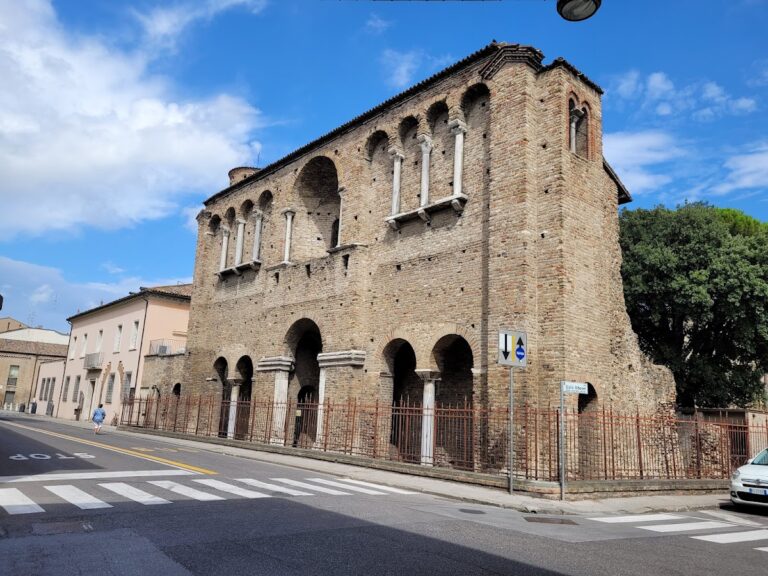
The basilica stood beside Theodoric’s palace and formed part of the royal setting in Ravenna. A ninth-century account by Agnellus of Ravenna, a cleric and chronicler, associated its foundation with an inscription in the apse. Agnellus wrote that the king had built the church from its foundations in the name of Jesus Christ. The inscription itself has not survived. Excavations carried out between 1910 and 1920 uncovered the palace ruins, and the mosaic labelled Palatium is conventionally linked with that complex.
The mosaic decoration began under Theodoric and was made by several artists. Its early phases included Christ with angels and parts of the palace image. The original program also incorporated imagery connected with the Ostrogothic rulers and their court, elements that were later altered or concealed.
Byzantine Reconsecration
Ravenna was conquered by the Byzantine Empire in 540 during the reconquest of Italy by Emperor Justinian I. Through the edict Sancta mater ecclesia Ravennas, vera mater, vera orthodoxa, Arian churches were transferred to the orthodox church. In 561, the basilica was reconsecrated to Saint Martin of Tours and became known as Sanctus Martinus in Coelo Aureo, or Saint Martin in Golden Heaven.
After the reconsecration, mosaics associated with Arian belief or the Ostrogothic court were partly reworked and partly darkened. Tradition attributes this darkening to Pope Gregory the Great, although that explanation is not presented as a documented event. During the Byzantine phase, new mosaics of martyrs and virgins were produced. Research also assigns the processions of saints largely to the reign of Justinian and dates the reworking of parts of the mosaic complex to the 560s, when memories of the Ostrogothic rulers were suppressed.
The Dedication to Saint Apollinaris
In 856, repeated pirate raids on Classe, Ravenna’s historic port district outside the ancient city walls, led to the transfer of the relics of Saint Apollinaris from the Basilica of Sant’Apollinare in Classe to this church. The basilica was then dedicated to Ravenna’s patron saint and acquired its present name, Sant’Apollinare Nuovo, meaning “New Sant’Apollinare.” The new name distinguished it from the older church at Classe. The relics returned to Sant’Apollinare in Classe in 1748, but the basilica retained both its dedication and its name.
Later Alterations
A cylindrical bell tower was added in the ninth or tenth century. During the sixteenth century, a marble portico replaced a presumed earlier enclosed forecourt, or quadripartite portico. The floor was also raised by 1.2 metres because of rising groundwater, destroying much of the sixth-century mosaic pavement.
The present apse belongs to the sixteenth-century alterations and was substantially modified in the eighteenth century, in 1950, and in 1986. It was reconstructed after damage during the Second World War. The present coffered ceiling was created in the seventeenth century, replacing an earlier ceiling associated with the name “Saint Martin in Golden Heaven.” Eight side chapels were added along the north aisle in the eighteenth century. One is dedicated to Saint Anthony of Padua and contains a statue used in processions. Another commemorates Italian soldiers killed in the First World War; its plaques and murals include imagery characteristic of Fascist-era propaganda and a monumental painting titled “God Bless Italy.”
The mosaic program underwent further restoration and alteration in the nineteenth century, including work by Felice Kibel, a restorer associated with the basilica’s mosaics. A portrait identified by its inscription as Emperor Justinian I has also been regarded by some researchers as a reworked portrait of Theodoric.
Heritage and Interpretation
In 1996, Sant’Apollinare Nuovo was inscribed with Ravenna’s other Early Christian Monuments on the UNESCO World Heritage List. The designation recognizes the building as an important expression of the fusion of western and eastern architectural traditions in the late fifth and early sixth centuries. Its surviving decoration preserves the effects of successive political and religious changes, from Theodoric’s Ostrogothic court to Byzantine rule and later Christian use.
Remains
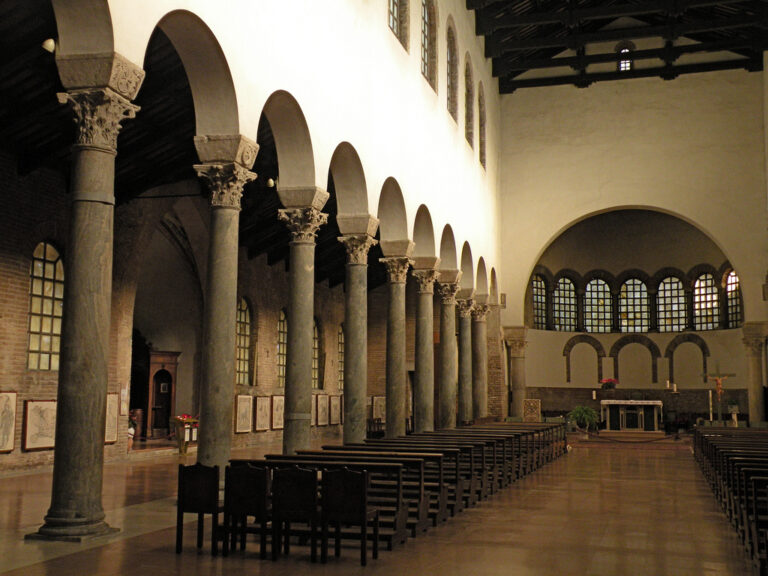
The basilica is a three-aisled brick building measuring approximately 42 by 21 metres. Its long central nave is flanked by lower side aisles and ends in a broad presbytery before the present apse. Brick walls, marble columns, three horizontal levels of interior mosaics, later chapels, and sculptural furnishings together preserve the changing form of the church from the Ostrogothic and Byzantine periods through later alterations.
Exterior and Nave Structure
Brick Church and Bell Tower
The exterior is built of brick, with walls articulated by pilasters and paired windows. The entrance is preceded by the sixteenth-century marble portico, which replaced the presumed earlier quadripartite portico. Beside the basilica stands a cylindrical bell tower approximately 38 metres high. Its windows progress from single openings at the lower levels to multiple openings higher up, giving the upper part a lighter appearance.
Columns and Arcades
The nave arcades consist of two colonnades, each formed by twelve marble columns brought from Constantinople. Their Corinthian capitals bear Greek letters. Arches rest directly on the columns rather than on a horizontal entablature, with projecting stone blocks called pulvini between the capitals and the points where the arches begin. These blocks, together with the basket-like capitals, are characteristic Byzantine features. The wide spacing of the columns allows the side aisles to merge visually with the central nave.
The central nave terminates in the Baroque apse, preceded by a broad presbytery restored in 1986. The north aisle contains the eight side chapels added in the eighteenth century. The basilica also preserves a sixth-century Byzantine-type ambo, a raised platform used for reading or proclaiming scripture, in the centre of the nave.
The Mosaic Decoration
Gospel Cycles
The upper mosaic level contains Gospel scenes, while the middle level presents prophets and saints. On the north wall, thirteen small mosaics show miracles and parables of Christ. They include the wedding at Cana, the multiplication of the loaves, the miraculous catch of fish and calling of Peter and Andrew, the healing of the blind man of Jericho, the healing of the bleeding woman, Christ and the Samaritan woman, the raising of Lazarus, the parable of the Publican and the Pharisee, the widow’s offering, the Judgment scene with the sheep and goats, the healing of the paralytic at Capernaum, the exorcism of demons into swine, and the healing of the paralytic at Bethesda.
The north-wall cycle contains forty-seven figures in thirteen scenes. Christ appears beardless and youthful, and the sequence follows Ravenna’s Easter readings rather than the chronological order of the biblical narratives. A failed restoration in 1854 replaced the wine jars in the Cana scene with baskets of bread, making the subject harder to identify. Other distinctive details include the bed of the paralytic being lowered through a pitched roof, the grille-like bed at Bethesda, and red and blue angels accompanying the sheep and goats in the Judgment scene.
The south wall contains thirteen scenes with ninety-nine figures. They depict the Last Supper, Christ’s farewell discourse with the apostles or his teaching to eleven apostles in Gethsemane, the Kiss of Judas, Christ before the Sanhedrin, the prediction and denial of Peter, Judas returning thirty pieces of silver, Christ before Pilate, Pilate washing his hands, the journey to Golgotha with Simon of Cyrene carrying the cross, the women and the angel at the tomb, the road to Emmaus, and the doubting of Thomas. Christ is bearded and has a more severe expression in this cycle. The scenes of the Passion and Resurrection omit the flagellation and crucifixion. A rooster on a column appears in the prediction of Peter’s denial, while the Holy Sepulchre is shown as a columned rotunda.
The two Gospel cycles are small and highly detailed. Architecture and landscape are lightly indicated or omitted. Decorative panels separate the scenes, showing shell-shaped niches, hanging textiles, crosses, and doves. The north and south walls differ in style, although they are generally considered to have been made during the same period by different artists.
Prophets and Saints
The middle level contains thirty-six prophets and saints placed between the windows. One figure occupies each mosaic except for a group of three in a windowless section. The frontal figures stand above a horizontal frieze filled with birds and vegetation, suggesting a paradisiacal setting. They wear white garments and halos and hold books or scrolls. Their faces have individual features, but the absence of identifying inscriptions prevents secure identification of the figures.
Procession of Male Martyrs
The lower south wall shows Saint Martin of Tours followed by twenty-five male martyrs. The procession moves from the Palatium toward Christ enthroned among four angels. Abbreviated inscriptions identify the saints, including Clement of Rome, Sixtus II, Lawrence, Hippolytus of Rome, Cornelius of Rome, Cyprian of Carthage, Cassian, John and Paul of Rome, Vitalis, Gervasius, Protasius, Ursicinus of Ravenna, Nabor, Felix, Apollinaris of Ravenna, Sebastian, Demetrius of Thessaloniki, Polycarp of Smyrna, Vincent, Pancratius, Chrysogonus, Protus, Jovinus, and Sabinus.
The martyrs carry crowns and are separated by palm trees across a flower-covered field. Most wear identical white garments. Martin has a brown pallium, a broad liturgical mantle, over his white clothing, while Lawrence wears a gold garment beneath his white tunic. Christ holds a sceptre that replaced a book during the 1860 restoration. The earlier book displayed the words “Ego sum Rex gloriae,” meaning “I am the King of glory.”
Procession of Female Martyrs
The lower north wall contains a procession of twenty-two female martyrs moving from Civitas Classis toward the enthroned Virgin and Child, who are surrounded by four angels. The first twelve figures are Euphemia, Pelagia, Agatha, Agnes, Eualia, Cecilia, Lucy, Crispina, Valeria, Vincentia, Perpetua, and Felicitas. Anastasia, Victoria, and Justina are identifiable among the remaining figures.
The women carry martyr’s crowns and pass between palm trees above a flower-strewn ground. Their gold-embroidered tunics and white veils are more richly rendered than the plain white garments of the male martyrs opposite them. The Magi, Balthasar, Melchior, and Gaspar, lead the procession and offer gifts to Christ. Their figures replaced an earlier representation of Theodoric’s wife.
City and Palace Images
The mosaic of Civitas Classis depicts the city and port of Classe at a time when both still existed. It includes the harbour and three ships. Figures of Ostrogothic aristocrats may originally have appeared on the port walls, but they were removed during the Byzantine reworking.
The palace mosaic was also altered. Traces of hands and semicircular outlines of heads suggest that Theodoric and other Ostrogothic figures once appeared beneath or within the palace architecture. Plain curtains were inserted into the arches to conceal these Arian figures. The processions, with their repeated upright figures, regular rhythm, palms, flowers, and frontal presentation, use a visual language characteristic of Byzantine composition.
Sculptural Furnishings
Throne, Canopy, and Altar Screen
The basilica preserves furnishings associated with Theodoric’s church, including a carved throne, a porphyry canopy, and a four-part altar screen. The screen is decorated with vine scrolls, a peacock, and a cross. The reverse of one panel carries a relief of Daniel in the lions’ den. This side was discovered in 1950, when the panel was removed from a side-chapel wall where it had been incorporated.
Ambo and Deleted Court Figures
The sixth-century ambo survives in the centre of the nave. The lateral-wall columns and the ambo are among the preserved elements of the earlier interior. Some columns retain images of arms and hands belonging to deleted figures of praying Goths and members of Theodoric’s court, providing material traces of the changes made to the church’s original decoration.
Nearby sites