Jesuit Church in Warsaw: A Roman Catholic Church and Marian Sanctuary
Site at a Glance
- Popularity
- High
- Country
- Poland
- Primary era
- Early Modern
- Eras represented
- Medieval, Early Modern, Modern
- Civilizations
- Polish–Lithuanian Commonwealth, Russian
- Site type
- Religious
- Remains
- Church
On this page20 sections
History
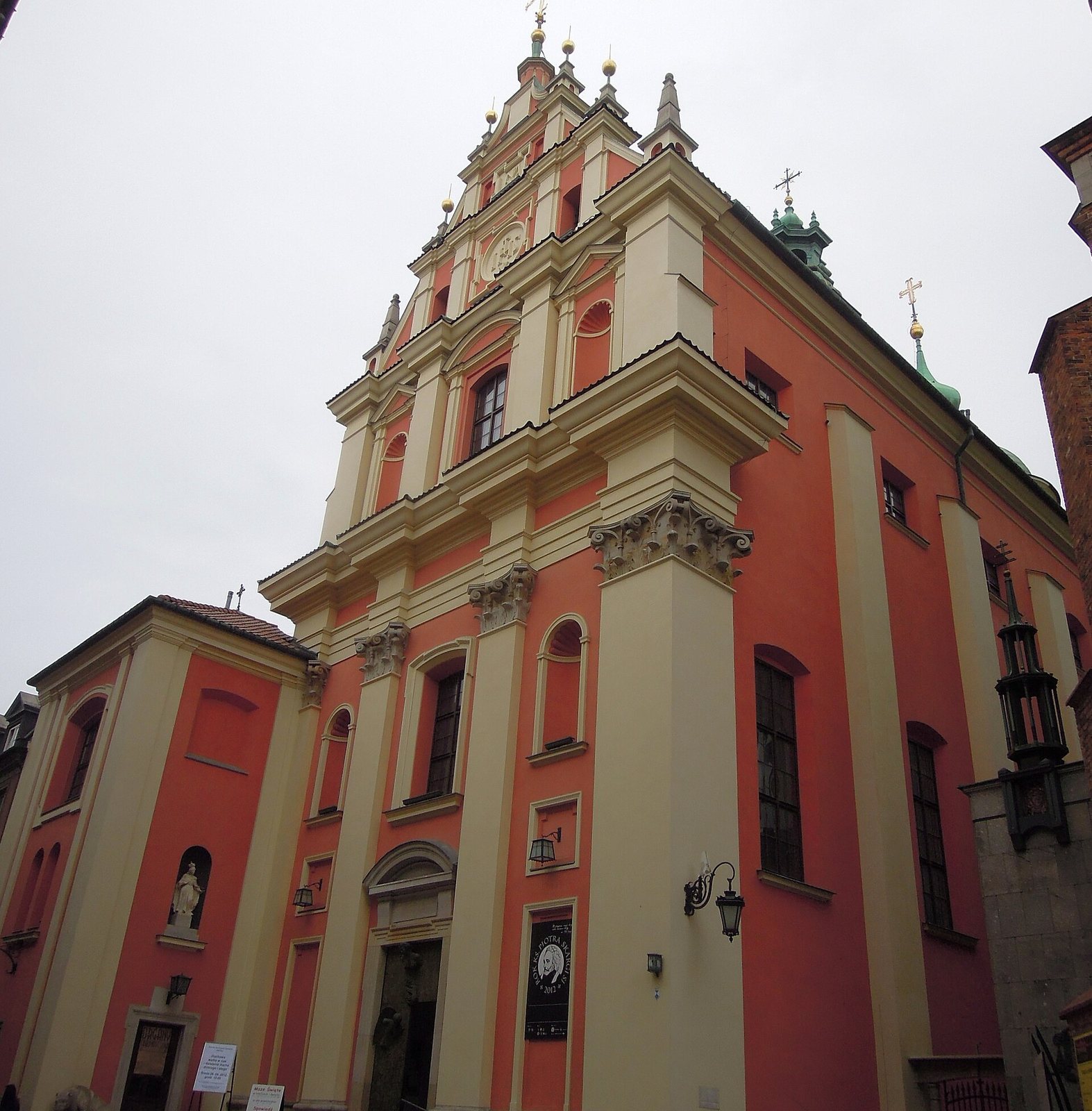
The Jesuit Church is a Roman Catholic church in Warsaw’s Old Town, Poland, founded in 1609 for the Society of Jesus, a Catholic religious order established by Ignatius of Loyola. Its main building was completed between 1609 and 1626, combining Polish Mannerist design, a regional style that elaborated on classical forms, with Baroque architecture, known for rich ornament. Today it is a rectoral church, administered by a rector, and a Marian sanctuary, a place of particular devotion to the Virgin Mary, dedicated to Our Lady of Grace. It is associated with the parish of St John the Baptist Archcathedral and the Archdiocese of Warsaw.
Jesuit foundation and early expansion
The Jesuits arrived in Warsaw in 1607, when the city was the seat of King Sigismund III Vasa. They sought a base near the royal castle and cathedral, a location intended to affirm the order’s standing. Piotr Skarga had earlier led an effort to buy a house for the Jesuits with alms collected in 1597. The order first lived in this property, known as the small monastery, then acquired neighboring houses and prepared a site for a church.
King Sigismund III and Andrzej Bobola the Elder, a royal court officer, were among the church’s founders, as were the Gostomski brothers. Skarga initiated the project, and architect Jan Frankiewicz is credited with the main building. Three chapels had been added by 1627, followed by a vestibule in 1633 and a choir in 1636. Urszula Meyerin, an influential courtier and supporter of the Jesuits, was buried in the church in 1635 and paid for a silver tabernacle, the receptacle for the consecrated Eucharist. Cardinal Charles Ferdinand Vasa installed a silver altar in the 1640s.
War, devotion, and Jesuit institutions
The image of Our Lady of Grace arrived in Poland in 1651 as a gift from Pope Innocent X, brought by Juan de Torres, the pope’s diplomatic representative. It had been commissioned for a Piarist church and was solemnly installed there on 24 March. A papal decree established a feast for Our Lady of Grace of Warsaw on the second Sunday in May. Devotion to the image grew especially after the 1664 epidemic, when people believed that the Virgin had saved Warsaw.
Swedish troops damaged and looted the Jesuit Church in 1656, during the Swedish Deluge, the Swedish invasion and occupation of much of the Polish-Lithuanian Commonwealth in the mid-17th century. Swedish and Brandenburg forces also plundered and destroyed Meyerin’s grave during the 1650s. In 1660 the Jesuits opened a pharmacy at the church, reached from the Old Town Market. It was Warsaw’s second-oldest pharmacy, after the one at the castle. The order established a school in 1668, with advanced studies that included theology and philosophy.
Work began in 1720 on a two-storey building behind the church, at the initiative of Ludwik Bartłomiej Załuski, Bishop of Płock. Its construction led to the creation of Jezuicka Street. The school moved into the new building and became informally known as Gymnasium Zaluscianum; a gymnasium was a secondary school. The pharmacy and a substantial library also moved there. The church acquired further Baroque furnishings, marble altars and floors, and two more chapels.
Changing uses and return to religious service
After the Jesuit order was suppressed in 1773, the church became a school church under the Commission of National Education, an educational authority in the Polish-Lithuanian Commonwealth, the state formed by Poland and Lithuania. It later passed through several uses and administrations, including brief periods with the German Brotherhood of Saint Bruno and the Paulines, another Catholic religious order. At times it was used to store church furnishings.
By 1818 the building served as a storehouse for the cathedral, and wool was kept there in 1828. Religious services resumed in 1834 under the Piarists, a Catholic teaching order displaced from their former church when it was converted into an Orthodox church. They brought their possessions, including monuments, to the Jesuit Church. The image of Our Lady of Grace was transferred there from the former Piarist church. After the Piarist order was suppressed in 1864, the building became an auxiliary church to the neighboring cathedral. The Jesuits regained it in 1918 and renovated it during the 1920s and 1930s.
Destruction, reconstruction, and modern status
In 1944, after German forces suppressed the Warsaw Uprising, the Polish resistance uprising against German occupation, fire and explosives almost entirely destroyed the church. Reconstruction from the 1950s to 1973 gave it a simplified architectural form. Gothic cellars were uncovered during the work, and the upper levels were excavated and conserved. In 1979 a chapel was established beneath the church in memory of teachers and students from a Jesuit-run secondary school in Vilnius, at the initiative of former pupils.
The Vatican approved Our Lady of Grace as patron of Warsaw in 1970. On 7 October 1973, Cardinal Primate Stefan Wyszyński led the crowning of the image with papal crowns. After damage from an unsuitable restoration in 1961, the image underwent professional restoration from 2004 to 2007. The church entered Poland’s register of historic monuments in 1965. It forms part of the Historic Centre of Warsaw, added to the UNESCO World Heritage List in 1980, and was designated a Historic Monument of Poland in 1994.
Remains
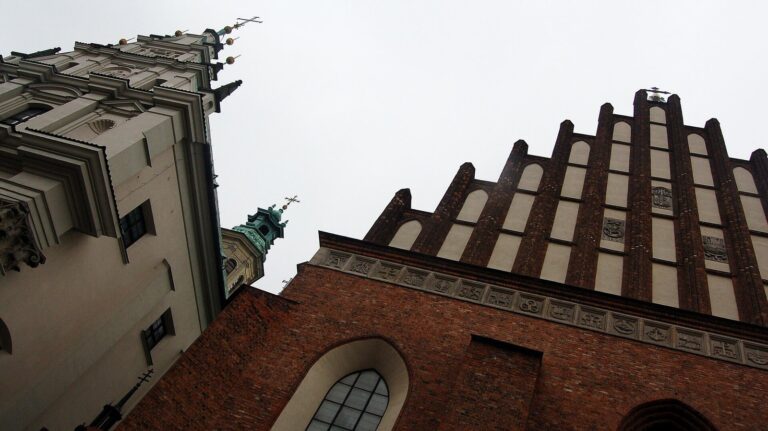
The church stands on Świętojańska Street beside St John’s Cathedral, its brick walls and single-nave plan fitted to a narrow plot in Warsaw’s Old Town. The surviving building combines Mannerist and Baroque forms with Italian and northern European elements. Its reconstructed upper structure, interior features, memorials, and cellars reflect both the church’s earlier history and its postwar rebuilding.
Church structure and interior
Plan and exterior
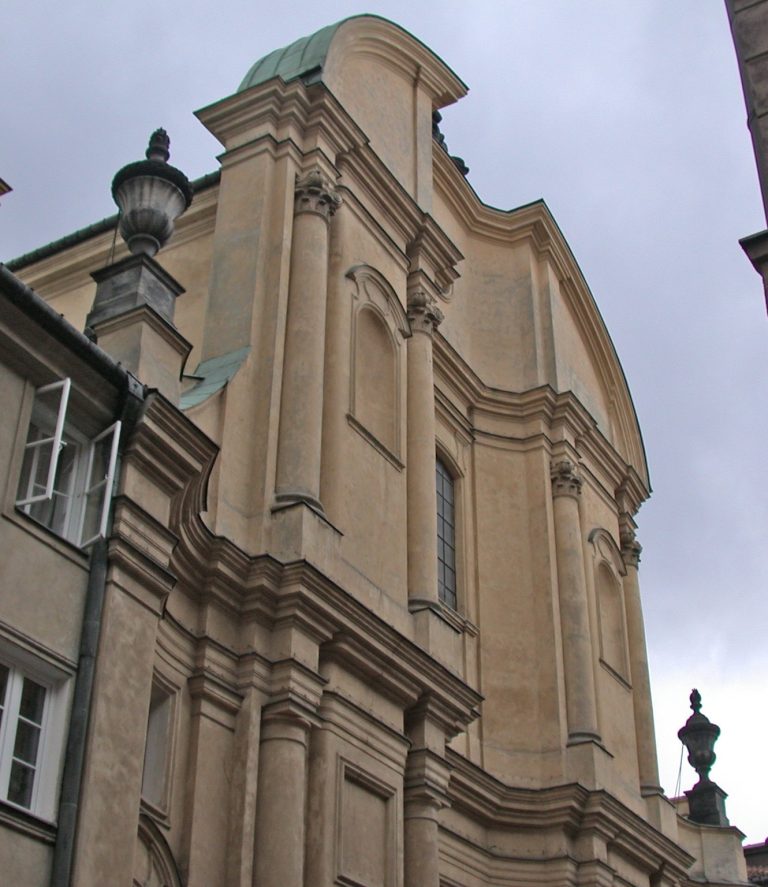
The façade is Mannerist, with a decorative gable. Above the apse, a recess at the end of the church, an elliptical dome has a lantern, a raised roof structure that admits light, to illuminate the altar. A 65-metre tower rises asymmetrically at the rear. The building also incorporates a Lublin vault, a regional Polish form of vaulted ceiling.
Nave and furnishings
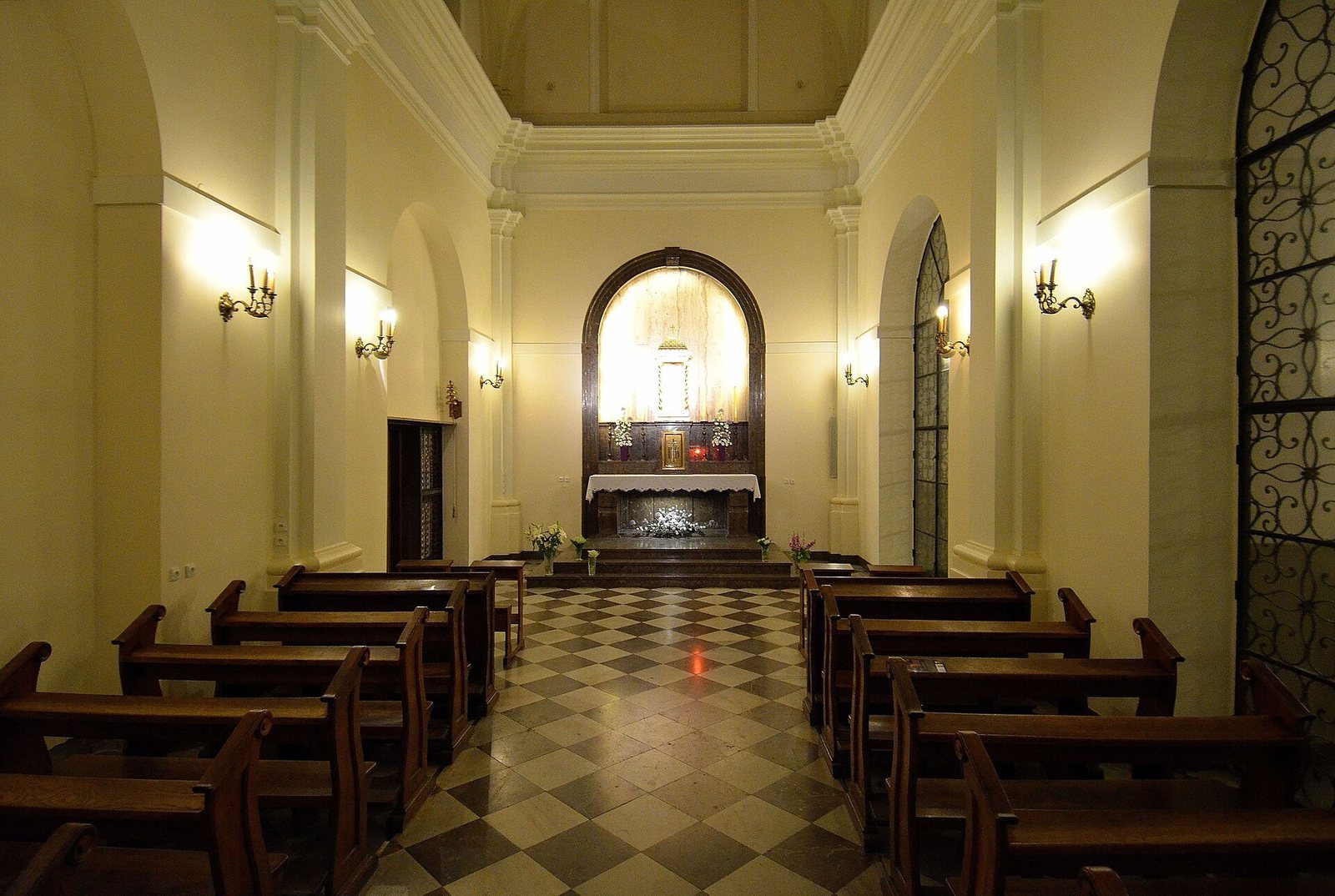
A side aisle contains a chapel for perpetual adoration, continuing devotional prayer before the Eucharist. The rebuilt interior is predominantly modern. It retains fragments of Jan Tarło’s tomb monument and reconstructed epitaphs associated with Maciej Kazimierz Sarbiewski, Stanisław Konarski, Onufry Kopczyński, and Jan Kiliński. Earlier interior fittings included costly altars, an elaborate altar canopy and pulpit, galleries with painted surfaces and balustrades, tapestries, paintings, and carefully arranged benches. The tower was described as having a clock and large bells.
Sacred images, memorials, and sculpture
Image of Our Lady of Grace
The oval painting of Our Lady of Grace is displayed in the apse of the main nave; it was originally housed in a side chapel. An unknown Warsaw artist made it as a copy of a Renaissance fresco in Faenza, Italy. The Virgin holds a broken arrow in each hand, an image associated with protection from calamities.
Wooden statue of Our Lady of Grace
A Baroque wooden sculpture of Our Lady of Grace shows the Virgin in gold robes and a blue mantle, wearing a gold crown set with black gemstones and holding broken arrows. The clothing represents authority and grace, while the arrows express mercy and the restraint of divine anger.
Crucifix from Lübeck
A wooden crucifix made in the 17th century was sent from Lübeck in 1645 by merchant Richard von der Hardt to royal secretary Jan Bolfelt in Gdańsk, with a request that it be placed in a Polish church. Bolfelt gave it to the Jesuits, who installed it in the nave on 14 September 1648. It was hidden during the Second World War and returned to the church in 1957. After the Jesuits built the Church of St Stephen in Mokotów, the original crucifix was placed on that church’s main altar; a copy is now in the Jesuit Church’s sanctuary.
Jan Tarło’s cenotaph
In the left side aisle stands the cenotaph, a memorial for someone buried elsewhere, of Jan Tarło, a provincial governor who died in 1750. His actual burial was at the Piarist church in Opole Lubelskie. Made in 1752–1753 in Jan Jerzy Plersch’s workshop from white and black marble, the monument was first created for a Piarist church. Faustyn Cengler later dismantled it, moved it, and reassembled it in the Jesuit Church. It was destroyed in 1944 and reconstructed in 2010.
Stone bear
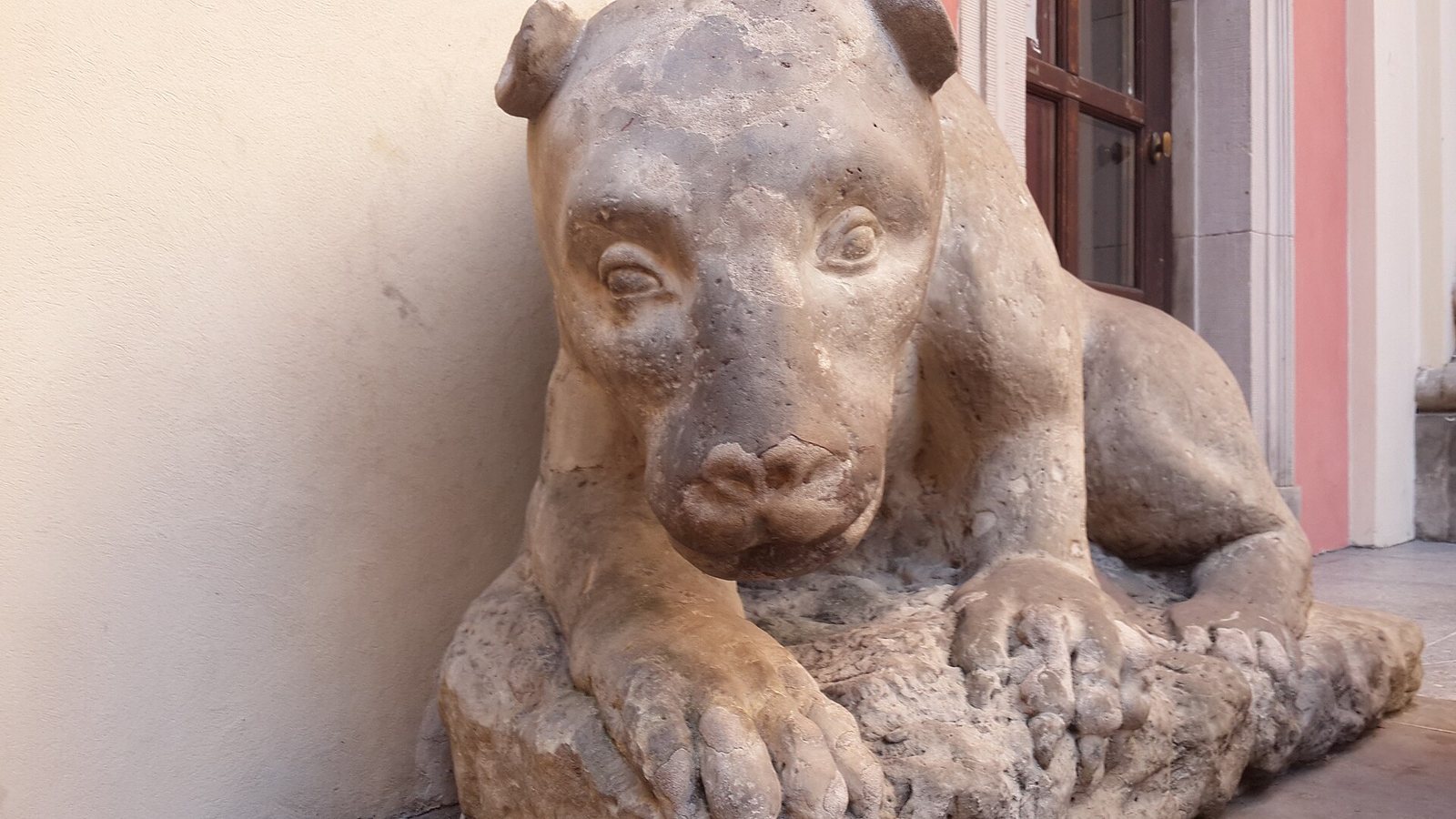
A reclining stone bear from the mid-18th century stands on the entrance steps. Made in Plersch’s workshop, it was created for a Piarist church as an attribute of the early Christian martyr Felician. The bear survived the Warsaw Uprising badly damaged and was later restored. A Warsaw legend identifies it with Prince Mieszko, supposedly turned to stone by grief over unreturned love and waiting for a woman whose affection will release him.
Entrance and underground spaces
Bronze entrance doors
Sculptor Igor Mitoraj made the bronze entrance doors in 2009 for the church’s 400th anniversary. Consecrated on 12 September that year, they carry a relief of the Annunciation, the biblical account of Gabriel telling Mary that she would bear Jesus. Mary appears above two angels shown on the moving door leaves. The design also alludes to Warsaw’s tragic history. Some criticism focused on the use of two angels rather than the familiar account centered on Gabriel; Mitoraj described his Madonna as an unconventional figure looking down on the angels in motion.
Gothic cellars
Multi-level Gothic cellars lie beneath the church, above the remains of earlier townhouses. The townhouse walls were reduced to ground level, while rubble filled deeper cellar levels and the uppermost level served as burial crypts, chambers beneath a church used for burials. During the partitions, Russian authorities ordered existing cellars walled up to prevent insurgents from storing weapons there. A stone-carving workshop occupies a crypt above the old townhouse foundations.
Crypts and Vilnius Chapel
The surviving burial spaces contain epitaphs and fragments recovered from beneath the church rubble, along with mementos of the Warsaw Uprising. Busts of Piotr Skarga and Maciej Kazimierz Sarbiewski are remnants of epitaphs that stood in the church before 1944. A separate room houses the Vilnius Chapel, dedicated to teachers and students of the Jesuit secondary school in Vilnius. Former pupils initiated its establishment in 1979.
Commemorative plaque
A stone plaque to the right of the entrance commemorates Pope John Paul II’s visits to the church on 2 June 1979 and 16 June 1983.